

For digital video subscription platforms, creating and managing content portfolios are critical to acquire new customers, retain existing customers, leverage cross-sales, and generate advertising revenues. We treat content portfolios as a form of pure bundling which may vary in composition and attractiveness over time. Therefore, evaluating the value contribution of each content piece is essential to manage a platform’s portfolio efficiently and to understand how a specific content piece contributes to the bundle’s attractiveness. In this article, we develop an ROI content valuation framework for a digital film subscription platform. This framework describes how a single piece of content diffuses through consumers’ journeys and influences subscription fees through acquisition and retention as well as revenues from cross-sales and advertising. This conceptual approach allows us to address the heterogeneity across content and platform contingencies such as exclusive availability and platform specifics, and link them to revenue streams. Building on this framework, we offer avenues for future research and provide potential lead performance indicators together with their operationalization, enabling all parties involved in the production, marketing, distribution, and sales of content to determine the platform-specific value of a content piece.
[Please read the research paper here]
A solution strategy based on integer linear programming models has been developed for leaf sweeping operations in the Argentine city of Trenque Lauquen. The aim is to achieve efficiency in the assignment of sweepers to city blocks, the identification of leaf bag deposit points and the routes to be followed by collection trucks for leaf bag pickup. Previous to this strategy, sweeper assignments were improvised and inefficient, with blocks often left unswept. Furthermore, no method was available for accurately determining the number of sweepers needed to ensure either full coverage of all city zones within the working day or a balanced work load distribution across all sweepers. Application of the solution strategy by the city has resulted in efficient definitions of sweeper requirements while optimizing sweeper assignments such that all blocks are covered. Once the strategy is fully implemented, the number of bag deposit points under the manual definitions should be reduced by roughly one-half and the total travel distance of the truck routes, modelled as an asymmetric travelling salesman problem, should be cut by 10–15% with the consequent savings in time, vehicle use and fuel consumption.
[Please read the research paper here]
The Double Traveling Salesman Problem with Multiple Stacks, DTSPMS, deals with the collect and delivery of n commodities in two distinct cities, where the pickup and the delivery tours are related by LIFO constraints. During the pickup tour, commodities are loaded into a container of k rows, or stacks, with capacity c. This paper focuses on computational aspects of the DTSPMS, which is NP-hard. We first review the complexity of two critical subproblems: deciding whether a given pair of pickup and delivery tours is feasible and, given a loading plan, finding an optimal pair of pickup and delivery tours, are both polynomial under some conditions on k and c. We then prove a (3k)/2 standard approximation for the Min Metric k DTSPMS, where k is a universal constant, and other approximation results for various versions of the problem. We finally present a matching-based heuristic for the 2 DTSPMS, which is a special case with k=2 rows, when the distances are symmetric. This yields a 1/2−o(1), 3/4−o(1) and 3/2+o(1) standard approximation for respectively Max 2 DTSPMS, its restriction Max 2 DTSPMS(1,2) with distances 1 and 2, and Min 2 DTSPMS(1,2), and a 1/2−o(1) differential approximation for Min 2 DTSPMS and Max 2 DTSPMS.
[Please read the research paper here]
Change-point (CP) VAR models face a dimensionality curse due to the proliferation of parameters that arises when new breaks are detected. We introduce the Sparse CP-VAR model which determines which parameters truly vary when a break is detected. By doing so, the number of new parameters to be estimated at each regime is drastically reduced and the break dynamics becomes easier to be interpreted. The Sparse CP-VAR model disentangles the dynamics of the mean parameters and the covariance matrix. The former uses CP dynamics with shrinkage prior distributions, while the latter is driven by an infinite hidden Markov framework. An extensive simulation study is carried out to compare our approach with existing ones. We provide applications to financial and macroeconomic systems.
[Please read the research paper here]
[Student IDEAS] by Tommaso Vercelli - Master in Management at ESSEC Business School
The article explores AI's transformative impact on the job market and wealth distribution, tracing its evolution from early symbolic AI to today's advanced machine learning. Unlike previous industrial revolutions, AI's capital-intensive nature may increase economic inequality. While AI promises significant productivity gains, its benefits could be unevenly distributed, highlighting the need for policies promoting equitable access and global cooperation to address disparities.
---
Artificial Intelligence (AI) is not the monolithic or one-dimensional entity often depicted in science fiction. It's not about sentient machines taking over the world or an all-knowing oracle. AI, in its true form, encompasses computational advancements that enable machines to perform tasks that would require intelligence if done by humans, such as learning, problem-solving, and decision-making. This definition underscores that AI is a constantly evolving frontier, stretching beyond static algorithms into adaptive learning and reasoning.
Historically, AI's journey began in the mid-20th century with the "Golden Age of AI," marked by the development of symbolic AI—machines designed to mimic human intelligence through logic and search algorithms. However, this approach eventually hit a roadblock known as combinatorial explosion, where the number of computational possibilities outstripped the capacity of computers to solve them in a reasonable time. This led to the first AI winter, a period of reduced funding and interest in AI research due to unmet expectations.
The resurgence came with the advent of knowledge-based AI, which focused on specific problem domains and relied on knowledge representation and inference rules, marking significant strides but also encountering limitations with the inherent "fuzziness" of the real world. These challenges pushed AI into the next evolutionary phase, marked by the emergence of machine learning and deep learning. Unlike their predecessors, these systems learn directly from data, leading to achievements such as natural language processing and object recognition. This sets the stage for more nuanced and complex tasks, including generative AI, which thrives on its ability to process vast amounts of unstructured data across multiple modalities.
In particular, Generative AI refers to a subclass of artificial intelligence technologies that can generate new content based on patterns and data it has learned from. The capabilities of generative AI have grown significantly in recent years, expanding the scope of AI's potential applications. For instance, AI programs like ChatGPT can write essays, compose emails, or code software, while others can create realistic images or compose music. The 'generative' aspect of this AI comes from its ability to take initial input and generate corresponding outputs that are coherent, contextually relevant, and often indistinguishable from human-created content. This features drastically increased speed of investment, development and adoption, projecting AI as the driver for a fourth industrial revolution. However, it will deeply differ from the previous three in speed and labour market consequences.

The First Industrial Revolution (1760-1840) marked a pivotal moment in history, transitioning from manual labor to mechanized production. The advent of the steam engine and mechanization in textile production catalyzed the transformation of agricultural societies into industrialized ones. This shift not only spurred urbanization as populations migrated to cities for factory jobs but also ignited a surge in economic productivity. However, it also introduced significant labor challenges and environmental issues. Job displacement occurred as many workers, particularly those in rural and agricultural settings, had to adapt to new factory roles, often under harsh conditions.
Similarly, the Second Industrial Revolution (1870-1914), or the Technological Revolution, was characterized by mass production and notable technological advancements, including electricity, the internal combustion engine, and the assembly line. The expansion of railroads and telegraph lines facilitated rapid communication and transport, laying the groundwork for globalization. This era of industrial expansion brought economic prosperity and an improved standard of living, but it also stirred societal unrest and deepened class divisions. Indeed, traditional craftsmen and small-scale industries were replaced by mass production methods, requiring workers to adjust to new industrial environments.
The Digital Revolution, or the Third Industrial Revolution (1950-2010), heralded the rise of electronics, telecommunications, and computer technologies, marking the transition from analog to digital. The introduction of personal computers and the internet transformed information sharing and processing, propelling societies towards service and information-based economies. While this revolution led to job displacement due to automation, it required a workforce skilled in information technology, representing a shift towards a newly trained job market. Even if big players like Google, Microsoft etc. had the opportunity to create monopolies during that period, the Digital Revolution allowed for widespread technology ownership and access, enabling individuals to create and profit from internet websites with minimal investment. The third industrial revolution characterized itself as the most democratic revolution among the three, in contrast to the capital-intensive nature of the previous two.
On the other hand, the Fourth Industrial Revolution (2010-current), driven by advancements in artificial intelligence (AI), mirrors the capital-intensive characteristics of the first two revolutions more than the democratized nature of the third. Even if the access is available to a vast amount of people, the price is significantly higher than the one for internet; a monthly subscription to chat GPT-4 comes at $20 per month. Above all, it is only access that is widespread while ownership will more likely remain under the control of a minority. In fact, despite AI's foundation on digital technologies, its development demands substantial computational power, vast datasets, and significant capital investment. While in the internet revolution everybody had the opportunity to profit by owning his own website, the same will not happen with artificial intelligence.
However, although AI development is currently resource-intensive, ongoing advancements in technology and methodology are likely to make it more accessible and cost-effective over time. However, whether these changes will fully democratize AI development or maintain its capital-intensive nature remains to be seen. Moreover, the development trajectory of AI could mirror that of telecommunications (and similar) in its initial capital intensity and gradual shift towards democratized access through service-based models. As AI technology continues to evolve, it may follow a similar path of increased regulation and widespread usage, making advanced AI capabilities accessible to a larger population.
Moreover, while the initial industrial revolutions primarily affected physical and manual labor (Exhibit 2 and 3), AI has the potential to transform all sectors of the labor market, including both manual (in conjunction with robotization) and knowledge work. This revolution will bring unprecedented changes to high-skilled job tasks, underscoring a significant evolution in the nature of work and the structure of the labor market.

Exhibit 2

Exhibit 3
A report by McKinsey1 underscores the transformative potential of Generative AI, estimating its impact could enhance the global economy by $2.6 to $4.6 trillion. Similarly, Goldman Sachs2 forecasts a 7% growth in global GDP over the next decade, translating to an infusion of nearly $7 trillion. The pivotal question then becomes: what mechanisms will drive this remarkable surge in revenue?
The primary conduit for this economic uplift is the boost in output production efficiency. By elevating the productivity of cognitive workers—who play a vital role in the production process—the overall output level of the economy increases. Economic theory, particularly Hulten's theorem, suggests that the effect of a productivity enhancement within a specific sector is directly tied to the extent of the productivity increase and the sector's contribution to the economy. Hulten's theorem3 states that the aggregate productivity impact of a sector is proportional to its size within the economy and the magnitude of its productivity improvement. Therefore, if generative AI amplifies the productivity of cognitive workers by 30% over one to two decades, and these workers constitute about 60% of the economy's value-added, we could anticipate an notablesurge in overall productivity. Specifically, multiplying the 30% productivity increase by the 60% economic contribution suggests an 18% surge in overall productivity and output during the same timeframe and output during the same timeframe.
The second, perhaps more vital, driver is the acceleration of innovation, which promises sustained productivity growth. Cognitive workers are instrumental not only in contributing to current output levels but also in pioneering new products, discoveries, and technological advancements that promise to elevate future productivity. This includes research and development efforts led by scientists and the crucial role of executives in integrating these innovations into broader production processes. A boost in the efficiency of cognitive workers can hasten technological advancement, thereby perpetually increasing the rate of productivity growth. For example, if the productivity growth rate stands at 2% and the efficiency of cognitive labor driving this growth improves by 20%, the productivity growth rate could ascend to 2.4%.
While the annual impact of such advancements may initially seem modest and can be overshadowed by cyclical economic fluctuations, the cumulative benefits of productivity growth are significant. A seemingly slight increase in productivity growth can lead to the economy expanding by 5% over a decade, with the effects magnifying progressively over time.
McKinsey's analysis suggests that AI has the capacity to automate tasks that occupy 60% to 70% of employees' time. However, the timeline for this transformation is subject to various factors. The adoption of new technologies on a large scale is a gradual process; for example, foundational technologies such as electricity and early computers took decades to significantly influence productivity. Additionally, the economic viability of adopting AI in the short term may not be immediately realized if the costs surpass those associated with human labor. Recent projections indicate that up to half of the work activities currently performed could be automated between 2030 and 2060, with a midpoint projection around 2045. It's worth noting that earlier forecasts made in 2016 anticipated this automation could occur between 2035 and 2070, with a midpoint in 2053. These timelines suggest a fast-shifting landscape, with the possibility that newer predictions could soon supplant existing ones.
In fact, the 2024 AI Index Report from Stanford4 notes that AI investments continue to grow, with substantial funding directed towards generative AI despite a broader decline in AI private investments. This indicates a strong belief in the transformative potential of generative AI across various industries. Moreover, the Microsoft and LinkedIn 2024 Work Trend Index5 revealed that a significant portion of knowledge workers are already using AI tools to improve efficiency and creativity, with many employees bringing their own AI tools to work. Finally, The MIT Technology Review6 highlighted that organizations are rapidly integrating AI into their processes, with a significant increase in the number of functions deploying generative AI expected in 2024.
The advent of generative AI promises significant productivity enhancements but also raises concerns about the equitable distribution of benefits across the workforce. It is anticipated that AI could automate a substantial number of tasks in various job sectors, notably impacting high-wage, cognitive roles. This development introduces uncertainty regarding future job demand and the adaptability of workers with skills that may become obsolete. Unlike previous technological shifts that primarily affected physical or routine tasks, generative AI targets cognitive functions, placing high-paying positions at risk and potentially resulting in considerable income losses for individuals with specialized skills that are no longer needed.
Generative AI's capacity for understanding and utilizing natural language is expected to maximize its impact in roles requiring communication, supervision, documentation, and interaction (Exhibit 4). Industries such as banking, high technology, and retail are poised for profound transformations (Exhibit 5). In banking, tasks like low-value risk management activities, reporting, monitoring, and collection are highly automatable. The high-tech sector may see dramatic improvements in software development speed and efficiency, while retail could benefit from more personalized marketing and sales approaches. For instance, Stitch Fix leverages algorithms for style recommendations, experimenting with DALL·E for product visualizations based on customer preferences. Similarly, Morgan Stanley is developing an AI assistant with GPT-4 to aid wealth managers in rapidly accessing and synthesizing information from extensive internal databases.
Although the risk of job displacement and adverse impacts on certain worker segments is real, evidence suggests that these technologies can also boost productivity, create demand for new skills, and enhance job quality. This situation highlights the importance for companies to invest in training their workforce for the AI era, focusing on developing both technical skills, such as AI engineering and enterprise architecture, and the ability for employees to work alongside AI-enhanced processes. Businesses must reconsider current roles, breaking them down into task bundles to pinpoint where AI can improve efficiency. Additionally, the rise of new positions, including linguistics experts, AI quality controllers, AI editors, and prompt engineers, is expected as AI becomes more widespread.

Exhibit 4

Exhibit 5
Research indicates that technological advancements, particularly in automation, play a significant role in driving income and wealth inequality. As highlighted in a study by Benjamin Moll and colleagues7, the benefits of new technologies accrue not only to high-skilled labor but also to capital owners, leading to increased capital incomes and thus, heightened economic inequality. The study introduces a theoretical framework to explain how automation exacerbates inequality by shifting demand from labor to capital, where the supply of capital is generally upward sloping. This shift increases the returns to wealth, resulting in greater concentration of the latter and income inequality. Additionally, the paper suggests that automation may cause wages to stagnate or decrease, especially for workers whose skills are more prone to automation, as capital owners capture some of the productivity gains.
Moreover, the preferential tax treatment of capital gains and corporate profits relative to income tax rates for manual labor plays a pivotal role in accelerating the adoption of AI and automation technologies. In many jurisdictions, the tax policies are structured in such a way that investments in technology, particularly in automation and AI, are more financially attractive than the costs associated with hiring and maintaining a human workforce. This is because corporate profits, often enhanced by the efficiencies brought about by AI, are taxed at lower rates compared to the taxes levied on wages. As a result, firms find a strong financial incentive to invest in technology that can perform tasks traditionally done by humans, even if the initial productivity and output remain unchanged.
Additionally, the increasing capability of AI systems to improve productivity over time further tilts the scale in favor of automation. Empirical evidence suggests that AI can lead to significant gains in efficiency and output, making the financial case for automation even stronger. The tax policy thus not only supports existing preferences for automation but actively encourages companies to replace manual labor with technological alternatives, potentially leading to job displacement and wider economic disparities within societies.
However, the issue of income inequality extends beyond national borders, affecting the global landscape. An analysis by the International Monetary Fund (IMF8) suggests that AI could impact nearly 40% of global employment, with advanced economies facing higher risks due to their reliance on high-skilled jobs susceptible to AI (Exhibit 6). Conversely, emerging markets and developing countries might not fully benefit from AI advancements due to infrastructural and workforce constraints, potentially exacerbating global inequality. The IMF's AI Preparedness Index measures countries' readiness for AI adoption, with wealthier nations like Singapore, the United States, and Denmark scoring high (Exhibit 7).

Exhibit 6

Exhibit 7
However, this advantage starkly contrasts with the situation in emerging markets and developing countries. This disparity is not merely a technical or economic challenge but a fundamental issue of equity and access. The AI revolution, therefore, mirrors the capital-intensive characteristics of the first and second industrial revolutions more than the democratized nature of the third. While the digital revolution allowed for broad participation through relatively low barriers to entry, such as the internet, the AI revolution requires substantial capital, sophisticated technologies, and complex datasets that are not as universally accessible.
The concentration of AI technology and expertise in a few nations exacerbates global inequalities and underscores the non-democratic nature of this technological advancement. Unlike the democratizing spread of digital tools, AI technologies are likely to remain under the control of a minority, comprising primarily those who can afford the hefty investments in the necessary computational resources. This concentration of knowledge and capability highlights a critical challenge: the potential for AI to enhance global disparities unless concerted efforts are made to democratize its benefits.
To address these challenges and forge a more equitable path, it is crucial for global policymakers to not only foster AI innovation within their borders but also support initiatives that enhance AI readiness and capabilities in less developed economies.
The transformative potential of AI across various industrial revolutions highlights both its capacity to drive innovation and its profound implications for the labor market and wealth distribution. As we stand on the brink of what may be the most transformative era yet—the Fourth Industrial Revolution—it is crucial to recognize that the benefits and challenges of AI are not distributed equally. The ongoing revolution has the potential to enhance global productivity and economic output significantly, yet it also poses risks of exacerbating existing inequalities and introducing new forms of economic disparity.
To navigate this transformative period, a balanced approach involving stakeholders from across the societal spectrum is essential. Policymakers, business leaders, and the workforce must engage collaboratively to ensure that the gains from AI are leveraged to promote inclusive growth and to mitigate the risks associated with job displacement and income inequality. This includes investing in education and training programs that equip workers with the skills needed to thrive in an AI-enhanced job market, as well as designing and implementing robust social safety nets to support those affected by the transition.
However, it is important to recognize that such measures, while beneficial at a national or regional level, may not significantly alter international disparities. Countries with advanced technological infrastructures and robust economies are better positioned to leverage AI for economic growth, potentially widening the gap between developed and developing nations. Developing countries may struggle to keep pace due to limitations in resources, infrastructure, and access to high-quality education and training programs.
To address these global disparities, international cooperation and support mechanisms are needed. This could involve technology transfer, investment in digital infrastructure in developing countries, and global initiatives aimed at ensuring equitable access to AI advancements. Without such efforts, the benefits of AI could exacerbate existing inequalities on an international scale.
Furthermore, the global nature of AI's impact requires international cooperation to ensure that both developed and developing countries can benefit from AI technologies. Policies must be crafted not only to foster innovation and streamline the integration of AI into economic infrastructures but also to ensure that these advances lead to broad-based benefits. The Global Partnership on Artificial Intelligence (GPAI), aimed at guiding the responsible development and use of AI, grounded in human rights, inclusion, diversity, innovation, and economic growth, has been created in 2020 in that direction. The partnership includes both developed and developing countries, encouraging the sharing of knowledge and resources to ensure that AI benefits are more equitably distributed globally. Another example is the Digital Public Goods Alliance (DPGA), which aims to accelerate the attainment of Sustainable Development Goals (SDGs) in low- and middle-income countries by facilitating the development and deployment of digital public goods. These include open-source software, open data, open AI models, and standards that can be used to improve digital infrastructure and services globally.
Ultimately, the future of AI and its influence on our economic landscape will depend significantly on the choices we make today. By prioritizing equitable growth and proactive governance, we can harness the full potential of AI to create a future that reflects our collective aspirations for a fair and prosperous world for all.
[CURATED CONTENT] The success of digital transformation will depend above all on "the ability of business leaders to make the right decisions so they do not fall behind".
This paper was first published on Le Monde and is available here (in French). To access the English translation, please follow this link.
by Guillaume Chevillon, Professor at ESSEC Business School and Laure Salvaing, Managing Director, Verian Group
June 10, 2024
Despite growing awareness of digital challenges among French companies, their digital strategy remains unclear, observe economics professor Guillaume Chevillon and Laure Salvaing, Director of the Verian opinion research institute, in an article for Le Monde. This hesitation could jeopardize future competitiveness and value creation.
[Student IDEAS] by Karen Taubenberger - Master in Management at ESSEC Business School
This article discusses the rise of generative AI chatbots like Dr. ChatGPT in healthcare. The article explores the potential benefits and risks of this technology, and the challenges that need to be addressed for safe and effective use. It also highlights the need for new regulations to govern the use of generative AI in healthcare.
---
Accessing health information online has become common in today’s society, with half of European Union citizens actively seeking health information online.1 In addition to cheap, easy and quick access to medical information, online search empowers patients to actively participate in the diagnosis and treatment process.2 Publicly accessible chatbots like ChatGPT are poised to further revolutionize the way individuals seek answers to medical questions. But how reliable is the new ‘Dr. ChatGPT’?
ChatGPT has elevated online search to unprecedented heights. Open AI’s chatbot operates on a foundation of a Large Language Model (LLM), a deep learning technique that can comprehend and generate human language text. In a recent study, ChatGPT (GPT-4) showed impressive performance compared to human doctors in symptom review, with the appropriate diagnosis listed within the top three results in 95% of cases.3 This vastly outperformed traditional symptom checkers such as the health website WebMD.
Around 7% of Google searches are health-related, the equivalent of 70,000 searches per minute.4 Given the rapid user growth of ChatGPT, it is likely that ‘Dr. Google’ will soon be augmented or even substituted by ‘Dr. ChatGPT’. With nearly half of the European population showing low health literacy1, chatbots could significantly improve the consumer’s understanding of health-related information.
A direct comparison between ChatGPT and Google Search assessed their effectiveness in conveying the most relevant information for specific medical inquiries from a patient's viewpoint, while also evaluating patient education materials. While ChatGPT fared better when offering general medical knowledge, it scored worse when responding to questions seeking medical recommendations and guidance.5
Not only are consumers increasingly likely to use ‘Dr. ChatGPT’, the rise of generative AI may also drastically change the way medical professionals work.
Healthcare has traditionally been a sector heavily reliant on human-to-human interaction. However, with an estimated global shortage of 10 million health workers by 20306 and strained health system finances, healthcare delivery requires transformation. With the advancement of generative AI, there is potential to unlock a US$1 trillion improvement opportunity within the healthcare industry.
Generative AI, a subset of machine learning, trains models on existing data patterns to generate new yet similar data. This technology is uniquely suited to unlocking the vast potential of healthcare's disparate, unstructured data—clinical notes, diagnostic images, medical charts, and more. Generative AI has multiple benefits in a healthcare setting over traditional machine learning techniques (discriminative models): Unsupervised learning allows to tap into this rich data pool without the need for expensive data labeling. Moreover, it opens up new use cases compared to traditional machine learning methods, enabling text synthesis and the generation of synthetic data sets.
Use cases for medical professionals fall broadly into administrative and clinical applications (see Figure 1). Initially, the integration of generative AI is more inclined towards administrative tasks (such as clinic documentation and creating discharge summaries) due to their simpler implementation and lower associated risks. However, it's anticipated that generative AI will eventually be more extensively utilized in clinical applications (such as diagnosis) in later stages. With healthcare systems facing chronic staffing shortages, Generative AI could hold the key to significantly enhancing the quality of care delivery and transforming the entire patient journey.
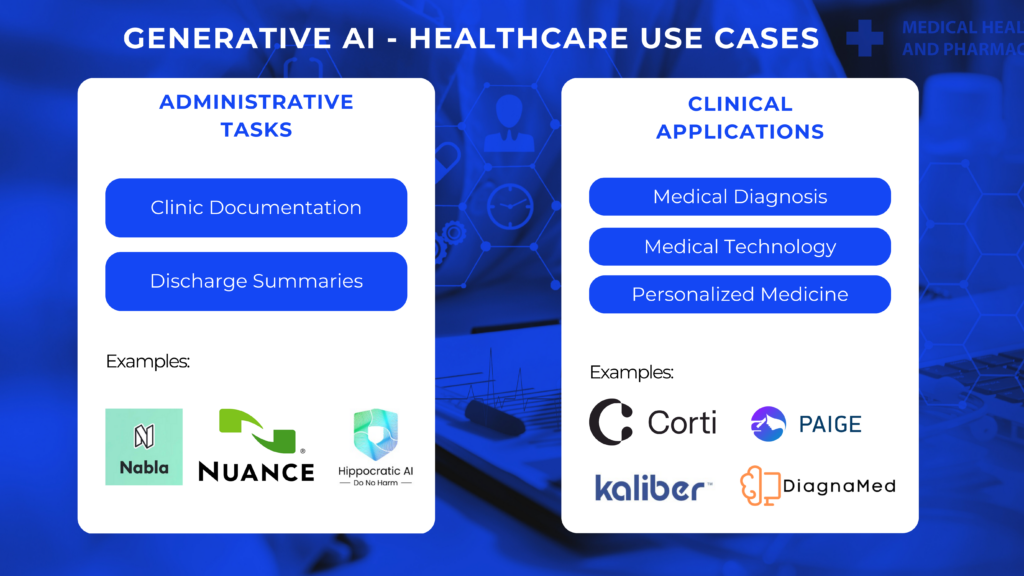
1 Figure 1: Selected use cases of Generative AI in healthcare
Physicians devote around one-sixth of their working hours to administrative tasks.8 Digital health start-ups, like the Paris-based Nabla, offer solutions to reduce the paperwork burden. Their digital assistant, called Copilot, automatically transcribes consultations into the typically required document-based endpoints such as prescriptions, follow up appointment letters and consultation summaries. Nabla claims that doctors can save on average 2 hours a day using Copilot.9 Similarly Microsoft-owned Nuance Communications integrated GPT-4 into its medical note-taking tool. Not only will generative AI integration allow for process streamlining and cost reductions, lowering the administrative burden will also positively affect doctors’ job satisfaction.
This also creates room for new business model innovations. For example, Hippocratic AI recently introduced on-demand AI agents starting from USD 9 per hour. These task-specific generative AI healthcare agents offer various services, ranging from pre-op assistance to discharge assistance to chronic care check-ins. Healthcare providers, payors, and pharmaceutical firms can book the task-specialized agents on an hourly basis. The development, in close cooperation with NVIDIA, has overcome existing challenges of generative AI tools to connect with patients on a personal level. NVIDIA’s AI platform allows for super-low-latency conversational interactions, which are crucial for building empathy.10 According to Hippocratic AI’s own user research, every half-second improvement in inference speed increases the ability for patients to emotionally connect with AI healthcare agents by 5-10% or more. While NVIDIA brings the technology stack for speed and fluidity, as well as the deployment of the AI models, Hippocratic AI has developed leading safety-focused LLM models specifically designed for healthcare applications.
Generative AI's application will not only be restricted to healthcare administration. Clinical application is an even bigger field ready for disruption, although most use cases are still pre-commercialization.
Medical Diagnosis - The ultimate deciding factor on whether generative AI will be the doctor of the future is whether LLM-powered systems are able to make reliable and accurate diagnoses. Google computer scientists developed Med-PaLM, a LLM powered chatbot fine-tuned for the healthcare industry. Med-PaLM was the first AI system to achieve a pass mark (>60%) in the U.S. Medical Licensing Examination (USMLE) style questions.11 The chatbot was further optimized for diagnostic dialogue based on real-world datasets such as transcribed medical conversations. According to an article published in Nature magazine, Med-PaLM matched or surpassed the doctor’s diagnostic accuracy across six medical specialities and the generated answers ranked even higher in terms of conversation quality.12 Despite the promising initial results, AI tools will likely only assist doctors in their diagnosis for a long time rather than make them redundant. In September, Copenhagen startup Corti raised USD 60 million in a Series B funding round to accelerate the development of their AI assistant, which supports clinicians with patient assessment in real-time.13 Features include analyzing patient interactions to guide decision-making and providing “second opinions.” Unlike other copilots, Corti has built its own models instead of relying on generic models such as GPT-3 from OpenAI. The product is currently used to assess 100 million patients a day, and Corti claims it results in 40% more accurate outcome predictions.14
Medical Technology - Generative AI also has the potential to be directly incorporated into medical products. For example, it can drastically improve the accuracy of the technical diagnostic capabilities of medical software. The end-to-end digital pathology solutions company Paige has recently released PRISM, an oncology-specialized foundation model. Pre-trained on a large-scale dataset of 587,000 whole-slide images and 195,000 clinical reports, the model aids pathologists in cancer detection by automatically generating diagnostic summary reports.15 Generative AI can also be directly integrated into medical devices. For example, Kaliber AI is currently developing a generative AI surgical operating system that provides real-time guidance during surgical workflows and surgeon feedback.16 However, integration into medical devices is still pending regulatory approval.
Personalized Medicine - Another clinical use case of generative AI lies in developing personalized treatment plans and improving medication adherence, which is estimated to be around 50% in the US.17 By creating tailored interventions and digital reminders, AI can help patients stay on track with their prescribed regimens, ultimately leading to better health outcomes. This opens the door to a range of new application fields. For example, the Canadian startup DiagnaMed is currently working on a brain health platform leveraging generative AI.18 The tool estimates brain age by collecting neural activity data with a low-cost headset and calculates a health score with a proprietary machine-learning model. The tool then provides actionable points for precision medicine and personalized treatment plans for mental health and neurodegenerative conditions powered by OpenAI’s GPT models.
The successful integration of generative AI into clinical settings hinges on addressing the following concerns:
With more than 1 in 10 American healthcare professionals already using ChatGPT in their daily work14 and increasingly larger shares of the public turning to generative AI tools for medical advice, exercising caution is important. While results might be more accurate than a Google Search in the past, blindly placing trust in the medical advice by generative AI is not advisable. The WHO recently issued a warning urging for caution over the use of generative AI in healthcare.19
While generative AI models have excelled in standardized medical examinations, their performance in real-world diagnostic settings has been less consistent. A recent study published in JAMA Pediatrics suggests that ChatGPT’s diagnosis for kids are especially inaccurate with an error rate of 83%.20 To improve diagnostic accuracy, LLM should be specifically trained on medical data, like in the case of Google’s Med-PaLM.
New model architectures might also play a crucial role in developing more accurate generative AI tools for the healthcare industry. Hippocratic AI has taken a novel approach to improving the accuracy of their AI agents with a foundation model based on a one trillion parameter constellation architecture, called Polaris.21 Unlike a general large model, the constellation architecture breaks down into a primary agent that focuses on driving engaging conversations and several specialists (see Figure 2).
The primary language model is optimized for conversational fluidity, rapport-building, and empathetic bedside manner, while specialized support models enhance medical accuracy and safety. Each safety-critical task is performed through cooperation between the primary model and the corresponding specialist agents. This redundancy ensures that if the primary model fails or misses a task for any reason, the specialist agent ensures that the system continues to operate correctly and safely.

2 Figure 2: High level overview of LLM constellation architecture Polaris
The risk of AI hallucinations, where LLMs make up source data when faced with data gaps resulting in "unfounded diagnoses" can prove detrimental in a healthcare setting. Considering the high stakes in a healthcare environment, even a 5% error rate is not acceptable. Thus, generative AI should be integrated as a data augmentation tool under human supervision rather than operating in a fully automated manner.
This human-generative AI collaboration would make the critical thinking skills of medical practitioners more important than ever. In other settings, studies have shown that the reliance on generative AI tools significantly increases with workload and time pressure.22 It is not far-fetched to imagine situations where healthcare professionals might be tempted to simplify their work by following the recommendations of generative AI tools without further investigation. Various precautions could help prevent such situations. One idea is to use AI tools only after an initial diagnosis by a doctor. Another idea is to design AI tools with features that encourage a healthy level of skepticism, such as using a "robotic" voice.
The risk of an inaccurate diagnosis by AI tools will never reach 0%—just as doctors can be fallible. One of the biggest questions will be who is liable if something goes wrong. Today, it is the healthcare provider, but with technological advancements, legal responsibilities might shift. This raises concerns about whether a shift in liability might lead to over trusting AI tools. Therefore, promoting a clear distinction of accountability between the tool and the medical professional is crucial.
The inherent biases in generative AI models' training datasets pose a significant threat to healthcare equity. Notably, gender bias remains a pervasive issue, as sex differences in cell physiology, symptom presentation, disease manifestation, and treatment response have been historically neglected. The availability and quality of sex-specific data are uneven, especially in lower-income countries.
Consequently, closing the data gap is crucial for ensuring the development of generative AI models that produce reliable outcomes for both genders. Ignoring biased training data could lead to misdiagnosis in certain populations. Thus, implementing rigorous governance mechanisms is essential to proactively identify and mitigate potential biases throughout the AI development lifecycle.
Startups like Dandelion Health are providing bias checker solutions for developers of healthcare AI models. Data access is particularly challenging in the healthcare sector, where patient records are subject to strict privacy laws. Dandelion allows its users to cross-check performance across diverse types of patients by leveraging its massive, de-identified dataset from millions of patient records.23
A 2023 Pew Research Center survey revealed that 60% of American adults would feel uncomfortable if their healthcare provider would rely on AI for their medical care.24 Safeguarding patient privacy remains paramount in healthcare, necessitating robust data security protocols and anonymization techniques to ensure information safety.
In this context, the utilization of synthetic data, which mimics the statistical relationships of real-world data without revealing identifiable patient information, might allow for the protection of individuals' privacy. Generative AI models like GANs can synthesize electronic health record data by learning the underlying data distributions without revealing sensitive patient information. However, challenges with synthetic data remain, such as reproducing the biases of the underlying dataset and artificially inflating model performance due to data leakage.
Healthcare is one of the most strictly regulated industries. In Europe, the EMA (European Medicines Agency) acts as a reviewing body for member nations, while in the US the FDA (Food and Drug Administration) oversees the industry.
In the US, specific regulatory categories tailored exclusively for AI-based technologies are presently lacking. Generative AI falls in a grey area between medical information websites and medical devices. Medical websites like WebMD, which merely aggregate knowledge, are not FDA regulated. On the other hand, AI medical devices “that interpret patient information and make predictions in medium-to-high-risk domains”25 (also called, Software as a Medical Device - SaMD) require FDA approval.
The European Parliament passed the AI Act on March 13, 2024, establishing the world’s first major law for regulating AI. This sector-spanning law introduces new requirements for developers and deployers of AI-enabled digital health tools. However, the concrete impact of the AI Act is still ambiguous, and details will only emerge later through associated guidance, standards, and member state laws and policies.26
Overall, the regulatory landscape for generative AI in the medical sphere is still in a nascent state. While existing frameworks cover general AI use cases, LLMs (large language models) significantly differ from prior deep learning methods. Addressing the regulation of generative AI’s adaptive algorithms and autodidactic functions remains an open task. To ensure the safe and effective implementation as well as commercialization of Large Language Models (LLMs) in the healthcare sector, new regulatory frameworks are imperative. These regulations should make a clear distinction between LLMs specifically trained on medical data and those designed for non-medical purposes. For the successful integration of generative AI in healthcare applications, regulatory focus should centre on overseeing individual companies rather than scrutinizing each individual iteration of LLMs.
One important component for future innovation, as envisaged in the new AI Act, will be “regulatory sandboxes”.27 These will allow businesses to explore and test new AI products and services in a controlled environment under a regulator's supervision.
‘Dr. ChatGPT’ is rapidly gaining importance in the medical space and has significantly changed the way we search for medical information over the past year. To unlock further use cases for administrative and clinical applications, addressing pain points will be paramount. In the clinical space, models trained specifically on medical data such as Med-PaLM will play a more important role compared to general models such as ChatGPT. One thing is clear: Generative AI has the potential to significantly alter patients’ healthcare journey. The transformation potential in the healthcare industry is tremendous and expands even into the development of new drugs.
[Student IDEAS] by Céline Viévard - Global BBA at ESSEC Business School
Is greed really good? Milton Friedman’s statement (1970) that profit maximization is the sole responsibility of companies has recently been up for debate. With the repeating tech titans’ data privacy scandals, a stark reality lays bare: people can come second to profit. In parallel to these giants' rise in influence, consumers are increasingly concerned regarding the societal impact of companies (Lewis, 2021) - they are now more than ever put under the microscope. Amidst the constant pursuit of “what’s next?”, a crucial question now arises: what is the purpose of driving this innovation?
Considering the fast nature of such an industry, are short-termism initiatives for profit maximization the most appropriate for survival? Is incorporating purpose going beyond their core mandate? Are profit maximization and purpose mutually exclusive? How could purpose be adopted in such a turbulent environment?
But what even is purpose? Corporate purpose, once synonymous with Friedman’s shareholder primacy, now encompasses all stakeholders and involves broader societal considerations (Business Roundtable, 2019). This new definition aligns with the concept of the Triple Bottom Line (TBL), which emphasizes that a company's purpose should consider not just its financial performance (Profit), but also its social impact (People) and environmental impact (Planet). Delivered in the form of environmental, social and governance (ESG) initiatives, purpose is a company’s commitment to:
Considering the range of stakeholders tech companies hold, with 91% of organizations undergoing digital transformation (Gartner, 2020) and over 5.35 million people globally using the Internet (DataReportal, 2024), purpose is a crucial force. On one hand, while 65% of employees feel their leaders overlook the societal impact of digital initiatives (Bannister et al., 2020), defining the ethical use and purpose of technology reduces risks like data privacy breaches, algorithmic biases, cybersecurity threats and others. On the other hand, as 68% of consumers believe companies need to drive positive social and environmental impact (Lewis, 2021), tech companies can leverage their resources to create value exceeding that of a product or service by contributing to causes for the communities they serve.
While most tech companies have adopted a purpose, many fail in their design or application (Kennedy et al., 2022b). This incongruence, known as the purpose gap, reflects a lack of alignment between the stated purpose and the company’s strengths, stakeholders and activities. Bridging this gap, aligning business with broader societal concerns while preserving company identity, is a complex dance. Yet, an achievable one when the following moves were respected.
At the heart of the purpose gap lies a lack of communication. For purpose to truly echo within and outside an organization, all stakeholders need to identify with it. What better way to find a purpose that all stakeholders are aligned with than directly discussing it with them?
Regarding top teams, many admit purpose is a subject they want to address but fear is not considered a top priority (Gast et al, 2020). The consequence? The Abilene Paradox, where silence is misinterpreted as agreement. The solution? Starting the dialogue. A way to ease into such a discussion is through an ‘ESG teardown’ - a strategic assessment of a company's existing ESG initiatives. This surfaces which key issues are being addressed and why - were they related to the key strength of the company? Or was it mimicking a competitor? You may also notice if there is an imbalance in the rigor of certain letters of ESG. Think of questioning whether ESG is reflected within operations - and if not, why? Completing this by evaluating your performance to your competitors will lay out a first draft of initiatives to introduce, keep, improve and remove.
Next are stakeholders - those who experience or perceive the company’s purpose. Their voices are crucial during its design and implementation. Employees, for example, face the dilemma between purpose and profit on a daily basis. For alignment, surveys like the Inclusion Index by Microsoft (McIntyre, 2023) alongside questioning what they value and where they find value in work is recommended. Assigning “purpose ambassadors" to champion employees’ desired purpose is also favorable. They could gather employee stories where your company truly lived its purpose, a powerful tool for later the integration phase. Such surveys can also be sent to consumers or investors to define what they seek in the company’s purpose and what they believe are its strengths and weaknesses.
With this range of potential purpose initiatives at hand comes the time to prioritize. The most suitable must match the company’s strengths: what unique value do you provide? How does it relate to purpose? How can it create value? They also need to generate stakeholder impact: what is the tangible impact? Metrics such as how much wage increases boost purchasing power or how much solar panels reduce greenhouse gases are examples. The long-term shareholder value must also be considered: what were the financial gains? Ideally, this should be in monetary terms like increased revenue or cost reduction. Some of these will not have monetized value, in that case, asking stakeholders to rank the initiatives or looking at what other organizations do may help guide your choice. Once selected, commit with a timeline and objectives for credibility but also to measure your success in the future.
For purpose to be more than a marketing campaign, it needs to initiate change within the organization.
There will be opportunities to go against your purpose, sometimes unknowingly. It’s important to keep in mind that nonmanagers are actually more likely than leaders to face this tension (Gast et al., 2020). Projecting possible scenarios of friction will help set a framework to guide them when the time comes. This can be done by making them test the purpose on their activities and communicate how it influences decisions and if there are any tensions. Through this feedback, you can refine your purpose statement and set a toolkit on how employees can demonstrate purpose daily.
It is important to set an ethical policy and culture reflecting your purpose. To do so, introducing and involving new key players like a chief ethical and humane officer as done by Salesforce (n.d.) or an AI and Ethics Research Committee like Microsoft (2018) has proven to be efficient. Such positions can assist in building a framework, ensuring its flexibility and monitoring or addressing any issues. Including non-financial stakeholders on the board can also help represent purpose during decision-making and embed such a culture.
With all of this set, it’s important to share with all stakeholders how purpose is now a part of your organization. For impact, this needs to be more than just communicating plans, you need story-telling to inspire (London Business Forum, 2016). Sharing the stories collected by the purpose ambassadors on value creation through work or the feedback on how purpose has guided decision-making are examples. Sharing will not only assist in its adoption but also push employees and decision-makers to take accountability and acknowledge the impact they have.
Although it will take years to truly impact society, it is essential to communicate goals, progress and setbacks. Not only does this push for accountability but will also highlight the quality of your impact and its returns, motivating all stakeholders.
There exists a wide range of reporting standards with varying levels of rigor for reference such as:
It is essential for the reporting to be adapted to your purpose and your initiatives. It may even be relevant to introduce new metrics to best measure your impact. Ask yourself: What data is crucial in understanding the performance of your impact? Have your current metrics given insight on how to improve your purpose? Is anything not being measured on your societal impact? Including metrics of the five dimensions of stakeholder impact may guide and ensure the completeness of your measures.
By tracking these comprehensive impact metrics, companies gain valuable insights. These metrics not only guide decisions about which initiatives to maintain, improve, or discontinue but they can also be used to incentivize employees by linking their compensation to long-term value creation. This aligns with current trends, as research shows that linking compensation with purpose enhances stakeholder outcomes (Sutherland & Falk, 2021). Such a data-driven approach to purpose can ensure company efforts translate into real-world improvements for all stakeholders.
The tech landscape is constantly evolving and the frameworks chosen today may be obsolete tomorrow. This is why the processes chosen need to be highly flexible to adapt to any potential changes. Through your measures you may also see there are still some inconsistencies and points of improvements on your purpose statement. Purpose is not just a subject you address once and never go back, it’s a daily matter.
Purpose is becoming not only a fruitful asset across all industries but its adoption requires resources, analysis and patience. Without respecting the careful steps for its implementation, there are high risks of falling in the purpose gap. Through a careful design process integrating all stakeholders, embedded within all operations and regular measurement and refining, purpose can shine within and without the organization's walls and set an example for other players across industries. As stakeholders progressively become focused on impact, with the rise of ethical consumerism and growing investor expectations regarding ESG principles, purpose could become the ultimate competitive edge, even trumping innovation.
[1] Friedman M. 1970. The social responsibility of business is to increase its profits. New York Times Magazine, September 13.
[2] Lewis, S. (2021, July 7). How to realize the full potential of ESG+. https://www.ey.com/en_fi/sustainability/realize-potential-esg-plus
[3] Business Roundtable. (2019). Business Roundtable Redefines the Purpose of a Corporation to Promote ‘An Economy That Serves All Americans’. https://www.businessroundtable.org/business-roundtable-redefines-the-purpose-of-a-corporation-to-promote-an-economy-that-serves-all-americans
[4] Bannister, C. et al. (2020). Ethical tech. Making ethics a priority in today’s digital organization. Deloitte Insights. https://www2.deloitte.com/us/en/insights/topics/digital-transformation/make-ethical-technology-a-priority.html
[5] Gartner (2020). Digitalisation Strategy for Business Transformation. https://www.gartner.co.uk/en/information-technology/insights/digitalization
[6] DataReportal, Meltwater, We Are Social. (2024). Number of internet and social media users worldwide as of January 2024 (in billions). Statista. Statista Inc.. Accessed: March 30, 2024. https://www-statista-com.essec.idm.oclc.org/statistics/617136/digital-population-worldwide/
[7] Kennedy, D. et al. (2022) Solving the tech industry’s purpose problem. https://www.bcg.com/publications/2019/solving-tech-industry-purpose-problem.
[8] Gast, A., Probst, N., & Simpson, B. (2020, December 3). Purpose, not platitudes: A personal challenge for top executives. McKinsey & Company. https://www.mckinsey.com/capabilities/people-and-organizational-performance/our-insights/purpose-not-platitudes-a-personal-challenge-for-top-executives
[9] McIntyre, L. (2023, November 2). Microsoft’s 2023 Diversity and Inclusion Report: A decade of transparency, commitment and progress - The Official Microsoft Blog. The Official Microsoft Blog. https://blogs.microsoft.com/blog/2023/11/01/microsofts-2023-diversity-and-inclusion-report-a-decade-of-transparency-commitment-and-progress/
[10] Salesforce (n.d). Ethical and humane use. https://www.salesforce.com/company/intentional-innovation/
[11] Microsoft News Center. (2018, March 29). Satya Nadella email to employees: Embracing our future: Intelligent Cloud and Intelligent Edge - Stories. Stories. https://news.microsoft.com/2018/03/29/satya-nadella-email-to-employees-embracing-our-future-intelligent-cloud-and-intelligent-edge/
[12] London Business Forum. (2016, March 11). David Pearl - Storytelling [Video]. YouTube. https://www.youtube.com/watch?v=4C0bbDAql_A
[13] World Economic Forum. Explore the metrics. (2021, September 20). https://www.weforum.org/stakeholdercapitalism/our-metrics/
[14] European Commission (2014). EU non-financial reporting directive (NFRD): Directive 2014/95/EU, European Commission, October 22, 2014, https://eur-lex.europa.eu/eli/dir/2014/95/oj.
[15] European Commission (2023). Corporate sustainability reporting. Finance. https://finance.ec.europa.eu/capital-markets-union-and-financial-markets/company-reporting-and-auditing/company-reporting/corporate-sustainability-reporting_en
[16] United Nations, Department of Economic and Social Affairs. (n.d.). THE 17 GOALS | Sustainable Development. (n.d.). https://sdgs.un.org/goals
[17] Global Reporting Initiave. (n.d.) GRI - Standards. https://www.globalreporting.org/standards/
[18] Sutherland, S., & Falk, B. (2021, March 26). How a purpose-led strategy can help boards prioritize stakeholders. EY Finland. https://www.ey.com/en_fi/board-matters/how-a-purpose-led-strategy-can-help-boards-prioritize-stakeholders
[ESSEC Knowledge] by Veronica Casarin - Professor at ESSEC Business School
Organizations often face conflicting values and challenges in defining success. The author proposes here a new framework to tackle this.
Her research introduces "calculative frames," a model that captures different perspectives on value within an organization. This helps understand how organizations navigate conflicting priorities, like social good vs. financial sustainability.
By analyzing how these perspectives are balanced through key metrics, Veronica Casarin reveals how organizations reach compromise. This research offers valuable insights for any organization facing diverse stakeholder demands and complex value measurements.
[To read the full article please follow this link.]
[CURATED CONTENT] This paper was first published on L'Obs and is available here (in French).
by Guillaume Chevillon, Institute for AI & Business Academic Co-Director
Dec. 17, 2023
In this article, Guillaume Chevillon talks about the use of Generative AI and its implications for students and the teaching profession. AI not only promises to revolutionize the world of work, it is also changing the relationship between teachers and students, both in the way knowledge is imparted and in assessment methods.