
MONDAY 17.04.2023
4:45PM-6:00PM
ESSEC CERGY PA 113
Metalab Student IDEAS organizes a workshop
Two roundtables on
followed by discussions and a poster session
The STUDENT IDEAS think tank is made possible thanks to the support of onepoint

IDEAS newsletter #4 has just been released!
This month, we propose you to discover the portraits of two students members of the editorial board as well as news on cryptocurrency and cybercrime, LLMs' integration into search engines, and more.
To read it, or if you want to subscribe, please follow this link.
IDEAS newsletter #3 has just been released!
This month, the focus is on generative AI models, European support towards green tech projects, and Central Bank Digital Currencies adoption challenges.
To read it, or if you want to subscribe, please follow this link.
[Student IDEAS] by Nelberto Nicholas Quinto and Kunal Purohit - Master in Management at ESSEC Business School
As established in Part 1, knowing how a decision is made by AI and which parties can be accountable for it are of paramount importance where there is high or unacceptable risk under the EU commission’s classification. In scenarios where explainability is consequential, the adoption of AI and the ability to realize the efficiencies that such a technology brings is much less straightforward. Explainability is a key ingredient of establishing trust between the users of AI and those who produce it. One can trust an algorithm for being accurate and reliable- i.e. predicting well and ‘getting the job done’ - but, in many circumstances, this simply is not enough.
Faced with a trade-off between performance and explainability, how should firms and governments alike go about choosing one over the other? Furthermore, when it comes to risky contexts where lives and individual freedoms are at stake, how should regulators ensure that organizations make the right choices? And when algorithmic design can always be hidden under the veil of proprietary secrecy, what hope is there for fairness, justice, and transparency when it’s needed most?
In order to fully harness the benefits that AI can bring, it is essential to move from a system of simply harnessing its ability to predict, automate, and decide, towards a system where different stakeholders trust the technology (and each other!). This is exceedingly important in high-stakes environments where the returns of having trustable AI are magnified. But if adoption necessitates algorithms to be trusted by users to predict with precision, sound-judgment, and fairness, what does it really mean to trust AI?
According to Arun Das and Paul Rad of IEEE, the world’s largest technical professional organizations dedicated to advancing technology for the benefit of humanity:
“Trustability of artificial intelligence models is a measure of confidence, as humans, as end-users, in the intended working of a given model in dynamic real-world environments. Thus, ‘Why a particular decision was made’ is of prime importance to improve the trust of end-users including subject matter experts, developers, law-makers, and laypersons alike” (Das & Rad, 2020)
In this definition, explainability (why a decision was made) appears to be vital in trusting AI. But is explainability the only thing that matters? Is it synonymous to trust? Or is it just one of the many components of trust ? If so, how does explainability interact with all the others?
According to Mckinsey & Co., there are several components of trust in AI algorithms apart from explainability. These include performance, fairness, and transparency. Since each of them is intricately linked to explainability, having AI that is explainable becomes both central and critical to producing trustable AI. With performance, for instance, whether measured by accuracy or precision, there is the potential trade-off with explainability, as discussed in the previous article. Then there’s the issue of fairness which is a measure of how much bias-free decision making is present in an AI. Automated decisions can be skewed and made unfair with respect to certain groups or individuals especially when sensitive variables such as gender, race, disability, etc., are involved. But in order to gauge whether an algorithm biases decisions or not, it simply must be understood first. Lastly, even if underlying algorithms are deemed reliable and marketed as ‘fair,’ end-users still fear that AI can be misused to exploit their personal information, collect and process more sensitive data than is necessary, or simply not be as bias-free as advertised. This underscores the value of transparency in how algorithms are used for decision-making. And just like fairness, it is difficult to be transparent when the inner-workings of an algorithm are not well understood to begin with. Therefore, while performance comes at the expense of algorithmic obscurity, other trust components such as fairness and transparency necessitate explainable AI.
What’s preventing explainable AI?
If explainability is so crucial for end-users to build trust with AI, and if it matters for riskier cases, then what’s stopping organizations from adopting it? Is it simply because of the performance trade-off? To understand this, we turn to the dynamics between different AI stakeholders (organizations, end-users, and regulators) and examine the familiar case of mortgage applications.
Organizations, usually firms or government institutions, produce AI for commercial, administrative, or policy-making purposes. They also use the technology to improve their goods, operations, and services. When we think of mortgages, these are the banks that use credit scoring and risk assessment algorithms to give automated loan decisions. They supply or use this “AI service” to “end-users,” in this case, the loan applicants. For something as important as providing a home for your family, you would expect that decisions, especially those related to rejections, could be explained by the bank. Even successful clients that were given certain borrowing rates would sometimes want to ensure that the right factors were considered- and sensitive matters such as race or gender would be left out. In the same way, regulators such as the U.S. Consumer Financial Protection Bureau would want to make sure that consumers were treated fairly in such a process. But because of the classic trade-off between performance and explainability, if a bank invests in making their algorithms explainable, they may lose some degree of predictive ability that can lead to a very costly increase in the number of defaults.
From the scenario above, we can postulate that end-users prefer products that they can trust while organizations face decisions related to calibrating the features that affect the level of explainability and performance needed to have a trustworthy and reliable product. Furthermore, despite its appeal on establishing consumer trust, explainability doesn’t necessarily become a de facto priority since organizations have to account for other factors. These include the impact on profits due to losing predictive capabilities, feasibility constraints of implementing explainable AI, and the risk of underlying algorithms being replicated by competitors. For these reasons, in order for explainable AI to be part of status-quo, regulators are left with the problem of creating the necessary incentives and standards for banks, technology firms, and all AI-producing bodies alike to invest in explainability.
Incentives for Firms
When the organization that supplies AI is a firm, their default goal is to maximize profit. So investing in explainability only makes sense if it increases their bottom line. Since profit is simply the difference between total revenue and all costs, firms will usually invest if one of two conditions are met. First the marginal increase in trust produced by making AI more explainable (often at the expense of predictive ability) must create an advantage that drives revenue for the firm. And second, investing in explainability must reduce costs. Indeed, to produce more explainable AI, organizations can tell their engineers to change pre-processing data techniques, embed new tools, use different datasets and the like- all of which entail some costs in the early stages of AI development. But most of these expenses related to investments in explainability do not come from tuning algorithms to make them more explainable, fair, or transparent- rather, they come from costs associated with regulatory compliance. Notably, a third, necessary but not sufficient condition, is that firms are able to facilitate adoption and ensure the correct use of AI for both their staff and, ideally, their customers.
Demand for Trustable AI
In a study based on interviews with 4,400 end-users of AI, Capgemini found that their views on ethics and AI threaten both company reputation and the bottom line - 41% said they would complain in case an AI interaction resulted in ethical issues, 36% would demand an explanation, and 34% would stop interacting with the company. From this information, we see that in broad measures, it is possible to lose revenue when an AI product or service is not explainable. But does the converse hold true? Do investments in explainability normally translate into more revenue? This depends on how explainability affects a product’s competitive advantage. Which, in turn, is a function of two things: how important explainable AI is to end-users in a given market and how much more trustable AI can be when its predictive reliability is dampened by making it more explainable.
What this all means for firms is that they have to understand just how important explainability is to their end-users, and whether investing in efforts to increase the valuation of end-users’ trust in AI can be a source of differentiation among competition, and hence a possible source of competitive advantage. But while explainable AI can make an organization more competitive in this manner, it could also lead rivals to learning about the intricacies of a firm’s algorithm. If such inner working of a firm’s AI practice were made available, then any advantage derived from intellectual property would be at risk. For this reason, Rudina Sesseri, managing partner of Glasswing Ventures, insists that: “if a startup created a proprietary AI system, for instance, and was compelled to explain exactly how it worked, to the point of laying it all out — it would be akin to asking that a company disclose its source code.” She further posits that regulators who push for transparency should be vigilant as such policies can stifle innovation by killing-off startups whose value and ability to compete with incumbents is primarily driven by their intellectual property.
Firms are then left with the decision of weighing any potential upside of having explainable AI against the probability and consequences of competition being able to benefit from learning about their algorithmic blueprint. This serves as an opportunity for regulators to enact the right policies that could protect proprietary algorithms while incentivizing firms to invest in explainable AI. But non-compliance of such policies entails costs to firms, from direct expenses such as fines to less direct ones such as the opportunity cost of not being able to provide certain goods, features, or services in a given market due to regulatory blockage.
Regulation and Costs
When firms face fees for non-compliance, investments in explainable AI are rarely worth it if they exceed such costs. What complicates matters further is that audit efficacy is sometimes affected by explainability. When it is not, then regulatory audits will normally suffice to induce investments if the economics make sense. However, recent research by economists Xavier Lambin and Adrien Raizonville (2021) informs us that when explainability facilitates regulatory audits, then firms may potentially hide their misconduct by making their algorithms less understandable for regulators. In other words, explainable AI could lead to ‘regulatory opportunism’ which refers to the act of regulators focusing their scrutiny on firms whose algorithms are simply ‘easier to understand’ than others, thereby making regulatory oversight counterproductive in incentivizing explainability. In summary, we see that as far as costs are concerned, firms would invest in explainable AI if non-compliance costs generally exceed investment costs and if they are in a regulatory climate where explainability does not facilitate audits ex ante. If the latter doesn’t hold however, then firms need to trust that regulators won’t engage in ‘regulatory opportunism’ once their algorithms are made explainable. To merit such trust, regulators also need to signal that they won’t do so even if they technically could.
Incentives for Government institutions
For government institutions that both produce and use AI, the dynamics are not too different from what we’ve seen with firms. While they may not need to generate revenues, firms need to ensure that the AI powered services they’re providing still produce reliable predictions if made explainable. Since public services such as judicial systems, defense, healthcare, transportation, etc. are all high-risk environments that can fundamentally affect the lives and freedoms of citizens, it is safe to say that the benefits of having a trustable, fair, and transparent algorithm outweigh the need for high performance algorithms in most cases.
So when will government agencies not invest in explainable AI? An obvious case is when contracting firms do not provide such AI in the first place. A lot of government agencies use AI but do not necessarily produce them. Instead, they contract these services from traditional for-profit firms. Hence, when such firms do not meet the conditions mentioned above, then government agencies that contract them are left to use what is available. Such is the case with COMPAS, a highly controversial AI solution which is currently being used in criminal cases to predict a defendant’s likelihood to re-offend. Despite several lawsuits and large public scandals that came its way, this judicial algorithm is still widely used in the United States because the company contracted by the government has not invested in explainable AI. This further underscores the need for regulators to exert the right pressure for firms to adopt explainability in high-risk environments.
Another reason for non-adoption of explainable AI in the public sector is when understanding the causes of a decision simply does not matter nearly as much as getting accurate, fast results. Examples include allocating emergency resources, rescue operations, tracking criminal activity, or administering radiology treatment. While these examples would not fall under limited or minimal risk under the EU commission’s classification, speed and precision can outweigh value-judgements associated with explainability in such cases, thereby bringing us back to the performance-explainability trade-off.
What’s next
There needs to be critical dialogue to happen between organizations, end-users, and regulators for explainable AI to be ingrained into status-quo. Just as organizations need to produce AI that end-users can trust, regulators need to earn the trust of firms that marginal investments in explainability does not increase chances of future misconduct to be detected and does not result in losing intellectual property advantages. Similarly, just as regulators need to signal to firms that they can be trusted to protect their interests should firms comply, end-users need to signal to organizations that trustworthy algorithms matter to them.
Bibliography
Rosi, F. (2019, February 6). Building Trust In Artificial Intelligence. JIA SIPA.
Seseri, R. (2018). The problem with ‘explainable AI’ – TechCrunch.
Stanton, B., & Jensen, T. (2021). Trust and Artificial Intelligence. NIST.
"As a central banker interested in information technology, should I regard this prospect as a dream or a nightmare? Perhaps the answer is that central bankers should enjoy life today"
(King 1999)
This question was posed over twenty years ago by a group of economists who wondered whether there was a threat of obsolescence posed on central banks from the innovations of information technologies. While a decline in the role of central banks has not been observed yet, the increasing adoption of crypto-assets relying on blockchain technology, and removing intermediaries from transactions, should not be overlooked.
European Central Bank President Lagarde called for more regulation of crypto-assets, which shows the breadth of the crypto phenomenon. Of course, one can not ignore the recent and significant Bitcoin and Ether crashes, nor the undeniable and massive environmental impact of crypto-assets mining.
Before diving into the question of whether crytpo-assets can substitute traditional currencies, this first article aims to identify and compare the properties of Bitcoin-like crypto-assets which led to their adoption by many, either for investment purposes or as a complement, if not replacement, to fiat money.
Bank money is the most abundant form of money today and is largely already digitized. In fact, money has been affected by information technology since the digitalization of account books and registers.
Before the invention of information technology, there were only three forms of money: coins, notes, and bank money. The first two forms of money are emitted by Central Banks of each monetary area, while the third is released by private banks, through the deposits that they hold and the credits they offer. The exchange of coins made of precious metals was one of the earliest methods of payment in the modern economy, to which gradually succeeded the notes, at first redeemable for precious metals. Today, and since the end of the Bretton Woods system and of the US Dollar’s convertibility to gold (James 1996), the notes’ value is determined by the activity of the central banks. The world’s most used currencies are not backed by commodities like precious metals anymore, but by the governments that issue them and the monetary policies that control them.
In the modern economy, commercial banks increase the amount of money in circulation every time that they lend. Indeed, banks credit their clients’ accounts with bank deposits of the size of the loans, creating new money. The amount of money created by private banks is not unlimited, it is in fact regulated by several factors. Market forces and firms' investment capabilities, risk mitigation through prudential regulation, and households’ behavior control the process of money creation. At the top of the system, central banks’ monetary policies act as the ultimate constraint - or incentive, depending on the context - on money creation. To achieve this, central banks have three tools at their disposal: the amount of minimum reserve requirements commercial banks must hold in central bank accounts, the policy interest rate at which commercial banks borrow and which is the building block of all other interest rates, and finally open market transactions in which the central bank buys or sells securities in the market. The latter has been massively expanded in its scale in the last decade through Quantitative Easing, or massive security purchase programs aiming to increase the money supply and sustain economies (McLeay, Radia & Thomas 2014).
With the rise of the internet, a fourth form of currency was created: cryptocurrency - that we shall call crypto-assets because they are not recognized as currencies by most governments - which differs from the previous types by its very essence: created and existing through computer code, it does not have any physical equivalent, unlike the other forms discussed. They are not controlled by any third party, but rather created through algorithms and the blockchain - a distributed ledger technology that records transactions as immutable timestamps, relying on a peer to peer network to validate transactions through complex computing problem-solving. Bitcoin, created in 2009, is the first crypto-asset in circulation. The creation and transaction process are quite different from that of bank money. Bitcoin is issued through the blockchain technology, which stores and transmits secure and transparent information, acting as a higher authority. New Bitcoins are created through the verification process of new transactions: to be effective, each transaction must be publicly verified by miners, through a series of complex algorithmic calculations which results in the storage of the transaction inside the blockchain. Mining is a laborious process that requires high computing power to solve the extreme complexity of the cryptographic puzzles. To acquire Bitcoin, one can either successfully mine transactions, or simply buy some on exchange platforms using Euros or Dollars for example.
Interestingly, Bitcoin has been programmed as a finite resource, like gold, silver, or oil: its total supply equals 21 million coins, expected to be all in circulation in 2140. Here, there is an interesting parallel to be made with other finite resources on earth, and the consequences on their values - this point of view on Bitcoin-like crypto-assets will be explored later in the article.
There are two major differences between crypto-assets and bank money, like the Euro for example. The first difference is of course the verification process of the transactions. For a currency like the Euro, the control of transactions is made possible through its centralization within commercial banks and the European Central Bank. For Bitcoin, transactions are, as we discussed, public and verified by miners, which can, in theory, be anyone willing to provide computing power to solve complex algorithmic problems in exchange for remuneration. The second major difference is how the system’s stability and security are guaranteed. On one hand, they depend on a higher authority, may it be commercial or central banks, on the other hand, they are based on information technology and high-level cryptographic security. The trust component is extremely important in guaranteeing the stability of a currency. In countries in which the government issues the currency, not backed by a physical commodity, the currency is fiat money. Most currencies today are fiat money. Their value and stability lie in the central bank’s policies and the control of inflation, and also in the trust that users place in them. As an example, the Euro is fiat money: its users trust Europe’s Eurozone economy and monetary policy, largely guaranteed by the European Central Bank.
Nevertheless, by their decentralized nature, crypto-assets remove from the system the very components dedicated to maintaining currency stability, and therefore trust. Bitcoin supporters argue that information technology and the blockchain are better guarantors of stability - of the system, the prices and the security of transactions - than the state or monetary authorities acting as regulators, for they are not subject to political influence and do not concentrate control over the money in the hands of a few, but rather give it to anyone wanting to contribute with their computing power. Considering that Bitcoin was created in 2009, at the heart of the global financial crisis, we understand that this innovation appeared as a result of a loss of confidence in the financial system and a will to break free from state authorities.
However, the stability of a fiat currency does not come solely from trust in the institutions backing it, but also from the economy to which it is attached to, and how deep and diversified it is. The liquidity of a currency is also of critical value to economic agents as they convert money into and from assets. Maybe the reasons for the observed relative instability of crypto-assets is that they are hardly linked to any economic zone, and are therefore not entrenched in any underlying local economic reality. After the recent crypto-asset crash of May 2022, ECB President Christine Lagarde said about crypto in general that “it is worth nothing, it is based on nothing, there is no underlying asset to act as an anchor of safety “. Of course, it is in the interest of Central Banks around the world to warn the populations of the speculative nature of crypto-assets and redirect financial transactions towards traditional currencies and their future digital form (central bank digital currencies). Nevertheless, the question remains: can crypto-assets claim the title of currencies, even when being exposed to what seems to be inevitable instability.
Bitcoin and other crypto-assets are not officially recognized as currencies by the IMF as they are not issued by central banks nor authorized by governments, in most cases (cf. later example of El Salvador). Nevertheless, the question of the classification of Bitcoin and similar assets as financial or nonfinancial assets is debated and debatable. To determine whether an asset behaves like a currency, an economist’s approach would be to ask if it functions as a medium of exchange, a unit of account and a store of value. Although the definition of a currency seems clear, opinions on how Bitcoin is defined diverge and do not find a consensus. Different views argue about whether or not Bitcoin is a medium of exchange. Since the first good bought in Bitcoins in 2009 - a pizza, acquired for 10,000 Bitcoins - crypto-assets have been used for acquiring goods and services all over the world (Yermack 2013) but its overall adoption level for transactions compared to traditional currencies remains low. In theory, crypto-assets offer advantages as mediums of exchange, amongst which pseudonymity, as practically no information is necessary to buy and transfer crypto-assets - although this is to be nuanced, as the blockchain stores all transactions ever made, allowing for traceability (the monero is incidentally replacing Bitcoin in criminal activities financing).
For cross-border transactions, crypto-assets offer the advantage of cutting processing time from days to a few hours through the lack of intermediaries, as well as low transaction fees (He 2018). The quality of Bitcoin as a medium of exchange is naturally debated as the high volatility that it is subject to makes it inconvenient for daily transactions. Yet, the role of Bitcoin as a store of value and as a unit of account is questioned more broadly. The IMF recognizes Bitcoin both as a medium of exchange and as a store of value, comparable to holding precious metals, especially in countries where central and commercial banks’ credibility is low (IMF 2021). JP Morgan compares Bitcoin to gold and shows how both are stores of value. Others disagree, putting forward the high volatility as the main argument. Views on the use of Bitcoin-like crypto-assets as a unit of account are less divided and tend to agree that their highly fluctuating value makes it impossible to express prices in Bitcoin that would not be unstable (Banque de France, 2018).
However, there are other approaches to the definition of money than the three characteristics seen previously. One of them is of particular interest and could shed new light on the debate over the proper qualification of crypto-assets. In one word: energy. This approach was developed at length in Octavian S. Ksenzhek’s work entitled Money: Virtual Energy. Economy through the Prism of Thermodynamics (2007). In this specific book, he makes a very elegant case for the similarity between energy and money. Energy, like money, is hard to define, and scientists, like economists, focus on determining its qualities or characteristics. Perhaps the most practical way to think about energy is as the capacity to produce work. Work here can be defined as an action of a system upon an external object followed by the production of certain changes in its structure or position. For instance, an athlete lifting a weight is performing work on the weight against gravity. This shift always requires an energy transfer from the system to the object, which usually means a conversion of energy into another form (from mechanical to electrical in a turbine for instance).
Now, let’s take a step back and see how relevant these concepts might be with respect to human societies and economies. All goods and services exchanged in economies require energy to be produced and delivered where they are needed. As seen previously, money quickly emerged as a necessary unified equivalent allowing for practical exchanges of such goods and services. In primitive societies, any object was used: shells, rams, grains and feathers. However, and as early as the 3rd millennium BC, precious metals were introduced as unified equivalents. Their unique properties, such as their scarcity, their durability or purity (difficult to corrode) and the ease with which they can be transformed, made them very efficient units of account, and later an ideal medium of exchange as they were turned into standardized coins.
Looking at it more closely, money based on precious metals share many properties with energy: money determines the capability to perform work (purchasing goods or services), money is always conserved -at least if the economic system that supports it is stable- and exists in different forms, and the process of energy dissipation is akin to money spending (as we spend money, it is getting more dispersed and less useful). Furthermore, when humans extract precious metals from the earth, they essentially transfer a massive amount of energy required for the mining process into the metal itself. Regardless of their practical utility for manufacturing or their social utility as wealth displays, the mere act of extracting and refining metals is sufficient to give them their value likely because of all the energy spent in the process. It is therefore interesting to ponder on the extent to which money is, from this perspective, a vector of condensed energy.
Unsurprisingly, this approach of money as a quantity has also been entertained by many economists, from Monetarists to Neo-Keynesians. For instance, Bill Philips, most famously known for his Philips Curve illustrating the relationship between unemployment and inflation, was also interested in physical and quantitative representations of money. He built a kind of early computer, simulating the economy using water as the physical representation of money flows. As such, this approach could shed a new light on crypto-assets. Indeed, their whole concept is based on the blockchain and usually the Proof of Work paradigm, which is a highly energy-intensive process. High amounts of electrical energies are converted by computers into information about transactions, giving value to crypto-assets such as Bitcoin. This is directly comparable to what was outlined above with precious metals. If it remains difficult to consider crypto-assets as currencies from the point of view of classical economics, the argument developed here gives further credence to the idea that crypto-assets are very similar to gold and other precious metals, which were used as currencies not so long ago.
However, this analogy, like all analogies, remains limited. First, it does not explain how humanity has moved away from using currencies requiring high amounts of energy. Fiat money, no longer tied to the value of gold, has been widely adopted all over the world because of its high efficiency and despite its value being detached from physical properties. Instead, its value comes from trust in institutions and the strengths of the underlying economy it is linked with. Likewise, not all crypto-assets are based on the high-energy Proof of Work paradigm, and a lot of them are trying to move to more energy efficient money creation and transaction processes (Proof of Stake for example). In this sense, crypto-assets could be just like other historical currencies and follow the same evolution.
As mentioned previously, markets in which the central bank has limited credibility and the banking system is weak - typically financially unstable countries - see users consider crypto-assets as a store of value on top of a medium of exchange, and thus drive adoption rates up at a faster speed than in more stable financial markets. There are many examples of countries where the population, unable to access the most basic financial products like bank accounts, turn towards crypto-assets. Financial instability can be the result of political instability and/or armed conflict, erosion of trust in the financial system (1997 Asian crisis), natural catastrophes or health crisis, and Bitcoin repeatedly plays the unprecedented role of the resource of reference in times of crisis. The return of the Taliban to Afghanistan in August 2021 resulted in a national cash shortage, closed borders, and a plunging local currency. Several banks closed their doors and most money transfer services stopped functioning. What resources did people turn to as their government and monetary institutions were failing them? The internet and crypto-assets, inevitably. The country saw a sharp rise in crypto adoption following the start of the conflict. Similarly, the mass adoption of crypto-assets in Lebanon resulted from central bank mismanagement and corruption, and therefore an important loss of trust in the system. A somewhat different example is that of Ukraine, which started accepting crypto donations in February as tensions with Russia rose, even before the war started. Indeed, the speed of transfers and the ability to cope with the rising inflation were all convincing arguments to turn towards crypto-assets.
One step further, El Salvador became the first country to recognize Bitcoin as a legal tender, to facilitate international remittances, tackle the problem of underbanking and mitigate the risk of dollarization (Arslanian and others 2021). The lesson is that crypto alternatives are positioning themselves as a great resource to fill the gaps in weakened economies. We can wonder whether the country will rule out this payment option once/if local fiat money finds more stability and people regain trust in monetary institutions, or whether the population will adopt crypto-assets in the long term and stick to its use even in a more stable environment. The answer is probably not, as naturally the majority of people are risk-averse and will prefer stability over speculation. Nevertheless, as we saw, trust is at the base of a strong economy, and people who were let down by their government and their monetary institutions might place more trust in crypto-assets despite higher volatility. We can imagine that owning crypto-assets could for instance be a risk mitigation or hedging strategy in countries with heavy economic distrust in the past, leading to limited demand for central bank money, which would then have difficulty setting interest rates freely. Just like dollarization can be a threat to local economies in emerging countries with weak foreign exchange and monetary policies, cryptoization represents a risk for macro-financial stability, consumer protection, and the environment (IMF 2021).
While economists, digital experts, and governments endlessly debate its nature and whether to regulate it, crypto is undeniably making a significant impact on the entire world’s economic system and is already instrumental in many further developments around the digitization of the economy (NFTs, metaverses and decentralized finance). Precisely because of their difference with regard to traditional currencies, they are unlikely to replace them entirely, at least for as long as sovereign states will exist. However, by removing part of the issue of trust inherent to any centralized currency system, they offer a useful alternative and complement to fiat money, as seen in unstable countries or in some specific ecosystems where their decentralized nature creates value.
There is no doubt that crypto will continue to evolve on adjacent paths to traditional currencies, perhaps with similar historical trajectories as explored in this article, and hopefully in a more sustainable direction both from a social and environmental standpoint. What is certain is that current financial institutions and central banks are paying a lot of attention to these new assets and how they might challenge their role and place in the economy. Following this trend, many central banks are hard at work on the creation of digital currencies and exploring how best to integrate them into the actual financial system, as we shall explore in our next issue.
Banque de France (2018). The emergence of Bitcoin and other crypto-assets: challenges, risks and outlook.
Fried, T. (2021). El Salvador has adopted Bitcoin as official legal tender - but will other countries follow? World Economic Forum. Available at: https://www.weforum.org/agenda/2021/09/el-salvador-officially-adopts-Bitcoin-as-legal-tender-but-will-other-countries-follow/
He, D. (2018). Monetary Policy in the Digital Age. International Monetary Fund, Finance and Development, Vol 55, No 2.
International Monetary Fund. (2021). Global Financial Stability Report. Monetary and Capital Markets Department.
James, H. (1996). International Monetary Cooperation since Bretton Woods. Oxford University Press. Chapter 8, “The End of Bretton Woods?”. DOI: https://doi.org/10.5089/9781475506969.071
Kim, P. (2022). What are the environmental impacts of cryptocurrencies?. Business Insider. Available at:https://www.businessinsider.com/personal-finance/cryptocurrency-environmental-impact?r=US&IR=T#:~:text=But%20in%202020%2C%20the%20US,by%20US%20Bitcoin%20mining%20alone.
King, Mervyn. (1999). “Challenges for Monetary Policy: New and Old.” Speech delivered at a symposium sponsored by the Federal Reserve Bank of Kansas City, Jackson Hole, WY, August 27. Available at: https://www.bankofengland.co.uk/-/media/boe/files/speech/1999/challenges-for-monetary-policy-new-and-old.pdf
McLeay, M., Radia, A. et Thomas, R. (2014). Money creation in the modern economy. Bank of England Quarterly Bulletin, Q1
Yermack, D. (2013). Is Bitcoin a Real Currency? An economic appraisal (Working Paper no 19747). National Bureau of Economic Research
Octavian S. Ksenzhek (2007). Money: Virtual Energy. Economy through the Prism of Thermodynamics
An article that looks into the relationship between AI and Human creativity. By defining what makes creativity distinctively human, tracing the ways in which AI is a means to further creativity, and examining how AI may someday compete with human creativity.
Nothing seems more human than creativity—the trait that underpins human innovation, from the arts to the sciences, and pretty much everything in between. According to the Cambridge dictionary, creativity is defined as “the ability to produce original and unusual ideas, or to make something new or imaginative.” However, physicists regard equations not only for their originality, merit, or consequence, but also for their elegance. On the way in which an equation can embody a truth. Ingenuity is defined not only by the solution-like quality it may have, but by the subjective emotion it can elicit.
One of the greatest love stories in medicine is that between William Steward Halsted, considered to be the father of American surgery, and Caroline Hampton Halsted, his scrub nurse. The story goes that around the winter of the 1890s, Caroline complained of dermatitis on her hands and arms due to the solutions used in the operating room. Given William’s regard for Caroline, he made a request to the Goodyear Rubber Company to make thin gloves as an experiment. And these became the rubber operating gloves used today, thin and reliable. Coupled with hand hygiene, it significantly reduced infections and deaths in the operating room. A simple innovation borne out of necessity and concern – a creative and consequential solution sparked by an understanding of context and the human need to alleviate emotional turmoil.
As it stands, artificial intelligence remains incapable of the emotion that makes creativity human. It can neither comment on the elegance of Einstein’s theory of special relativity nor attribute any solution it proffers as stemming from pain, devotion, or the desire to simply evoke emotion. But ask any AI specialist today, and they will heartily tell you that AI already has a relationship with creativity, one that is beneficial to both parties and largely in service of human creativity. Not quite out to compete with human creativity. Not yet anyway.
Over the years, creativity has been defined in multiple ways. All with the explicit aim of capturing and accounting for every facet of the concept. From breaking it down into different types, to analysing its consequences, and clearly defining the common thread of what makes a certain idea, behaviour, or endeavour creative.
One of the most known and cited definitions was given by Simonton in 2012. It follows the criterion used by the United States Patent Office to determine whether an invention can come under patent protection. An idea or invention must be original, useful, and surprising to achieve either full, or partial patent protection. Another famous definition was used by Boden in 1998, in her article on creativity and its connection with artificial intelligence. According to her, there are three types of creativity, all involving the generation of novel ideas, and each type is capable of bringing about the emotion of surprise:
By categorising creativity in these three ways, Boden was able to evaluate computer models in accordance with the categories. She additionally differentiated creative endeavours as either being:
In this way, computer models could be built to mimic the process by which creative ideas could be generated.
However, the key component of whether an idea can be considered creatively successful is the context in which it is made. Great poetry does not simply follow a good rhyming scheme but comments on the human condition in a way that resonates with people—which is to say, artificial intelligence when applied to creativity must be directed. For instance, in the fields of visual art or music composition, AI can be programmed to produce something that is transformational, in that it can create something new and unexpected and be deemed creative. But whether it can be considered a work of art that is largely admired by society is another question. It is imperative for AI to understand, evaluate, and adjust accordingly to contextual cues to compete with this innately human aspect of creativity.
Artificial neural networks (ANN), a set of networks that are inspired by the human brain, try to address this question of recognition. ANN emulates and uses a reduced set of frameworks from biological neural systems. More specifically, these models imitate the electrical activity of the human brain and nervous system. The ANN models are neurons in a complex and nonlinear form. The neurons are connected to each other by weighted links. There is a supervised procedure that comprises three layers: input, hidden, and output. Now, instead of simply asking the algorithm to create something novel and unexpected, it uses an algorithm designed in accordance with the human brain, with narrowed-down data sets chosen by human beings.
For example, in music, as in several creative fields, there exist melodies and patterns that can influence human emotions in certain ways. A study done in China using AI capitalizes on this fact. Fundamentally, music has three distinct parts: time, pitch, and texture. Using machine learning and deep learning paired with facial recognition and music, they created a model that could assess the effects of certain types of music on a customer’s behaviour. Essentially, they tracked if the music played would affect how long a customer would stay in a certain store. And it did. It confirmed that digital transformation brought about by AI could be used as an environmental stimulus to affect customer behaviour.
All this to say that one can train a model using a data set of the most known and beloved musical pieces across the centuries and it will manage to render melodies that will resonate with human beings. In this way, the creativity involved is combinational, exploratory, and historical.
It is almost akin to Doctor Halsted bringing about the invention of thin medical gloves, wherein the data provided to the algorithm is the context of the good doctor’s concern for his eventual wife, thus emphasising the human component in the creative endeavour. Essentially, AI can create works of art or demonstrate creativity by having access to data that provides human preferences. This type of work effectively improves upon human creativity, actively resulting in something useful like knowing the type of music to play to encourage customers to stay longer at a certain shop.
Another aspect of creativity is the combination of transformational and psychological, a creation that manages to balance surprise with societal acceptance and be new to the algorithm itself. In this regard, there have also been advances. An astounding example would be the work of computer scientist Ahmed Elgammal at Rutgers University in 2017. He used generative adversarial networks (GAN) that can do more than recognize existing images of objects, but also generate novel images, simply by inverting the "image coding/recognition" procedure. He developed a new GAN known as the Artificial Intelligence Creative Adversarial Network (AICAN) which was able to not only judge its own work, but also look for styles that have yet to exist. In essence, it could create.
The key part of this endeavour was that he trained the algorithm on a database of over 80,000 images from Western art in the periods between 1400 and 2000. The machine produced its own style by knowing about the styles that already existed in that period. Now for the judgement: the AICAN images were shown at the 2016 Basel fair in competition with works by human artists, and the judges preferred the AICAN images. The judges collectively regarded the images as creative. The case to be made, however, is that the newly produced AICAN images followed the style of heavy abstraction, which follows in line with the history of art.
As such, an argument could be made that in this instance, the artwork fell just in line with the creative categories of transformational and psychological, given the domain of western art paintings. Regardless, the results were impressive and indicate a positive for AI in creativity. But while it is brilliant that AI can create something entirely new and manage to adhere to human preferences, it remains that there was a human touch to the data: the algorithm was created by humans, and trained on a data set curated by humans.
Hence, it misses the purpose born of an artist’s context that is usually involved in the production of art. Moreover, western art is a domain with a wider tolerance for astonishment and abstraction far removed from human experience. A domain wherein the purpose of art is allowed to be less important than its ability to elicit an imaginative response from humans.
The opposite is required for great stories, the narratives and writing that eventually become a part of the literary and cinematic canon need to be attached to the human experience. Indeed, for stories to work, they must go beyond the technical elegance of the writing, they must speak to some sort of human truth. Even the most fantastical of stories, like the Harry Potter series or the Lord of the Rings, revolve around certain universal truths: the experience of adolescence and the ethical conundrum of what is good or bad. In essence, great stories must have a narrative that humans can identify with.
In this realm, there are two use cases of AI that have garnered a lot of attention.
Most commonly used across different storytelling mediums. For instance, the incorporation of digital storytelling in television, film, gaming, and the entertainment industry fall under this category. In essence, these AI interventions are to be incorporated into the genre of Choose Your Own Adventure (CYOA), a type of story that gives its audience a hand in the direction of the narrative.
A familiar example would be Netflix’s Bandersnatch, a standalone episode of the popular Black Mirror series, wherein the audience is presented with different choices at different points throughout the narrative that affect the ending.
The use of AI in this genre is through narrative generation systems, wherein the system responds to user input and allows for interactivity. The difference between the traditional application of CYOA is that, previously, the author had to create the different predetermined storylines upon writing the story. But the use of AI, will allow computational algorithms to process and produce audiovisual media more seamlessly in service of the author’s vision.
This will allow for a wider variety of endings with different nuances in place—making the arc of the storyline more diverse and less predictable for the viewers.
This second approach is in line with the combination of transformational and psychological creativity; these forms of AI try to be content creators themselves. Such works have largely been experimental and academic, but some projects have made it into the public domain.
Some examples include projects like Ross Goodwin and Oscar Sharpe’s AI screenwriter, along with Botnik Studios AI. The stories these projects have developed are far from the coherent, emotional, and storytelling standards of the commercial entertainment industry.
But like AICAN images, they have managed to intrigue enough to garner an audience. Perhaps, with time, these stories will eventually evolve from curious, abstract, and compelling in their strangeness, to emotionally moving narratives that account for human context and emotion.
Distilled, the relationship between AI and creativity can be categorised in two ways: the empowerment of human creativity and the pursuit of a creativity that can pass as human. Currently, AI has made more strides in the first category, working more so in partnership and with the guidance of human creativity to achieve new heights.
The latter category which proffers AI as having the ability to compete with human creativity by correctly accounting for emotion, nuance, and societal context, remains in progress. The questions is how long. But for now, creatives all over can capitalize on the ways in which AI is another means for them to exercise their creative juices and dazzle their target audiences—to lean in, and treat AI as what it currently is: a powerful boost to human creativity.
[Student IDEAS] by Yinzhe HUANG - Master in Data Sciences & Business Analytics at ESSEC Business School and CentraleSupélec
Digitalization and AI-based applications are being integrated into firms’ human resource management (HRM) approaches for managing people in domestic and international organisations. Amongst the whole process of HRM, Talent Acquisition (TA) is the best-equipped one with Digitalization. There is no doubt that machines are good at some sort of work. However, we must know that the efficiency sometimes takes costs, such as privacy and bias.
In general, TA can be splitted into three main steps: planning, sourcing, and selection.
Meanwhile, the processes of TA are not separated. In practice, the processes work in a PDCA way, with continuous iteration and evolution as the business moving forward.
To visualise the comprehensive picture of how digitalization technologies affect TA and human-machine configurations at work and their influences on organisational level outcomes, we develop an overarching conceptual framework through this review:

In general, the PDCA circuit [3] is essential in the organical combination of Talent Acquisition & Artificial Intelligence. AI assists in HR planning by determining future employee needs and making effective recruitment decisions [4]. It is also evident that AI-enabled recruitment and selection play a crucial role in attracting and selecting the most talented work pool to the organisations, as these advanced technologies can access data and make decisions at a speedy pace and can handle large volumes of information in a time that far exceeds human capacity [5]. As a result, AI algorithms can improve job candidate identification, that is who is most interested and suited for the job and provide better communication of the job opening. Influencing job seekers’ technology increases their participation in AI enabled recruiting [6]. AI also assists in making the job interview process more effective, so that the interview process is now changed from face-to-face to internet-based interviews, such as asynchronous video interviews (AVIs) . Moreover, Pessach et al. [7] found in their studies that using a hybrid decision-support tool helped HR professionals in the recruitment and placement processes and increased the impact of recruiters and maximised organisational return on investment. AI Algorithms allowed HR professionals to identify suitable profiles for job vacancies, eliminating cognitive biases of race, gender and sexual orientation that mar human judgement in recruiting activities. The latest work of Baidu [8] even takes the salary management into account.
In the following paragraphs, we will take two examples from the Chinese context to show how system design and AI can empower talent acquisition.
Before talking about how AI upgrades automation in the talent acquisition process, we would like to briefly introduce the key elements of a user-friendly digital talent acquisition system. In this section, we would like to take Lark (an enterprise cooperation platform developed by ByteDance) as an example.
Founded in 2015, Baidu TIC aims to form a systematic data-driven solution for talent management based on the accumulated advantages in AI and Big Data of Baidu (HBR China, 2018). After 6-year cultivation in this area, the team developed many algorithms with real-world applications in Talent Acquisition.
In terms of technical accumulation, the team started from the analysis of trend of job market [9] by dynamically tracking the evolving recruitment topics with hierarchical dirichlet processes. And then, the team evaluate both the profile of employers [10] and the skills of employees [11]. With those key insights being clarified, they built a Person-Job Fit Neural Network [12] Design, Operation, Product, and Technique) and enhanced the model by designing an Ability-Aware Mechanism [13]. Apart from the resume filtering which gets HR into loads of repeat work, the team also focused on AI-driven Interview Assessment [14], which enables a variety of applications in job interviews, and AI-driven Salary Management [15], which assesses skill value from a market-oriented perspective.
Nonetheless, we shall always notice that even state-of-the-art techniques are the means to realize the end. It is more important to recognize the value creation than to simply show off IT skills. Therefore, the systematic design, which combines the value creation chain and the state-of-the-art techniques organically, is even more essential for business success.
With the technical backbone, Baidu is able to build a whole solution for AI-driven Talent Acquisition (CSDN) which can boost HRM extraordinarily. The solution concentrates on three main perspectives in HRM: talent, organization, and culture. In this article, which focus mainly on talent acquisition, we would like to emphasise more on the first part.
In the talent perspective, the solution covers almost the whole process of talent acquisition, including job analysis, sourcing, and selection.
Covering almost the whole process of Talent Acquisition, this solution has become a module of Baidu AI Services. In application, Baidu co-operated with Beisen to help CP Group to realize Digital Transformation in Talent Acqusition.
We evaluated above some digital evolutions in Talent Acquisition. However, it is important to realize that efficiency comes at some costs. In this part, we would like to evaluate some of the concerns of digitalization in talent acquisition.
Digitalization can improve the efficiency of talent acquisition in two main aspects: well-defined enterprise cooperation systems and machine decision. The former way improves the workflow by integrating the whole process, extracting process knowledge for stakeholders decisions under context, and seamless cooperation with other tools. The latter way protects the HRs from manually evaluating the candidates one by one.
However, several concerns arise under the digitalization. We have to make an ethical trade-off between efficiency and personal rights. The way to digitise the Talent Acquisition processes is to improve the efficiency in systematic design under the prerequisites of compliance to regulation and respect of privacy. Not only do we need the improvement of efficiency, but also should we cage the power so that it can remain under control.
Artificial intelligence or AI is increasingly finding its way into most of the products, services, and decisions that we encounter each day. From chatbots, to streaming platforms, to automated vehicles, and even tools that power law enforcement, loan approvals, and trial convictions: AI has permeated deep within business and society. In fact, estimates provided by Grand View Research forecast the market for AI-powered products growing at an impressive CAGR of 57.2% from 2017 to 2025.1 With such technology being ever so ubiquitous and influential in daily-life, there has understandably been a recent push for regulation that mitigates some of the risks that it comes with. One key agenda for policy is to find solutions for the ever-so controversial ‘black box’ nature of AI.
In traditional computing parlance, a ‘black box’ is a program or system where the input and output are clearly defined yet the inner processes and workings in-between aren’t. AI is often called a black box because many of the tools and systems that it fuels with immense predictive power comes at the expense of opaque, incomprehensible results. This leaves both experts and firms who rely on AI blind to how these sophisticated algorithms come up with decisions that can dramatically affect the lives of many.2
Figure A: Illustration of the Black-Box Dilemma

Photo taken from: GoodFrims.co
Because of this dilemma, there has been demand for explainable AI. According to IBM, AI is deemed explainable when we can “comprehend and trust the results and output” created by its underlying algorithms. This generally involves understanding its decision-making process, its expected impact, and potential biases. For example, if a bank uses AI to make predictions on whether or not someone’s mortgage application should be approved, a customer who finds themselves on the bitter-end of a decision would conceivably want answers to why they were rejected. If the bank’s technical experts are able to come up with an explanation, then we have AI that is explainable.3 However, this is rarely the case. More and more companies are relying on highly convoluted yet powerful models, powered by neural networks and the like. In matters where high performing algorithms like these are involved, results become nearly impossible to explain due to their sheer complexity. This trade-off between performance and explainability is a key defining tension in the journey towards more explainable AI and will be discussed in more detail later on.
Presently, at least in the banking sector, we see that governments around the world are setting regulatory boundaries when it comes to AI and explainability. This involves requiring some level of disclosure on the reasoning behind loan application decisions, putting pressure for the industry to incorporate explainable AI in their strategy and investment horizon.4 Unfortunately, for many business leaders across other less regulated industries, explainability remains irrelevant. So long as their firm’s AI practice produces fruitful results for their business, then there is little to no need to invest in opening that mystery ‘black box’ and all the potential problems and trade-offs it could come with.
AI that is made explainable generally hinges on aggregating what are called “model interpreters” to be able to describe a decision process. To illustrate, take a simple scenario of AI trying to identify which images contain a cat. The algorithm here will map the concept of a cat with the same features that humans use to recognize the creature. It will look for a group of pixels that represents whiskers, a tail, and perhaps, a collar. These will then be understood as a collection of interpretable features that contributed to its final decision: cat or no cat.
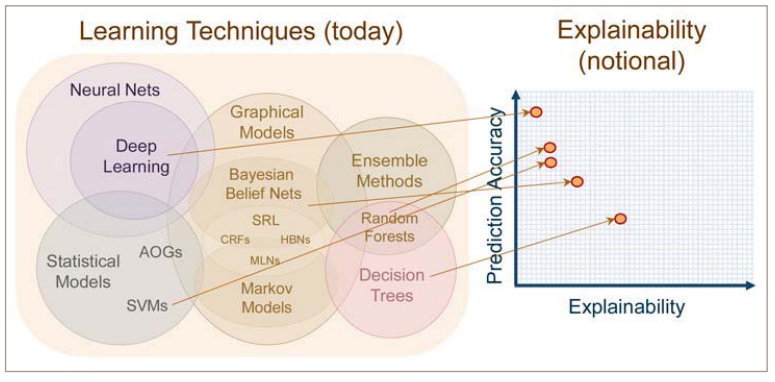
Interpretability therefore can be understood as the extent to which a model can assign interpretable features to a prediction, and therefore is linked to explainability. But this association generally comes at a cost: the more complex the model, the more accurate it is, but the less interpretable it becomes. DARPA, the research arm of the U.S. Department of Defense, shows this as they map the relative explainability of different machine learning algorithms in Figure B below.
Figure B: Performance and Explainability Trade-Off
Photo by: DARPA
Because predictive power is linked with better business and organizational outcomes, firms and other AI producing bodies can’t switch to more explainable algorithms to more explainable algorithms. Left unregulated, profit-making organizations tend to engage in risky behavior that drives economic results at the expense of exposing them to unintended, often disastrous, consequences. Think of financial products, for instance. The rule of thumb in the trading industry is: the less oversight, the better the possible returns. However, this is like playing Russian roulette. There’s an intrinsic risk and horrible outcomes will eventually surface - in this case: markets crashing. Therefore, regulation exists to prevent such occurrences.
In the context of AI and explainability, regulation will be discussed in the proceeding article. In absence of regulation however, there are firms who still adopt certain practices and strategies to make AI more explainable because they want to ensure that they sustainably reap the benefits of this technology and avoid treading down the path of bankruptcy or self-destruction. While use cases of this will be discussed in the next sections, the first step for such firms is to clearly navigate through the complexity associated with their algorithms of choice.5
Complexity is driven by the type of model used. In AI models, there are performance parameters that can be tuned and adjusted to influence both their performance and relative complexity. For decision tree algorithms that are mostly used for classification decisions (reject or accept, cat or not a cat, etc.), the number of “trees” or “leaves” are examples of such parameters. Decision trees, as can be seen from the figure above, are highly amenable to explanation. In Figure C, we can see an example of the output of a decision tree model used to predict customer churn. Technical experts can interpret this with the naked-eye and can readily understand the algorithmic decision process. For more complex trees, commercially available software can generate somewhat similar diagrams that outline the relevant decision process and then trace clear paths to extract the key determinants of a prediction.
But for more complex models such as neural networks, the diagrams tend to become too large and confounded to produce useful graphical representation. They contain too many interacting nodes that make it inherently difficult to interpret. Given these constraints, many businesses have developed (or have been developing) software aimed at producing granular investigations that could shed light on the decision path of such complex models. One popular toolkit is IBM’s AI Explainability 3606, which provides an open source solution that helps users comprehend how machine learning models predict labels by various means throughout the AI application lifecycle. There are also companies that have successfully navigated this dilemma and have produced remarkable explainable AI use cases in spite of this trade-off. Below, we will examine two such cases.7
Figure C: Decision Tree

Commercial losses resulting from energy theft are disabling resources worldwide, generating an estimated $ 89B per year and raising energy prices for customers. Electric thieves use many methods to steal energy: they can get in line between a transformer and a house, they can get into a neighbor's meter, they can lower their meter, and so on.
To reduce theft, the Revenue Protection Officer needs a comprehensive list of possible theft cases that need to be investigated. Such a list can be generated by an ML model trained in intelligent meter data and external factors such as weather, environmental hazards etc. The tool must be flexible enough to adapt to flexible theft methods. The tool needs to be able to identify factors that increase the risk of theft and to clear the location of the case.
Different types of theft require different investigative action. The postponed meter needs to be disconnected, the city where the thief is located to steal the neighbor's power needs to be informed and the meter changed. In the event the transformer line hits the truck it needs to be sent to the correct location etc. This requires a deep understanding of the model’s decision process and hence, there has been a huge need for AI that is explainable to facilitate theft investigations. This case shows how there is intrinsic business value in making AI explainable.
Droughts are one of the most challenging natural hazards to be predicted owing to multiple predictors and non-linearity between them. A paper by Dikshit and Pradhan (2021) used explainable AI to help local governments provide more transparency to the public. Here, explainability was essentially for them to interpret models in the field of drought forecasting to preemptively examine future drought scenarios. This also provides a nice use case where the right balance of performance and explainability was achieved. The pair of researchers used deep learning algorithms while incorporating some techniques for explainability. Their solution had an accuracy of around 85%, which was sufficient for drought prediction. While tuning the parameters and model could have led to higher accuracy measures, they would have risked convoluting results to an extent that made explainable results impossible.8
The European Union became the first regulatory body that has issued an exhaustive list of regulations on AI systems. The objective as portrayed by the EU is to encourage AI excellence along with Trustworthy AI. On one hand, the Commission plans to invest €1 billion per year in AI to encourage and spread the usage of the technology, and on the other hand, proposed three legal initiatives to regulate AI. One of these initiatives is a framework that protects fundamental rights & addresses safety risks.9
According to a report by McKinsey, they found that only 48 percent of organizations report recognizing regulatory compliance risks, and even fewer (38 percent) report actively working to address them. Their study emphasizes that AI systems have revolutionized how companies perform and make a fundamental impact on consumers across all industries.10 Yet analysts of the esteemed consulting firm also insist that there is still a large opportunity to push the boundaries of innovation and value creation in AI if the inherent risks associated with it are addressed. Inevitably, one of these is un-explainability. The same research by McKinsey highlights that companies with the highest AI returns are more likely to have addressed the technology's risks.
From Mickinsey’s research, we see that investments in explainability can have a large upside even from a purely business standpoint. But from the EU’s risk classification in Figure D below, we can also infer that explainable AI is not always necessary. Because there are trade-offs associated with the performance of algorithms, it may be prudent to apply them to situations where they matter most, such as those deemed “Unacceptable” or “High-risk” in their classification. These scenarios come with AI applications where safety, individual freedoms, lifelong economic opportunities, and other high-stake affairs are at stake. For more casual, and commercial oriented applications, such as chatbots, automated emails, and inventory optimization which would be classified as “limited” or “minimal risk,” it would make sense to prioritize AI that makes strong predictions over AI that is more explainable.11
In any case, the next article in this series will shed light on how companies that utilize AI can be incentivized to build trust with consumers, central to which is having explainable AI, in-spite of this performance-explainability trade-off. It will address questions such as “what is truly preventing explainable AI from becoming part of the status quo?” and “what are the different incentives that each stakeholder faces?” - from firms, to government bodies, to regulators, and AI users. Finally, it will also push for an agenda in which each stakeholder can learn to trust each other, given the constraints and potential incentives they face, in order to fundamentally facilitate critical dialogue that leads to explainable AI being found where it matters most.12
Figure D: EU Risk Classification of AI

References:
[2] What the draft European Union AI regulations mean for business - McKinsey
[3] Introducing AI Explainability 360 - IBM Blog
[4] The Three Core Pillars Of Responsible AI - Forbes
[5] Would You Trust An Artificially-Intelligent Expert? - National Law Review
[6] Introducing AI Explainability 360 - IBM Blog
[7] Would You Trust An Artificially-Intelligent Expert? - National Law Review
[8] Interpretable and explainable AI (XAI) model for spatial drought prediction - ScienceDirect
[9] Shaping Europe’s digital future - Regulatory Framework - European Union
[10] What the draft European Union AI regulations mean for business - McKinsey
[11] Shaping Europe’s digital future - Regulatory Framework - European Union
[12] The Three Core Pillars Of Responsible AI - Forbes
Let’s start with a little thought experiment. When a digital platform shows you an ad for a product or service that really interests you, does the platform help you find what you are looking for or does it try to influence your preferences? The answer of course depends on who you ask, but an increasing number of people believe that those platforms try to gain profits by changing user behaviour.
The recent increase in the amount of data and the proliferation of algorithms based on these data have given rise to a new form of capitalism based on surveillance of consumers. Surveillance capitalists1, hereafter called gatekeeper platforms, can modify user behaviour to create profit from sales or advertising. How this happens is well illustrated by looking at how Meta earns money from for example Facebook and Instagram.
Users do not pay for the services offered by Meta, it is the advertisers who pay Meta proportionally to how well users respond to their advertisements. Meta therefore has an incentive to not only predict, but also modify the behaviour of users to optimise their response to offered advertisements. Users therefore trade their data and attention for access to Meta’s services.
This analysis becomes highly relevant when exploring the consequences of the Metaverse, a virtual world populated by avatars that users can create. In the Metaverse, the scale of data collection will increase enormously. To provide an illustration of how far this can go: Meta has patented technology to track eye-movement and brain activity through their Oculus VR-set.
This article starts from the premise that surveillance capitalism is to a certain extent undesirable for society. The way gatekeeper platforms are incentivised to collect more data with higher predictive value conflicts with human privacy and autonomous decision making. How exactly does this happen? Tracking users’ internet activity across websites or tracking brain activity is arguably a breach of personal privacy that comes close to surveillance. As stated before, this data is used to influence purchase or (in the case of Cambridge Analytica) voting decisions. To come back to the initial thought experiment: people who feel that digital platforms influence preferences have a solid argument.
In what follows, the focus is on one aspect that enables gatekeeper platforms to thrive: most of them create a so-called walled garden ecosystem. After setting the stage, we will explore pathways to a Metaverse without walled gardens. The hope is that by opening these ecosystems up to fairer competition, consumers will get more decision power to step away from gatekeeper platforms that misuse their data. In case this works, firms would get a new set of incentives that align more closely with consumer interests.
Walled Gardens is a term used to refer to digital ecosystems created by some gatekeepers. It is easy to enter the ecosystem, but once inside, users will find it hard to exit.
The ecosystem created by Apple is a good example. Once a consumer buys an Apple device, it becomes more convenient for them to purchase other Apple products. Once in possession of a MacBook, Iphone and Ipad, it will be inconvenient to switch to another brand due to the difference in operating systems that make communication and data transfer cumbersome with devices outside of the Apple ecosystem. This goes for the chargers that are different, to data that is stored on Apple servers. Within the Apple ecosystem, the company has complete control over the consumer’s data.
This convenience comes at a cost though. Due to the power Apple has over the mobile game market, the company charges app developers a commission of 30% on every transaction made through the app store, an issue that was recently brought to court.2 App developers currently have very few alternatives to bring their apps to consumers.
Another example can be found in the advertising business, where Meta, Google and Amazon combine for a total share of 60% of all digital advertising revenue generated in the United States. These Big Tech firms are in full control of the ecosystems they have created. They succeed very well in offering convenience to consumers. Once you start buying products through Amazon, they will become increasingly better at offering the products that you respond to. The more convenient it is for consumers, the harder it becomes to switch to an alternative. Consumers that find this undesirable should be able to switch to alternatives. 3
The main idea behind the Metaverse can be summarised by the desire to enable as many activities as possible (work, social gatherings, events...) from the physical world to happen in the digital world. Thereby removing certain frictions present in the physical world like distance and space limitations. In this endeavour, certain characteristics emerge that should be fulfilled before we can speak of a Metaverse.
Each characteristic raises certain challenges. Solving these will take time, that’s why many people believe that the Metaverse is not yet around the corner. To ensure synchronous experiences for example, millions of people should be connected in real time, current infrastructure has problems connecting more than a hundred.
That being said, some of the biggest companies in the world are heavily investing in an attempt to not get left behind. Microsoft will try to extend its dominance for work-related activities, Facebook's name change into Meta speaks for itself and some of Google's investments like virtual assistants and wearables seem to fit perfectly with the Metaverse.
By starting this article by explaining the concept of Surveillance Capitalism, I hope to have made the reader aware that this form of capitalism poses certain threats, but also that it will pose many more in case the Metaverse becomes mainstream. Initiatives that could tear down one of the preconditions of surveillance capitalism are therefore worth exploring.
Recently, the European council and parliament reached an agreement on the Digital Markets Act (DMA) and the Digital Services act (DSA).4 The DMA imposes new obligations on so-called gatekeeper platforms, mostly US firms, that provide core platform services such as search engines, social networking services and advertising services. The rationale is that due to advantageous conditions like network effects, lock-in effects and economies of scale, certain industries are now characterised by weak contestability of the dominant firm and unfair business practices towards users. The DSA stresses that “what is illegal offline, should be illegal online”. It tackles illegal content, and imposes transparency regarding advertising and recommender systems. Users should for example be able to choose the data that recommender systems can use to make recommendations.
The DSA’s main focus is on limiting the negative consequences of gatekeeper platforms. The aim of this article and the DMA is to explore pathways to an economy where gatekeeper platforms face more competition. In what remains, the focus will therefore be on the DMA. However, I deemed it necessary to also mention the DSA, as both should be seen as a unified effort to make digital ecosystems a fair and safe space.
The DMA hopes to open up the walled garden ecosystems to allow more competition, to offer more choice to users and to ensure fairness. Non-compliance can lead to fines of up to 20% of turnover in case of repeated infringement, in comparison to 4% in case of GDPR breaches. For Google and Meta, this could respectively go up to $50 billion and $23 billion.
Because the DMA is not designed specifically for the Metaverse, questions arise about how the Metaverse fits into this regulation. The DMA applies to ‘core platform services provided or offered by gatekeepers to business users in the Union or end users established or located in the Union’ (article 1.2.). The DMA does not contain a general definition of core platform services. Rather, article 2.2. lists types of services such as social networking services, search engines, intermediation services etc., most of which are based on existing legislative definitions. The Metaverse aims to integrate various core platform services and to add new, not yet identified services. Therefore, it remains to be seen how the regulation will apply. Especially since article 19 states that the Commission may add core platform services after conducting market investigations.
For this article, we will examine some of the obligations and outline their impact on the Metaverse. In this way, the aim of the DMA becomes clear.
Article 5.2b): “The gatekeeper shall not combine personal data from the relevant core platform service with personal data from other core platform services or from any other services provided by the gatekeeper or with personal data from third-party services.”
Article 5.2b) gets to the core of what gatekeeper platforms do: use personal data to predict and possibly change behavior. Because these companies are the owners of a whole ecosystem, they aggregate data from various sources. The aim of this obligation is to limit the extent to which these platforms can create walled gardens. Practically, data collected from the different services integrated in the Metaverse should be stored separately.
Article 5.5): “The gatekeeper shall allow end users to access and use, through its core platform services, content, subscriptions, features or other items, by using the software application of a business user, including where those end users acquired such items from the relevant business user without using the core platform services of the gatekeeper.”
This clause gives developers access to the users of gatekeeper platforms without having to necessarily use all the gatekeeper’s payment or advertising services. The problem Epic Games raised about Apple's commissions is tackled in this way. By imposing this, an opportunity is created for small companies to monetise their creations.
Article 6.5): “The gatekeeper shall not treat more favorably, in ranking and related indexing and crawling, services and products offered by the gatekeeper itself than similar services or products of a third party. The gatekeeper shall apply transparent, fair and non-discriminatory conditions to such ranking and related indexing and crawling.”
In the past, gatekeeper platforms have been blamed for favouring their own products. The DMA clearly sets out to eliminate this unfair practice. It is complementary to the previous article as third-party products will gain visibility.
By zooming in on these three clauses, the aim of the DMA becomes clear. It hopes to make markets fairer and more competitive for existing firms, new entrants and business/end users. At the same time, the DMA looks to change the current incentive system in the digital world. If it becomes public that a company misused data, users will be empowered to choose a different service provider.
The DMA has great potential to limit the extent to which gatekeeper platforms are able to maintain walled gardens. There is a willingness to look at their activities, and to render illegal those that are most harmful. On the other hand, the obligations are written up retrospectively. The activities targeted in the three clauses have taken place before, and the DMA offers an efficient framework to punish them.
However, questions remain about its global impact. The DMA is a European piece of legislation which will mainly impact US firms, it therefore seems unlikely that the United States will replicate it domestically. It remains to be seen how other countries will react.
The Metaverse is as of now uncharted territory with enormous potential when it comes to profit and data collection. Ensuring fair competition is therefore of the utmost importance. The DMA might prove to be effective in tackling the current walled gardens, but in its current form it offers no guarantees that walled gardens will not arise in the future. However, if fitting changes are made, it might prove a pathway to a Metaverse without walled gardens. As such, the DMA could take away a foundational building block that allows gatekeeper platforms to thrive. Limiting their power is already very important now. In the Metaverse, I believe this will become absolutely essential.