

[Student IDEAS] by Hugo Jalet - Graduate of the Global BBA at ESSEC Business School
Artificial intelligence is fundamentally altering the statistical nature of cyber risk in finance, shifting it from an isolated, firm-specific operational threat into a correlated, fat-tailed financial variable. By moving attack vectors from network perimeters to training data and foundation models—and with high market concentration across a few cloud and AI providers—AI-driven threats introduce heavy-tailed loss severity, accelerated industry-wide propagation, and extended detection lags where malicious interventions hide as ordinary "model drift." Because existing financial pricing, capital buffers, and board governance remain calibrated to pre-AI historical data, institutions are running an unpriced tail risk that threatens equity financing, liquidity, and balance sheet stability; addressing this requires integrating cyber and AI governance, stress-testing for multi-day operational outages, and sizing capital against third-party concentration.
---
In early 2024, a finance employee at the British engineering firm Arup joined what looked like a routine video call with her chief financial officer (CFO) and several colleagues. By the end of it, she had authorised fifteen transfers totalling roughly $25 million to accounts in Hong Kong. Weeks later, the firm discovered that every participant on the call, CFO included, was a deepfake: a hyper-realistic fake video and voice, generated by artificial intelligence (AI), that impersonates a real person.1 The story made headlines for a few days, then faded. It should not have. By mid-2025, deepfake-enabled fraud alone had driven close to $900 million in reported losses globally, with more than $410 million concentrated in the first half of the year, already exceeding the total for all of 2024.2
The Arup incident is usually told as a story about weak verification protocols and the need for better employee training. That framing is not wrong, but it is far too narrow. Arup lost money on a single wire; the underlying phenomenon is something finance has not yet priced. Artificial intelligence is quietly reshaping what cyber risk looks like as a statistical object. Losses are becoming less idiosyncratic and more correlated, tails are fatter, detection is slower, and propagation across firms is faster, largely because banks, insurers, and asset managers increasingly share the same foundation models, training data, and cloud vendors.
This matters because finance has, for more than a decade, treated cyber as primarily an operational and compliance issue: a cost line, a maturity score, an audit-committee bullet. That mental model was already strained, and in an AI-driven system, it quietly breaks. Cyber resilience is no longer a sidebar; it is a financial variable whose distribution has shifted, and which neither markets nor most institutions have repriced. The practical question for boards, chief risk officers (CROs), and investors is therefore not "how much more should we spend on security?" but "how must we redesign governance, capital planning, and disclosure once the tail of cyber losses has moved?"
To see why the familiar playbook no longer fits, it is worth being precise about what is genuinely new.
The past decade of digital transformation in finance mostly expanded what cyber risk could affect: more systems online, more data in motion, more third parties in the chain. Artificial intelligence does something different. It shifts four properties of the loss distribution itself, and each of these shifts quietly erodes the "perimeter plus patch" mental model (the assumption that security means defending a network boundary with firewalls and access controls, then closing known software flaws with timely patches) that still governs most cyber budgets.
The attack surface moves from code and credentials to data and models. Classical cyber defence is organised around code, infrastructure, and identities: firewalls, segmentation, access controls, patch cycles. An AI system is a different object. It can be compromised by corrupting the training data itself, before a single credential is ever stolen. Yerlikaya and Bahtiyar (2022) show how quickly this matters. They study data poisoning, which means deliberately corrupting part of the training data, the data used to teach and build a model. Across four datasets (spam, botnet, malware, and medical diagnostics) and six standard algorithms, the researchers deliberately altered the correct classifications in a quarter of the training data (labelling spam as legitimate, for instance). This alone cut classification accuracy by 15 to 40 percentage points, and when half of the training data was corrupted, model performance collapsed in several configurations. Transposed to finance, this is a structurally new threat: a well-placed intervention in the training pipeline (the process that collects, prepares, and feeds data into a model while it is being built) of a credit-scoring model, a transaction-monitoring engine, or an algorithmic pricing system does not need to breach the firewall to cause losses.
These threats target two distinct stages in the life of an AI system. At training time, while the model is being built, data poisoning and training-set contamination corrupt what it learns. At inference time, when the trained model is being used to make real decisions, attackers exploit it through prompt injection (hiding malicious instructions in the text or data the model reads) and model manipulation (feeding it carefully crafted inputs, or tampering with the model itself, so that it produces the outputs the attacker wants). Both bypass the controls built for the old perimeter: neither needs to breach a firewall or steal a credential, because the vulnerability lives in the data and the model itself, not at the network boundary. They now sit beside ransomware and phishing on the threat list.
Detection lag lengthens because model failure looks like drift. Traditional cyber incidents are largely binary. A system is down, an account is drained, a file is encrypted. AI failures are probabilistic. A poisoned fraud model does not stop working; it simply scores certain transactions a little more leniently. A manipulated credit model does not crash; it tilts approvals in a subtle direction. These incidents are easily reinterpreted as "model drift", an accepted, almost decorative feature of machine-learning (ML) models in production. The result is that the time between occurrence, discovery, and recognition stretches. Even without AI, the problem is already acute: using cross-country operational-loss data from seventy banks over sixteen years, Aldasoro et al. (2023) document an average lag of more than a year between when an operational loss occurs and when it is finally booked (formally recorded as a loss in the accounts), with a long-tailed distribution in which a meaningful share of events remain unaccounted for after two years. Layer on the probabilistic opacity of AI systems and one should expect that distribution to stretch further, not tighten. For capital and liquidity planning, the implication is unpleasant: by the time a model-level compromise is formally recognised, much of its damage may already have been absorbed into the balance sheet.

Timeline of an operational loss event. Source: Aldasoro et al. (2023). Three dates structure every loss event: occurrence, discovery, and recognition. AI-driven incidents stretch t₁ (occurrence → discovery) because probabilistic failures resemble model drift.
Propagation accelerates through shared models, shared data, and concentrated cloud providers. The novelty is blunt: banks, insurers, and asset managers no longer need to do business with each other to share cyber exposure; they only need to rely on the same foundation model, the same training corpus, or the same hyperscale cloud provider, so a single compromise can reach firms with no direct contractual link. This is a different transmission channel from the one finance is used to.
In the pre-AI cyber world, contagion travelled mainly through explicit economic linkages: interbank exposures, counterparty relationships, payment networks. The pre-mortem analysis of Fedwire by Eisenbach, Kovner and Lee (2022) already showed how powerful that channel alone could be. The impairment of any one of the five largest U.S. banks spills over to an average of 38% of the network. A shock concentrated on a single third-party service provider common to several large institutions does even more damage: it pushes the weighted share of impaired institutions to roughly 60%, with potential forgone payment activity reaching more than 2.5 times daily gross domestic product (GDP) once banks start hoarding liquidity.
That shared layer is no longer hypothetical. In the 2024 survey by the Bank of England and the Financial Conduct Authority (FCA), 75% of UK financial firms reported already using AI, up from 58% two years earlier, though adoption remains uneven: many firms are still standing up data pipelines or running a general-purpose chat assistant for back-office work, while a smaller set already embeds foundation models directly into credit, fraud, and trading decisions. Foundation models account for 17% of all use cases, and a third of use cases now run on third-party implementations (Bank of England and FCA, 2024).
That third-party supply is strikingly concentrated: the three most-cited providers account for 73% of all named cloud providers, 44% of model providers, and 33% of data providers. Concentration on that scale means many institutions are exposed, without any direct link to one another, to the same handful of upstream failures, which is why the same survey ranks cybersecurity as the highest perceived systemic risk and critical third-party dependencies as the fastest-growing one. This is precisely the concern the EU's Digital Operational Resilience Act (DORA) attempts to address through its oversight regime for "critical" third-party information and communication technology (ICT) providers, which formally recognises for the first time that cloud and model concentration is a systemic variable, not a purely commercial one (Kun, 2024).

The figure shows the distribution of the network impact for the scenario with a disruption originating from a third-party service provider. “Share” represents the unweighted percent of institutions that become impaired. “Weighted share” represents the percent of institutions that become impaired, weighted by asset size. “Net weighted share” refers to the percent of institutions that become impaired, net of the shocked institutions.
Loss tails fatten because one compromise now hits many pipelines at once. The combination of the first three shifts has a direct statistical consequence: the severity distribution of cyber losses becomes heavier in the right tail. If a single poisoned dataset or compromised model feeds credit decisioning, fraud scoring, and trading signals across multiple institutions, a single event generates correlated losses across several profit-and-loss (P&L) lines and several firms simultaneously. Aldasoro et al. (2023) already find that although cyber events are still rare relative to other operational losses, cyber risk can account for up to a third of a bank's total operational value-at-risk, with most of that contribution concentrated in the tail. A 2025 panel of chief information security officers (CISOs) and board directors convened by McKinsey and the National Association of Corporate Directors (NACD) captures the shift in blunt terms, with one participant noting that under AI-fuelled threats, the "variability and severity are so drastic" that traditional maturity scores carry little signal (McKinsey & Company, 2025).
Taken together, these four shifts describe a cyber risk that is less idiosyncratic, less binary, more correlated across firms, and slower to surface than the one the industry has built tools for. The governance model inherited from the last decade (a CISO who patches systems, an audit committee that tracks maturity scores, and an insurer who prices firm-level history) was not designed for this object. The question is what happens once this new distribution is properly recognised, first in prices and capital, then in governance and disclosure.
A shift in the cyber loss distribution only matters financially to the extent that it travels into the numbers that boards, creditors, and markets actually look at. And on current evidence, much of that journey has not yet happened.
Inside the firm. The most visible channel is the earnings hit. Operational losses from remediation, incident response, customer notification, legal fees, and regulatory fines feed directly into quarterly results. Using a cross-country panel of roughly seventy large banks over sixteen years, Aldasoro et al. (2023) estimate that operational risk capital varies between 1% and 7.5% of gross income depending on the calibration method used, and that cyber-specific capital can account for up to a third of that total. Franco et al. (2024) argue that even those figures underestimate firm-level exposure for the median institution because they remain rooted in probability-based simulations rather than observed real-world loss data; their Real Cyber Value at Risk (RCVaR) framework is designed precisely to close that gap by estimating costs directly from industry incident reports.
A second channel is the balance sheet. Remediation spending, accelerated information-technology investments, and litigation reserves erode capital buffers over the quarters that follow an incident, which changes how firms finance themselves. Liu, Luo & Yawson (2025), using a U.S. sample running from 2005 to 2019, find that attacked firms become 56% to 61% less likely than matched non-attacked firms to undertake a seasoned equity offering (SEO), that is, a new share issue by an already-listed company, over the three years after the attack, with SEO proceeds dropping in parallel. The mechanism they document is not a shortage of capital need but an excess of capital cost: reputation loss raises the adverse-selection premium that equity investors demand, and firms rationally shrink their equity issuance. The effect also spills over to industry peers who were not themselves attacked, whose SEO probability falls by roughly 18% to 20% of its baseline and whose SEO proceeds decline by about 13.5%, suggesting that markets treat a single cyber event as information about a sector's underlying cyber risk, not just about the target firm.
The third and most underappreciated channel is liquidity. Eisenbach, Kovner & Lee (2022) show that a successful cyber attack on any one of the top-5 U.S. wholesale payment banks impairs on average 38% of the network, and that once uninfected banks begin hoarding liquidity defensively, forgone payment activity can reach more than 2.5 times daily GDP within a few days. This matters particularly in AI-driven finance because authentication, payments, trade settlement and fraud routing all increasingly depend on ML-based systems. A model-level compromise does not only hit the targeted firm's P&L; it can disable a counterparty's ability to send or receive, which is a classical liquidity event wearing an AI costume. What looks operational becomes financial the moment confidence in settlement is shaken.
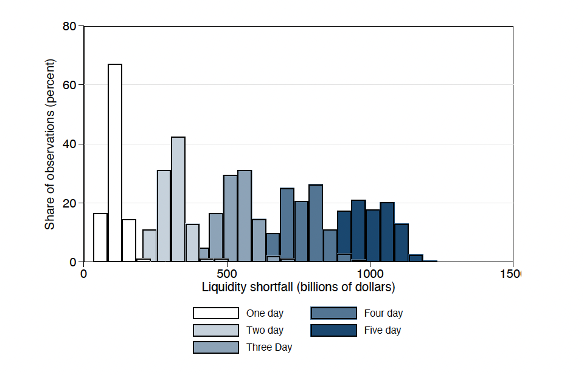
The figure shows the distribution of aggregate liquidity shortfall resulting from an attack that lasts from 1 to 5 days, averaged across the top-5 scenarios.
In markets. Do equity and credit markets price any of this? Partially. The existence of a cyber risk premium is by now empirically documented: firms with higher cyber exposure trade at a discount and face measurably higher costs of external financing after incidents (Jiang et al., 2024; Liu, Luo & Yawson, 2025). But the size of that premium is calibrated to the pre-AI tail. It reflects the historical distribution of cyber events as rare, largely firm-specific, and usually reversed within a few quarters. It does not yet reflect the four shifts described above: correlated incidents across firms that share a foundation model or a cloud region, slow-maturing damage from poisoned training sets, and losses that simultaneously hit credit decisioning, fraud scoring, and trading signals. The useful question is therefore not "is cyber risk priced?", but "is the post-AI tail priced?". On current evidence the answer is largely no.
Why not? Four structural frictions keep the post-AI tail out of prices.
Opacity. Cyber events are systematically under-reported. Aldasoro et al. (2023) document an average lag of more than a year between the occurrence of an operational loss and its recognition on the balance sheet, with a meaningful share of events still unaccounted for after two years. Markets cannot price what they cannot see, and as long as AI-related incidents hide inside "model drift" or "performance degradation", the signal does not reach them.
Externalities. Vendor and model concentration is a public bad. An institution that chooses a hyperscale cloud provider or a dominant foundation model captures private benefits (cost, performance, speed) but imposes a systemic risk that its own funding spread does not internalize. Kun (2024) argues that this is exactly the gap DORA's oversight regime for critical ICT providers was introduced to fill: firm-level risk management cannot price a shared-infrastructure externality, which is why a public authority has to look at concentration directly.
Rare-event neglect. Fat-tailed distributions are hard to estimate from short histories, especially when the underlying generating process has recently changed. The pre-AI cyber loss series is neither long enough nor stationary enough to calibrate a post-AI tail, and market participants (like most people) tend to under-weight tail risks they have not personally lived through.
Correlation blindness. Markets price firms, not shared-infrastructure clusters. There is no traded instrument whose payoff depends on whether ten banks share the same credit-scoring model, the same transaction-monitoring vendor, or the same cloud region. Until such an instrument exists, or until supervisors require concentration disclosure, correlated tail risk remains diversified on paper but concentrated in reality, which is the worst of both worlds for holders of the equity and debt of such firms.
The cumulative effect of these four frictions is that funding spreads, valuation multiples, and cyber insurance pricing continue to reflect a distribution that has already moved. Institutions whose capital planning, liquidity stress tests, and board-level risk dashboards rest on those same prices are therefore running a hidden short position on the post-AI tail. The rest of the article asks what changes (in governance, in disclosure, and in the practical work of CROs, CFOs, boards, and investors) once that short position is properly acknowledged.
If the post-AI tail is not yet in prices, the governance question is where the adjustment should come from. No single actor can close the gap: CROs and CFOs need to rebuild the quantitative plumbing, boards need to govern AI and cyber as one integrated risk, and investors and supervisors need to replace narrative assurance with credible tests. Institutions that move first stand to gain more than safety: the evidence discussed above suggests they may also fund themselves more cheaply and earn greater counterparty trust.
For CROs and CFOs: rebuild the quantitative plumbing. Three moves matter. First, model cyber losses at the tail, not at the mean. Franco et al. (2024) argue explicitly that most existing cyber capital models remain rooted in probability-based simulations calibrated on thin historical samples, exactly the wrong posture when the generating process has changed; their RCVaR framework estimates costs from observed industry data and makes the gap between expected loss and the 95th percentile explicit. Aldasoro et al. (2023) provide an independent benchmark: operational risk capital varies between 1% and 7.5% of gross income depending on calibration, with cyber-specific capital reaching a third of that. A capital plan sitting near the lower bound of those ranges is making an implicit bet that the post-AI tail will look like the pre-AI one.
Second, add authentication and payment outages to liquidity stress tests. Eisenbach, Kovner and Lee (2022) show that a five-day payment impairment at one of the five largest U.S. banks produces aggregate system liquidity shortfalls rising from roughly $122 billion on day one to around $1 trillion by day five, and that at the individual-bank level the 95th-percentile shortfall can reach 5% of risk-weighted assets or 37% of tier-1 capital.

Distribution of liquidity shortfall across impaired banks, relative to risk-weighted assets (left) and tier-1 capital (right). Source: Eisenbach, Kovner & Lee (2022). The tail is long: at the 95th percentile, shortfalls reach roughly 5% of risk-weighted assets and 37% of tier-1 capital. Capital buffers calibrated to the mean of this distribution leave the firm materially exposed to the tail.
Most internal liquidity frameworks still do not include a scenario in which the firm's ability to authenticate customers or send payments is disabled for several business days. Adding such scenarios, and sizing contingent buffers accordingly, is the single most concrete change a CFO can make.
Third, calibrate capital buffers to vendor concentration, not only firm-level history. The Bank of England's 2020 survey, cited by Kun (2024), finds that over 70% of U.K. banks and 80% of insurers use only two cloud providers for infrastructure services. Eisenbach et al. (2022) quantify the systemic side: a shock to a third-party service provider common to several large institutions impairs roughly 60% of the network by assets. CROs therefore need a vendor-concentration metric that feeds directly into capital buffer sizing, alongside a single risk register integrating model, data, and infrastructure exposures.
What makes such a test different from current ones is the unit of analysis. A conventional stress test breaches one firm at a time; a vendor-concentration test shocks the shared provider, not the firm, and asks how much of the book fails with it. In practice, it maps each critical AI dependency (foundation model, cloud region, data vendor) to the lines of business that rely on it, and identifies where the same provider silently underpins supposedly independent functions such as credit scoring, fraud detection, and trading. It then measures the correlated loss when that one provider goes down, and sets it against how many direct competitors share the same dependency. Given that three providers already account for the bulk of cloud and model relationships, those overlaps are the rule, not the exception.
For boards: govern AI and cyber as one integrated risk. The McKinsey and NACD (2025) panel of CISOs and directors is blunt that "the era when cybersecurity was a separate, isolated function at organizations is over" and that AI-fuelled threats require what one panellist calls "air-to-ground coverage" across the institution. In practice, this means moving cyber out of the audit-committee sidebar into a standalone risk or technology committee with genuine technical fluency, and changing the metrics boards track. Generic maturity scores were designed for a world where cyber was firm-specific and procedural; they do not capture the post-AI tail. The metrics that do are operational: credible recovery time objectives for AI-dependent services under adversarial conditions, vendor and model-concentration exposure, and the credibility of the firm's scenario library. Concretely, a post-AI tail metric is not a maturity score but a small set of tail-sensitive quantities tracked over time: a concentration ratio (the share of AI-dependent critical services running on the firm's single largest external model, cloud, or data provider, and how that compares with peers); an independently tested recovery-time objective for each AI-dependent service under adversarial, not benign, failure; and a tail gap, the distance between the firm's modelled expected cyber loss and its 95th-percentile loss, with capital sized to the latter. Each of these moves with the actual loss distribution; a maturity score does not. As Marco Maiurano of First Citizens Bank puts it in the panel, the variability and severity are now so drastic that single-point maturity scores carry little signal.
For investors and supervisors: replace narrative assurance with concrete tests. Investors should make vendor and model concentration a standard due-diligence item: which foundation models, cloud regions, and third-party data vendors does the firm depend on, and how many of its direct competitors share those dependencies? This is more than a checklist item: it is one of the few mechanisms through which correlated tail risk can become visible in prices at all. No single firm's disclosure can reveal that ten competitors depend on the same model or cloud region; only a party comparing across firms can see it. Concentration is therefore a classic collective-action problem that markets cannot solve unaided, which is the substantive case for supervisory concentration testing rather than another maturity questionnaire. Kun (2024) argues this is precisely the gap DORA's oversight regime for critical ICT third-party providers was designed to fill at the supervisory level. Supervisors, for their part, should test recovery credibly rather than accept qualitative reporting: Aldasoro et al. (2023) find that better supervisory quality is empirically associated with roughly 11% faster recognition of operational losses. Applied to AI-driven finance, this argues for system-wide cyber stress exercises and independent audits of recovery time objectives rather than another layer of disclosure.
Once the tail has shifted, continuing to govern cyber risk with pre-AI tools is itself a strategic choice. It shows up first in the cost of capital: Liu, Luo and Yawson (2025) document that attacked firms and their peers face measurably higher equity financing costs after incidents, and Jiang et al. (2024) show that firms with higher cyber risk exposure pay a persistent premium. As markets learn to price the post-AI tail, those premia may widen for institutions that cannot credibly demonstrate tail-sensitive governance. It shows up next in counterparty trust: firms that cannot show credible recovery metrics are likely to be dealt with on less favourable terms long before they are breached.
The competitive frontier in AI-driven finance is not "best security" in the traditional sense. It is lowest uncertainty around service continuity under fat-tailed, correlated disruption. On a calm day, that looks like a cost line. On a bad day, it looks like the only institutions still open for business.
The Arup deepfake was told as a fraud story. It was really a preview. The same mechanism, scaled up, reaches training pipelines, credit models, authentication layers, and cloud regions shared across the industry. Cyber risk in AI-driven finance is no longer a compliance sidebar. It is a tail-sensitive, liquidity-relevant, correlation-heavy financial variable whose distribution has moved, and whose new shape is not yet in prices, capital, or boardroom dashboards.
None of this requires waiting for the next major incident. The data already exist. The shift is documented, the propagation channels are mapped, the pricing gap is measurable, and the regulatory direction of travel, from DORA onward, is set. What is missing is the governance layer that turns those inputs into capital plans, stress tests, and disclosures calibrated to the post-AI tail rather than the pre-AI one.
That gap is not neutral to wait on. Repricing the post-AI tail is likely to be a source of advantage, and one that compounds over time. The evidence does not yet prove this directly, but it points in that direction. If markets already charge a premium for observable cyber exposure (Jiang et al., 2024; Liu, Luo and Yawson, 2025), an institution that quantifies its cyber-and-AI tail, sizes capital and liquidity to it, and can disclose it credibly should be well placed to fund itself more cheaply and to be dealt with on better terms, with savings that would accrue quarter after quarter. An institution that does not is not standing still; it is quietly accumulating an invisible liability, a hidden short position on the post-AI tail whose premium it collects in good quarters and whose true size it discovers only when the distribution moves against it. The longer the two paths run, the wider the distance between them. The hidden variable is unlikely to stay hidden forever, and when it surfaces, the firms that priced it early may well find themselves years ahead.
[1] CNN. (2024, February). Finance worker pays out $25 million after video call with deepfake ‘chief financial officer’. CNN.
[2] Surfshark Research. (2025, July). Deepfake fraud losses near $900 million by mid-2025. Surfshark, using data from the AI Incident Database and Resemble.AI.
[3] Eisenbach, T. M., Kovner, A., & Lee, M. J. (2022). Cyber risk and the U.S. financial system: A pre-mortem analysis. Journal of Financial Economics, 145(3), 802–826.
[4] Franco, M. F., Künzler, F., von der Assen, J., Feng, C., & Stiller, B. (2024). RCVaR: An economic approach to estimate cyberattacks costs using data from industry reports. Computers & Security, 139, 103737.
[5] Jiang, H., Khanna, N., Yang, Q., & Zhou, J. (2024). The Cyber Risk Premium. Management Science, 70(12), 8791–8817.
[6] Kun, E. (2024). Challenges in regulating cloud service providers in EU financial regulation: From operational to systemic risks, and examining challenges of the new oversight regime for critical cloud service providers under the Digital Operational Resilience Act. Computer Law & Security Review, 52, 105931.
[7] Liu, X., Luo, J., & Yawson, A. (2025). Equity offering following cyberattacks. Journal of Corporate Finance, 91, 102710.
[8] Yerlikaya, F. A., & Bahtiyar, Ş. (2022). Data poisoning attacks against machine learning algorithms. Expert Systems with Applications, 208, 118101.
[9] McKinsey & Company, Risk & Resilience Practice. (2025, August). Competitive advantage through cybersecurity: A board-level perspective.
[10] Bailey, T., Del Miglio, A., & Richter, W. (2014, May). The rising strategic risks of cyberattacks. McKinsey & Company.
[11] Aldasoro, I., Gambacorta, L., Giudici, P., & Leach, T. (2023). Operational and Cyber Risks in the Financial Sector. International Journal of Central Banking, 19(5), 341–402.
[12] Bank of England & Financial Conduct Authority. (2024, November). Artificial intelligence in UK financial services - 2024. Bank of England.
[Student IDEAS] by Hugo Jalet - Graduate of the Global BBA at ESSEC Business School
Artificial intelligence is fundamentally altering the statistical nature of cyber risk in finance, shifting it from an isolated, firm-specific operational threat into a correlated, fat-tailed financial variable. By moving attack vectors from network perimeters to training data and foundation models—and with high market concentration across a few cloud and AI providers—AI-driven threats introduce heavy-tailed loss severity, accelerated industry-wide propagation, and extended detection lags where malicious interventions hide as ordinary "model drift." Because existing financial pricing, capital buffers, and board governance remain calibrated to pre-AI historical data, institutions are running an unpriced tail risk that threatens equity financing, liquidity, and balance sheet stability; addressing this requires integrating cyber and AI governance, stress-testing for multi-day operational outages, and sizing capital against third-party concentration.
---
In early 2024, a finance employee at the British engineering firm Arup joined what looked like a routine video call with her chief financial officer (CFO) and several colleagues. By the end of it, she had authorised fifteen transfers totalling roughly $25 million to accounts in Hong Kong. Weeks later, the firm discovered that every participant on the call, CFO included, was a deepfake: a hyper-realistic fake video and voice, generated by artificial intelligence (AI), that impersonates a real person.1 The story made headlines for a few days, then faded. It should not have. By mid-2025, deepfake-enabled fraud alone had driven close to $900 million in reported losses globally, with more than $410 million concentrated in the first half of the year, already exceeding the total for all of 2024.2
The Arup incident is usually told as a story about weak verification protocols and the need for better employee training. That framing is not wrong, but it is far too narrow. Arup lost money on a single wire; the underlying phenomenon is something finance has not yet priced. Artificial intelligence is quietly reshaping what cyber risk looks like as a statistical object. Losses are becoming less idiosyncratic and more correlated, tails are fatter, detection is slower, and propagation across firms is faster, largely because banks, insurers, and asset managers increasingly share the same foundation models, training data, and cloud vendors.
This matters because finance has, for more than a decade, treated cyber as primarily an operational and compliance issue: a cost line, a maturity score, an audit-committee bullet. That mental model was already strained, and in an AI-driven system, it quietly breaks. Cyber resilience is no longer a sidebar; it is a financial variable whose distribution has shifted, and which neither markets nor most institutions have repriced. The practical question for boards, chief risk officers (CROs), and investors is therefore not "how much more should we spend on security?" but "how must we redesign governance, capital planning, and disclosure once the tail of cyber losses has moved?"
To see why the familiar playbook no longer fits, it is worth being precise about what is genuinely new.
The past decade of digital transformation in finance mostly expanded what cyber risk could affect: more systems online, more data in motion, more third parties in the chain. Artificial intelligence does something different. It shifts four properties of the loss distribution itself, and each of these shifts quietly erodes the "perimeter plus patch" mental model (the assumption that security means defending a network boundary with firewalls and access controls, then closing known software flaws with timely patches) that still governs most cyber budgets.
The attack surface moves from code and credentials to data and models. Classical cyber defence is organised around code, infrastructure, and identities: firewalls, segmentation, access controls, patch cycles. An AI system is a different object. It can be compromised by corrupting the training data itself, before a single credential is ever stolen. Yerlikaya and Bahtiyar (2022) show how quickly this matters. They study data poisoning, which means deliberately corrupting part of the training data, the data used to teach and build a model. Across four datasets (spam, botnet, malware, and medical diagnostics) and six standard algorithms, the researchers deliberately altered the correct classifications in a quarter of the training data (labelling spam as legitimate, for instance). This alone cut classification accuracy by 15 to 40 percentage points, and when half of the training data was corrupted, model performance collapsed in several configurations. Transposed to finance, this is a structurally new threat: a well-placed intervention in the training pipeline (the process that collects, prepares, and feeds data into a model while it is being built) of a credit-scoring model, a transaction-monitoring engine, or an algorithmic pricing system does not need to breach the firewall to cause losses.
These threats target two distinct stages in the life of an AI system. At training time, while the model is being built, data poisoning and training-set contamination corrupt what it learns. At inference time, when the trained model is being used to make real decisions, attackers exploit it through prompt injection (hiding malicious instructions in the text or data the model reads) and model manipulation (feeding it carefully crafted inputs, or tampering with the model itself, so that it produces the outputs the attacker wants). Both bypass the controls built for the old perimeter: neither needs to breach a firewall or steal a credential, because the vulnerability lives in the data and the model itself, not at the network boundary. They now sit beside ransomware and phishing on the threat list.
Detection lag lengthens because model failure looks like drift. Traditional cyber incidents are largely binary. A system is down, an account is drained, a file is encrypted. AI failures are probabilistic. A poisoned fraud model does not stop working; it simply scores certain transactions a little more leniently. A manipulated credit model does not crash; it tilts approvals in a subtle direction. These incidents are easily reinterpreted as "model drift", an accepted, almost decorative feature of machine-learning (ML) models in production. The result is that the time between occurrence, discovery, and recognition stretches. Even without AI, the problem is already acute: using cross-country operational-loss data from seventy banks over sixteen years, Aldasoro et al. (2023) document an average lag of more than a year between when an operational loss occurs and when it is finally booked (formally recorded as a loss in the accounts), with a long-tailed distribution in which a meaningful share of events remain unaccounted for after two years. Layer on the probabilistic opacity of AI systems and one should expect that distribution to stretch further, not tighten. For capital and liquidity planning, the implication is unpleasant: by the time a model-level compromise is formally recognised, much of its damage may already have been absorbed into the balance sheet.
Timeline of an operational loss event. Source: Aldasoro et al. (2023). Three dates structure every loss event: occurrence, discovery, and recognition. AI-driven incidents stretch t₁ (occurrence → discovery) because probabilistic failures resemble model drift.
Propagation accelerates through shared models, shared data, and concentrated cloud providers. The novelty is blunt: banks, insurers, and asset managers no longer need to do business with each other to share cyber exposure; they only need to rely on the same foundation model, the same training corpus, or the same hyperscale cloud provider, so a single compromise can reach firms with no direct contractual link. This is a different transmission channel from the one finance is used to.
In the pre-AI cyber world, contagion travelled mainly through explicit economic linkages: interbank exposures, counterparty relationships, payment networks. The pre-mortem analysis of Fedwire by Eisenbach, Kovner and Lee (2022) already showed how powerful that channel alone could be. The impairment of any one of the five largest U.S. banks spills over to an average of 38% of the network. A shock concentrated on a single third-party service provider common to several large institutions does even more damage: it pushes the weighted share of impaired institutions to roughly 60%, with potential forgone payment activity reaching more than 2.5 times daily gross domestic product (GDP) once banks start hoarding liquidity.
That shared layer is no longer hypothetical. In the 2024 survey by the Bank of England and the Financial Conduct Authority (FCA), 75% of UK financial firms reported already using AI, up from 58% two years earlier, though adoption remains uneven: many firms are still standing up data pipelines or running a general-purpose chat assistant for back-office work, while a smaller set already embeds foundation models directly into credit, fraud, and trading decisions. Foundation models account for 17% of all use cases, and a third of use cases now run on third-party implementations (Bank of England and FCA, 2024).
That third-party supply is strikingly concentrated: the three most-cited providers account for 73% of all named cloud providers, 44% of model providers, and 33% of data providers. Concentration on that scale means many institutions are exposed, without any direct link to one another, to the same handful of upstream failures, which is why the same survey ranks cybersecurity as the highest perceived systemic risk and critical third-party dependencies as the fastest-growing one. This is precisely the concern the EU's Digital Operational Resilience Act (DORA) attempts to address through its oversight regime for "critical" third-party information and communication technology (ICT) providers, which formally recognises for the first time that cloud and model concentration is a systemic variable, not a purely commercial one (Kun, 2024).
The figure shows the distribution of the network impact for the scenario with a disruption originating from a third-party service provider. “Share” represents the unweighted percent of institutions that become impaired. “Weighted share” represents the percent of institutions that become impaired, weighted by asset size. “Net weighted share” refers to the percent of institutions that become impaired, net of the shocked institutions.
Loss tails fatten because one compromise now hits many pipelines at once. The combination of the first three shifts has a direct statistical consequence: the severity distribution of cyber losses becomes heavier in the right tail. If a single poisoned dataset or compromised model feeds credit decisioning, fraud scoring, and trading signals across multiple institutions, a single event generates correlated losses across several profit-and-loss (P&L) lines and several firms simultaneously. Aldasoro et al. (2023) already find that although cyber events are still rare relative to other operational losses, cyber risk can account for up to a third of a bank's total operational value-at-risk, with most of that contribution concentrated in the tail. A 2025 panel of chief information security officers (CISOs) and board directors convened by McKinsey and the National Association of Corporate Directors (NACD) captures the shift in blunt terms, with one participant noting that under AI-fuelled threats, the "variability and severity are so drastic" that traditional maturity scores carry little signal (McKinsey & Company, 2025).
Taken together, these four shifts describe a cyber risk that is less idiosyncratic, less binary, more correlated across firms, and slower to surface than the one the industry has built tools for. The governance model inherited from the last decade (a CISO who patches systems, an audit committee that tracks maturity scores, and an insurer who prices firm-level history) was not designed for this object. The question is what happens once this new distribution is properly recognised, first in prices and capital, then in governance and disclosure.
A shift in the cyber loss distribution only matters financially to the extent that it travels into the numbers that boards, creditors, and markets actually look at. And on current evidence, much of that journey has not yet happened.
Inside the firm. The most visible channel is the earnings hit. Operational losses from remediation, incident response, customer notification, legal fees, and regulatory fines feed directly into quarterly results. Using a cross-country panel of roughly seventy large banks over sixteen years, Aldasoro et al. (2023) estimate that operational risk capital varies between 1% and 7.5% of gross income depending on the calibration method used, and that cyber-specific capital can account for up to a third of that total. Franco et al. (2024) argue that even those figures underestimate firm-level exposure for the median institution because they remain rooted in probability-based simulations rather than observed real-world loss data; their Real Cyber Value at Risk (RCVaR) framework is designed precisely to close that gap by estimating costs directly from industry incident reports.
A second channel is the balance sheet. Remediation spending, accelerated information-technology investments, and litigation reserves erode capital buffers over the quarters that follow an incident, which changes how firms finance themselves. Liu, Luo & Yawson (2025), using a U.S. sample running from 2005 to 2019, find that attacked firms become 56% to 61% less likely than matched non-attacked firms to undertake a seasoned equity offering (SEO), that is, a new share issue by an already-listed company, over the three years after the attack, with SEO proceeds dropping in parallel. The mechanism they document is not a shortage of capital need but an excess of capital cost: reputation loss raises the adverse-selection premium that equity investors demand, and firms rationally shrink their equity issuance. The effect also spills over to industry peers who were not themselves attacked, whose SEO probability falls by roughly 18% to 20% of its baseline and whose SEO proceeds decline by about 13.5%, suggesting that markets treat a single cyber event as information about a sector's underlying cyber risk, not just about the target firm.
The third and most underappreciated channel is liquidity. Eisenbach, Kovner & Lee (2022) show that a successful cyber attack on any one of the top-5 U.S. wholesale payment banks impairs on average 38% of the network, and that once uninfected banks begin hoarding liquidity defensively, forgone payment activity can reach more than 2.5 times daily GDP within a few days. This matters particularly in AI-driven finance because authentication, payments, trade settlement and fraud routing all increasingly depend on ML-based systems. A model-level compromise does not only hit the targeted firm's P&L; it can disable a counterparty's ability to send or receive, which is a classical liquidity event wearing an AI costume. What looks operational becomes financial the moment confidence in settlement is shaken.
The figure shows the distribution of aggregate liquidity shortfall resulting from an attack that lasts from 1 to 5 days, averaged across the top-5 scenarios.
In markets. Do equity and credit markets price any of this? Partially. The existence of a cyber risk premium is by now empirically documented: firms with higher cyber exposure trade at a discount and face measurably higher costs of external financing after incidents (Jiang et al., 2024; Liu, Luo & Yawson, 2025). But the size of that premium is calibrated to the pre-AI tail. It reflects the historical distribution of cyber events as rare, largely firm-specific, and usually reversed within a few quarters. It does not yet reflect the four shifts described above: correlated incidents across firms that share a foundation model or a cloud region, slow-maturing damage from poisoned training sets, and losses that simultaneously hit credit decisioning, fraud scoring, and trading signals. The useful question is therefore not "is cyber risk priced?", but "is the post-AI tail priced?". On current evidence the answer is largely no.
Why not? Four structural frictions keep the post-AI tail out of prices.
Opacity. Cyber events are systematically under-reported. Aldasoro et al. (2023) document an average lag of more than a year between the occurrence of an operational loss and its recognition on the balance sheet, with a meaningful share of events still unaccounted for after two years. Markets cannot price what they cannot see, and as long as AI-related incidents hide inside "model drift" or "performance degradation", the signal does not reach them.
Externalities. Vendor and model concentration is a public bad. An institution that chooses a hyperscale cloud provider or a dominant foundation model captures private benefits (cost, performance, speed) but imposes a systemic risk that its own funding spread does not internalize. Kun (2024) argues that this is exactly the gap DORA's oversight regime for critical ICT providers was introduced to fill: firm-level risk management cannot price a shared-infrastructure externality, which is why a public authority has to look at concentration directly.
Rare-event neglect. Fat-tailed distributions are hard to estimate from short histories, especially when the underlying generating process has recently changed. The pre-AI cyber loss series is neither long enough nor stationary enough to calibrate a post-AI tail, and market participants (like most people) tend to under-weight tail risks they have not personally lived through.
Correlation blindness. Markets price firms, not shared-infrastructure clusters. There is no traded instrument whose payoff depends on whether ten banks share the same credit-scoring model, the same transaction-monitoring vendor, or the same cloud region. Until such an instrument exists, or until supervisors require concentration disclosure, correlated tail risk remains diversified on paper but concentrated in reality, which is the worst of both worlds for holders of the equity and debt of such firms.
The cumulative effect of these four frictions is that funding spreads, valuation multiples, and cyber insurance pricing continue to reflect a distribution that has already moved. Institutions whose capital planning, liquidity stress tests, and board-level risk dashboards rest on those same prices are therefore running a hidden short position on the post-AI tail. The rest of the article asks what changes (in governance, in disclosure, and in the practical work of CROs, CFOs, boards, and investors) once that short position is properly acknowledged.
If the post-AI tail is not yet in prices, the governance question is where the adjustment should come from. No single actor can close the gap: CROs and CFOs need to rebuild the quantitative plumbing, boards need to govern AI and cyber as one integrated risk, and investors and supervisors need to replace narrative assurance with credible tests. Institutions that move first stand to gain more than safety: the evidence discussed above suggests they may also fund themselves more cheaply and earn greater counterparty trust.
For CROs and CFOs: rebuild the quantitative plumbing. Three moves matter. First, model cyber losses at the tail, not at the mean. Franco et al. (2024) argue explicitly that most existing cyber capital models remain rooted in probability-based simulations calibrated on thin historical samples, exactly the wrong posture when the generating process has changed; their RCVaR framework estimates costs from observed industry data and makes the gap between expected loss and the 95th percentile explicit. Aldasoro et al. (2023) provide an independent benchmark: operational risk capital varies between 1% and 7.5% of gross income depending on calibration, with cyber-specific capital reaching a third of that. A capital plan sitting near the lower bound of those ranges is making an implicit bet that the post-AI tail will look like the pre-AI one.
Second, add authentication and payment outages to liquidity stress tests. Eisenbach, Kovner and Lee (2022) show that a five-day payment impairment at one of the five largest U.S. banks produces aggregate system liquidity shortfalls rising from roughly $122 billion on day one to around $1 trillion by day five, and that at the individual-bank level the 95th-percentile shortfall can reach 5% of risk-weighted assets or 37% of tier-1 capital.
Distribution of liquidity shortfall across impaired banks, relative to risk-weighted assets (left) and tier-1 capital (right). Source: Eisenbach, Kovner & Lee (2022). The tail is long: at the 95th percentile, shortfalls reach roughly 5% of risk-weighted assets and 37% of tier-1 capital. Capital buffers calibrated to the mean of this distribution leave the firm materially exposed to the tail.
Most internal liquidity frameworks still do not include a scenario in which the firm's ability to authenticate customers or send payments is disabled for several business days. Adding such scenarios, and sizing contingent buffers accordingly, is the single most concrete change a CFO can make.
Third, calibrate capital buffers to vendor concentration, not only firm-level history. The Bank of England's 2020 survey, cited by Kun (2024), finds that over 70% of U.K. banks and 80% of insurers use only two cloud providers for infrastructure services. Eisenbach et al. (2022) quantify the systemic side: a shock to a third-party service provider common to several large institutions impairs roughly 60% of the network by assets. CROs therefore need a vendor-concentration metric that feeds directly into capital buffer sizing, alongside a single risk register integrating model, data, and infrastructure exposures.
What makes such a test different from current ones is the unit of analysis. A conventional stress test breaches one firm at a time; a vendor-concentration test shocks the shared provider, not the firm, and asks how much of the book fails with it. In practice, it maps each critical AI dependency (foundation model, cloud region, data vendor) to the lines of business that rely on it, and identifies where the same provider silently underpins supposedly independent functions such as credit scoring, fraud detection, and trading. It then measures the correlated loss when that one provider goes down, and sets it against how many direct competitors share the same dependency. Given that three providers already account for the bulk of cloud and model relationships, those overlaps are the rule, not the exception.
For boards: govern AI and cyber as one integrated risk. The McKinsey and NACD (2025) panel of CISOs and directors is blunt that "the era when cybersecurity was a separate, isolated function at organizations is over" and that AI-fuelled threats require what one panellist calls "air-to-ground coverage" across the institution. In practice, this means moving cyber out of the audit-committee sidebar into a standalone risk or technology committee with genuine technical fluency, and changing the metrics boards track. Generic maturity scores were designed for a world where cyber was firm-specific and procedural; they do not capture the post-AI tail. The metrics that do are operational: credible recovery time objectives for AI-dependent services under adversarial conditions, vendor and model-concentration exposure, and the credibility of the firm's scenario library. Concretely, a post-AI tail metric is not a maturity score but a small set of tail-sensitive quantities tracked over time: a concentration ratio (the share of AI-dependent critical services running on the firm's single largest external model, cloud, or data provider, and how that compares with peers); an independently tested recovery-time objective for each AI-dependent service under adversarial, not benign, failure; and a tail gap, the distance between the firm's modelled expected cyber loss and its 95th-percentile loss, with capital sized to the latter. Each of these moves with the actual loss distribution; a maturity score does not. As Marco Maiurano of First Citizens Bank puts it in the panel, the variability and severity are now so drastic that single-point maturity scores carry little signal.
For investors and supervisors: replace narrative assurance with concrete tests. Investors should make vendor and model concentration a standard due-diligence item: which foundation models, cloud regions, and third-party data vendors does the firm depend on, and how many of its direct competitors share those dependencies? This is more than a checklist item: it is one of the few mechanisms through which correlated tail risk can become visible in prices at all. No single firm's disclosure can reveal that ten competitors depend on the same model or cloud region; only a party comparing across firms can see it. Concentration is therefore a classic collective-action problem that markets cannot solve unaided, which is the substantive case for supervisory concentration testing rather than another maturity questionnaire. Kun (2024) argues this is precisely the gap DORA's oversight regime for critical ICT third-party providers was designed to fill at the supervisory level. Supervisors, for their part, should test recovery credibly rather than accept qualitative reporting: Aldasoro et al. (2023) find that better supervisory quality is empirically associated with roughly 11% faster recognition of operational losses. Applied to AI-driven finance, this argues for system-wide cyber stress exercises and independent audits of recovery time objectives rather than another layer of disclosure.
Once the tail has shifted, continuing to govern cyber risk with pre-AI tools is itself a strategic choice. It shows up first in the cost of capital: Liu, Luo and Yawson (2025) document that attacked firms and their peers face measurably higher equity financing costs after incidents, and Jiang et al. (2024) show that firms with higher cyber risk exposure pay a persistent premium. As markets learn to price the post-AI tail, those premia may widen for institutions that cannot credibly demonstrate tail-sensitive governance. It shows up next in counterparty trust: firms that cannot show credible recovery metrics are likely to be dealt with on less favourable terms long before they are breached.
The competitive frontier in AI-driven finance is not "best security" in the traditional sense. It is lowest uncertainty around service continuity under fat-tailed, correlated disruption. On a calm day, that looks like a cost line. On a bad day, it looks like the only institutions still open for business.
The Arup deepfake was told as a fraud story. It was really a preview. The same mechanism, scaled up, reaches training pipelines, credit models, authentication layers, and cloud regions shared across the industry. Cyber risk in AI-driven finance is no longer a compliance sidebar. It is a tail-sensitive, liquidity-relevant, correlation-heavy financial variable whose distribution has moved, and whose new shape is not yet in prices, capital, or boardroom dashboards.
None of this requires waiting for the next major incident. The data already exist. The shift is documented, the propagation channels are mapped, the pricing gap is measurable, and the regulatory direction of travel, from DORA onward, is set. What is missing is the governance layer that turns those inputs into capital plans, stress tests, and disclosures calibrated to the post-AI tail rather than the pre-AI one.
That gap is not neutral to wait on. Repricing the post-AI tail is likely to be a source of advantage, and one that compounds over time. The evidence does not yet prove this directly, but it points in that direction. If markets already charge a premium for observable cyber exposure (Jiang et al., 2024; Liu, Luo and Yawson, 2025), an institution that quantifies its cyber-and-AI tail, sizes capital and liquidity to it, and can disclose it credibly should be well placed to fund itself more cheaply and to be dealt with on better terms, with savings that would accrue quarter after quarter. An institution that does not is not standing still; it is quietly accumulating an invisible liability, a hidden short position on the post-AI tail whose premium it collects in good quarters and whose true size it discovers only when the distribution moves against it. The longer the two paths run, the wider the distance between them. The hidden variable is unlikely to stay hidden forever, and when it surfaces, the firms that priced it early may well find themselves years ahead.
[1] CNN. (2024, February). Finance worker pays out $25 million after video call with deepfake ‘chief financial officer’. CNN.
[2] Surfshark Research. (2025, July). Deepfake fraud losses near $900 million by mid-2025. Surfshark, using data from the AI Incident Database and Resemble.AI.
[3] Eisenbach, T. M., Kovner, A., & Lee, M. J. (2022). Cyber risk and the U.S. financial system: A pre-mortem analysis. Journal of Financial Economics, 145(3), 802–826.
[4] Franco, M. F., Künzler, F., von der Assen, J., Feng, C., & Stiller, B. (2024). RCVaR: An economic approach to estimate cyberattacks costs using data from industry reports. Computers & Security, 139, 103737.
[5] Jiang, H., Khanna, N., Yang, Q., & Zhou, J. (2024). The Cyber Risk Premium. Management Science, 70(12), 8791–8817.
[6] Kun, E. (2024). Challenges in regulating cloud service providers in EU financial regulation: From operational to systemic risks, and examining challenges of the new oversight regime for critical cloud service providers under the Digital Operational Resilience Act. Computer Law & Security Review, 52, 105931.
[7] Liu, X., Luo, J., & Yawson, A. (2025). Equity offering following cyberattacks. Journal of Corporate Finance, 91, 102710.
[8] Yerlikaya, F. A., & Bahtiyar, Ş. (2022). Data poisoning attacks against machine learning algorithms. Expert Systems with Applications, 208, 118101.
[9] McKinsey & Company, Risk & Resilience Practice. (2025, August). Competitive advantage through cybersecurity: A board-level perspective.
[10] Bailey, T., Del Miglio, A., & Richter, W. (2014, May). The rising strategic risks of cyberattacks. McKinsey & Company.
[11] Aldasoro, I., Gambacorta, L., Giudici, P., & Leach, T. (2023). Operational and Cyber Risks in the Financial Sector. International Journal of Central Banking, 19(5), 341–402.
[12] Bank of England & Financial Conduct Authority. (2024, November). Artificial intelligence in UK financial services - 2024. Bank of England.
[Student IDEAS] by Dan Xiao - Master in Management at ESSEC Business School
As Big Tech dominates foundation models, software is shifting to the application layer with Systems of Action (SOA)—autonomous software that targets global professional labor spend by executing end-to-end outcomes. Led by capital-efficient second movers, vertical AI startups are building defensible moats through a four-step execution stack: cost-optimized model routing, proprietary Retrieval-Augmented Generation (RAG), agentic workflows, and outcome-based pricing. By turning regulatory compliance like the EU AI Act into trust barriers and mastering deep domain edge cases, specialized application-layer platforms are redefining value capture beyond brute-force compute.
---
As Big Tech bundles good enough AI into every existing seat, how can a software startup survive the gravity of the giants?
The answer is simple: if you are still using AI just to draft emails or fix typos, you are missing the forest for the trees. While the masses use AI for these simple tasks, a fundamental transition is occurring in the corporate world: the narrative of AI is shifting from what it says to what it does. We are witnessing a fundamental transition: the focus is moving from the Foundational Layer to the Application Layer. In this new era, AI is reshaping the very concept of SaaS (Software as a Service), shifting the value proposition from managing data to executing outcomes.
Let’s review how SaaS has evolved1.
As highlighted in NEA’s 2025 analysis2, while traditional SaaS captures a share of the $500 billion enterprise software sector, AI “Systems of Action” are now targeting the $11 trillion global professional services labor spend.
The disruption is both localized and surgical. A group of second-mover3 startups are quietly dominating entire industries with narrow, high-margin AI services, intentionally avoiding the massive capital demands of the model race. While this efficiency movement is global, European founders have emerged as its primary architects. They are turning the EU AI Act4 into a form of regulatory sovereignty, creating a home-field advantage in high-stakes sectors where trust is currency.
According to a recent report by Goldman Sachs5 US giants are bleeding capital, with Big Tech capex projected to exceed $400 billion. In contrast, while European founders lack the same raw financial firepower, they excel at capital conversion—matching Silicon Valley's ability to turn investments into $1B+ outcomes, but on a much leaner budget. European founders are not inferior to their Silicon Valley counterparts in their ability to convert “investment amounts” into “company value”. Along with the decrease of token fees, second-mover start-ups maintain strong 60% gross margins and healthier scaling trajectories6. They’ve realized one crucial wisdom: It’s time to trade hype for impact.


How do these second-mover startups win? Which investment hotspots are overheated, and which are untapped? This article will decode the profit logic and the cycles that will decide who actually captures value in the next decade.
The conventional wisdom that the European tech scene lags behind due to capital inefficiency is a persistent myth. In reality, the data tells a different story: when normalized for total capital raised, European startups share the exact same probability of reaching unicorn status as their American counterparts.
Another counter-intuitive reality is the role of the EU AI Act. While often criticized as a hurdle for innovation, it is increasingly viewed as a form of “regulatory sovereignty”. This framework provides Europe with a natural home-field advantage in high-stakes, highly regulated sectors like Healthcare and RegTech, where trust is the primary currency.
In these specialized sectors, Vertical AI has become a clear trend. Vertical AI refers to Artificial Intelligence applications that are purpose-built to solve problems within a specific industry (a “vertical”), such as Law, Healthcare, Construction, or Finance. Unlike Horizontal AI (like ChatGPT or Claude), which can do a little bit of everything, Vertical AI is a specialist. These applications are purpose-built for specific industries to combine the raw power of LLMs with industry-proprietary data, specialized workflows, and strict regulatory compliance.
Take a French healthcare startup, Nabla for example, it achieved $70 million in Series C funding last year in New York. Nabla directly embed AI into their care service by generating high-quality clinical notes in seconds through ambient documentation and real-time medical coding. Their advanced products save doctors hours of paperwork while maintaining the highest data privacy standards required by law.
To see how the Vertical AI trend is manifested on a global scale, let’s look at the regional divergence in strategy. Synthesizing the latest 2025 reports from Accel, Bessemer Venture Partners (BVP) and Atomico, the table below illustrates how different regions are positioning themselves for the next phase of the “model wars.”
| Region | Core Strategy | Primary Capital Focus | Target Industries | Strategic / Economic Moat |
| USA | Compute & Foundation Models | Infrastructure Layer (75%+) | Consumer Tech, Hyperscale Search, General Productivity | Capital Concentration: Massive CapEx scale ($400B+); “Winner-takes-all” platform dynamics. |
| Europe(EU) | Vertical Specialization & Digital Sovereignty | Application Layer (60%+) | Advanced Manufacturing, RegTech, Healthcare, Sovereign Cloud | Trust Moat: EU AI Act compliance; focus on data privacy, ethics, and B2B workflow depth. |
| China | Mass Implementation & Full-Stack Integration | Hardware & Industrial B2B Apps | E-commerce, Humanoid Robotics, Smart Cities, Supply Chain | Data Scale: Massive closed-loop industrial datasets; state-led infrastructure and 5G/6G integration. |
| Israel / UK | Deep Tech Niches & Security Resilience | Vertical SaaS & Agent | Cybersecurity, FinTech, Drug Discovery | Talent Density: Specialized R&D hubs; high concentration of “Exit-focused” elite engineering talent. |
This data further demonstrates why Europe is winning the race for capital efficiency: it has chosen the application layer as its battlefield, a space characterized by higher gross profit margins (70–80%) and greater industry depth, allowing it to avoid the computing-power quagmire dominated by American giants.
Does this focus on the application layer mean we can ignore the “model wars”? Certainly not. While common sense holds that building a frontier LLM model requires $10B+, as OpenAI did, France’s Mistral AI has shown that mathematical elegance can rival brute force. By pioneering optimized architectures like Mixture-of-Experts (MoE), a design that routes queries only to specialized experts rather than activating the entire massive model for every single task, Mistral released models (e.g., Mistral Large 2) that match the performance of GPT-4 while requiring significantly fewer parameters and lower inference costs. They proved that you don’t need a power plant to run world-class AI, you just need a smarter design.
On the other hand, for those operating on the Application Layer, the path can lie in Vertical Specialization. For example, which apps do you use more often: DeepL or Google Translate?
Most people use them in different contexts: Google Translate is often used for quick, casual queries, while DeepL is seen as a gold standard for professional and business communication. This is a striking example: in 2024, DeepL reached a $2 billion valuation7 and was reportedly exploring a $5 billion IPO (Initial Public Offering), with just $132 million in primary capital. DeepL is proving that “precision” can scale faster than “brute force.” Its specialized engine consistently achieves strong BLEU scores (Bilingual Evaluation Understudy), often outperforming general-purpose models like GPT-4 in high-stakes formal business contexts.

Apart from capital efficiency, DeepL also shows incredible advantages in real-time solutions among plenty of languages. It perfectly exemplifies the “European Second-Mover” logic: instead of racing to build general models, they mastered the domain-specialized workflow—locking in a critical vertical and building an unassailable moat of expertise.
But how is this moat actually engineered? Behind the striking valuation of companies like DeepL lies a fundamental shift in how AI products are built. In 2026, creating a Vertical AI leader is about orchestrating a four-step strategic stack that prioritizes precision over brute force.
To build a Vertical AI leader that can stand up to Silicon Valley giants, founders are moving away from General AI to adapt a specialized blueprint that prioritizes localized intelligence, proprietary context, and outcome-based economics. Here is the organized 2026 prospecting execution stack:
Instead of chasing the massive, generalized intelligence of a GPT-4, Vertical AI starts with Model Routing and Distillation.
In 2026, inference cost has replaced hosting as the primary variable expense for software firms. According to Accel 2025, inference costs have crashed by 97%. Specifically, GPT-4 pricing fell from $75 per million tokens in March 2023 to just $2 per million tokens for equivalent mini models by late 2025.

By running a smaller, fine-tuned model locally, you capture 70-80% gross margins that were previously lost as external API fees paid to model providers. Use a “Frontier Model” (like Claude 3.5) for the initial reasoning, but then distill that specific industry knowledge into a smaller, faster, and cheaper model (like Mistral 7B or Llama 3.1).
The second step in the vertical blueprint is the Context Layer. This is achieved through Retrieval-Augmented Generation (RAG). RAG makes it possible to feed AI with proprietary, high-density data such as a law firm’s past 5,000 litigation files, a manufacturer’s sensor logs, or a hospital’s clinical case histories.
First, for grounding in proprietary data assets, Vertical AI leaders build their moats by feeding models with data that Silicon Valley giants cannot easily access. In Europe, the EU AI Act creates a compliance moat. Research from team.blue suggests that 72% of European CIOs have concerns about “data sovereignty” when using public cloud LLMs based in the US.
RAG provides a technical solution to these regulatory hurdles. Because it retrieves information at the time of the prompt rather than embedding it in model weights, it enables superior data governance. For example, if a user exercises their “right to be forgotten” under the GDPR or the EU AI Act, a RAG system can simply delete the specific document from its index. In contrast, a model that has been fine-tuned on that data would theoretically require expensive retraining to ensure the data is fully removed. This makes RAG-based architectures the default choice for compliant Vertical AI in sectors such as finance, law, and healthcare. Below are examples of RAG-layer implementations for specific provisions of the EU AI Act.
| EU AI Act Article | Requirement (extracted from contexts8) | RAG Layer Implementation |
| Article 10 | High-quality, error-free training data | Automated data validation and bias scanning |
| Article 15 | Accuracy, robustness, and cybersecurity | LLMfFirewalls and real-time monitoring of RAG retrievals |
| Article 17 | Quality management system | Documented data lineage and decision logs for every AI action |
By 2026, 40% of AI-driven applications will feature task-specific AI agents to complete end-to-end tasks, moving away from simple “chat” prompts9. This means that after 2026, the vanguard of Vertical AI will be built entirely on agentic workflows.
To illustrate what “agentic” means, consider a traditional supply chain application: previously, a user had to manually type a prompt asking, 'Where is the delay?' In the 2026 agentic paradigm, however, the AI operates and observes entirely in the background. It monitors the data, identifies the delay, drafts a re-routing plan, and presents it for a one-click approval. This is the “Invisible AI” concept. There is no UI; the AI becomes a background process that orchestrates complex tasks through tools like LangChain or CrewAI. This shift is being accelerated by frameworks like Google’s Agent Development Kit, which standardizes how developers orchestrate sub-agents. Gartner10 also expects that by 2028 there will be multi-agent systems, working like an F1 car pit crew. However, the increased latency and compounding risk of errors inherent in multi-agent reasoning remain open questions.
It is already striking that BVP predicts the transition of SaaS to AI “Systems of Action” (not solely through Vertical AI) has the potential to grow from $500 billion to $11 trillion. It is an ambitious figure. How can we know if it is realistic? What if this is just a shift from one hype cycle to another?
First of all, this leap in valuation reflects a fundamental expansion of the total addressable market (TAM). The focus is shifting from the software budget to the much larger labor budget. Since the target market has moved from tools to labor, the profit model must adapt accordingly. To capture the labor-based value, a new charging standard—outcome-based pricing—is emerging. In this model, customers pay for a successful outcome such as a resolved support ticket, a booked meeting, or a successfully filed permit, rather than for access to the tool. This makes sense because if your AI can do the work of a junior accountant in 10 seconds, charging per seat becomes a strategic mistake.
BVP notes that outcome-based pricing is expected to grow 10x faster than traditional SaaS pricing11. We can already see early signs of this shift in companies like RELX (a London-based global leader in legal, medical, and scientific analytics) . While the broader market feared AI disruption, RELX’s legal AI platform saw revenue growth accelerate to 8% in H1 2025. This acceleration isn’t coming from selling more seats to the same lawyers, but from deep workflow integration, where AI creates high-value outcomes—such as real-time fraud detection and automated legal drafting—that customers are willing to pay a premium for.
In the short term, gross margins may be lower. This may be driven by two factors: the orchestration costs of agentic workflows, which demand a massive volume of tokens, and the initial engineering overhead required to ground models in proprietary industry data. However, Customer Acquisition Cost (CAC) is lower because the “pain point” (e.g., manual data entry) is so visceral that the product effectively sells itself.
However, in the long game, the battlefield shifts to data network effects. Every additional customer makes the model cheaper and the predictions sharper, until switching feels like leaving a social graph. In the European context, this advantage is further reinforced by regulation. Regulated European data pools and the EU AI Act are turning today’s utility feature into tomorrow’s licensed infrastructure. Achieving compliance for “high-risk AI” (as defined by the Act in sectors like HR, credit, or healthcare) is an expensive, demanding process. Once a vertical leader becomes the “certified infrastructure” within a regulated data pool, it is transformed into a licensed utility rather than just a software vendor. Obviously, a Silicon Valley giant cannot simply “A/B test” its way into a market that requires a two-year compliance audit and strict data residency requirements.
Still, we should not be overly optimistic. This brings us back to the question of survival: how do you resist the gravitational pull of bundling from Microsoft, Google, and Salesforce? Beyond the “model wars,” these players are not standing still. Their strategy is to add a good-enough AI layer to the tools enterprises already pay for. Even if a specialized AI is 20% better, a CFO may still choose Microsoft Copilot because it is “free” within an existing E5 license.
In a world of distilled models, the winner is not who has the most data, but who owns the edge cases. Does your software solve the 20% of problems that 80% general models fail at? It is time for second movers to think strategically and act decisively.
[1] https://www.bvp.com/atlas/roadmap-ai-systems-of-action
[3] Second-mover: Here means those who belong to application layers that entered the market after the initial LLM hype in the AI era.
[4] The EU AI Act: officially entering into force in mid-2024 with major compliance deadlines rolling out through 2025 and early 2026, is the world’s first comprehensive horizontal legal framework for AI. It classifies AI applications by risk levels and imposes strict transparency and governance obligations on high-risk sectors and General-Purpose AI (GPAI) models.
[6] https://www.bvp.com/atlas/the-state-of-ai-2025#AI-Shooting-Stars
[7] https://www.deepl.com/en/press-release
[8] https://artificialintelligenceact.eu/article/10
[11] https://www.bvp.com/atlas/state-of-the-cloud-2024
[Student IDEAS] by Karen Taubenberger and Michelle Diaz - Master in Management at ESSEC Business School
This article explores the legal and existential tension between generative AI and copyright law, arguing that the depletion of human-generated data poses a threat to AI’s own development. By analyzing cases like Kashtanova and Getty Images, it highlights the "grey zones" of authorship and the risk of "model collapse" when AI is forced to train on its own synthetic outputs. Ultimately, the author contends that protecting creators through new licensing models is essential to prevent a "world starved of creativity" and ensure a high-quality data supply for future innovation.
---
On March 25, 2025, OpenAI dropped a new image-generation feature with its GPT-4o release, stirring immediate controversy1. The tool lets users whip up stylized visuals that eerily mimic the signature styles of iconic studios like Studio Ghibli. Notably, co-founder Hayao Miyazaki, a fierce critic of AI art, slammed it as “an insult to life itself2”.
Similarly, the Writers Guild of America (WGA) went on a months-long strike in 2023 over fears that generative AI threatens writers’ livelihoods, halting production on numerous TV shows and films. At the same time, headlines have been flooded with copyright infringement claims during AI model training. All this seems to point to one thing: Generative AI has a copyright problem. In the mid- to long-term, this isn’t just a problem for creators: AI companies might feel the fallout too.
Generative AI (GenAI) refers to artificial intelligence systems designed to create original content, rather than just analyzing existing data. These systems generate new material by identifying and learning complex patterns from vast datasets using different techniques. For instance, they can understand and generate text by recognizing relationships between words (transformers3) or identify key features in images, sounds, or designs and use them to create new versions (autoencoders4). This ability to independently create instigates concern on who should be credited as the creator, how rights should be assigned, and whether such creations can be legally protected5.
Copyright was built for a human world, with its earliest statute dating back to 1710. Originally designed to protect “literary, scientific, and artistic works” such as poems, films, or songs6. It grants creators exclusive rights that fall into two categories: economic rights, which allow them to control and earn from the use of their work, and moral rights, which protect their personal connection by ensuring they are credited and can prevent changes that alter the original. In the EU, these protections last for 70 years after the creator’s death7.
Importantly, the moment you create something original, it’s protected. “All rights reserved” is applied automatically, no formal registration needed. However, one core principle underpins all copyright law: the author must be human.
That’s where things get complicated in the world of AI. For instance, if a programmer (a human) writes software code, that work is protected by copyright8. Similarly, if a human writes the training code that enables a machine-learning model to function, that code is protected. But what about the output of the model itself? Going forward, one of the most tricky issues will be around authorship and ownership of works created and co-created by AI.
Historically, copyright has been quite clear in terms of ownership. Whoever or whatever entity creates a certain piece of work/way of working clearly owns the rights so long as they are able to prove and register ownership. In a sense, there’s a clear thread between what is produced and the human/s that were involved in the production.
In an age where one can produce or create something that is not entirely human-made or can be a combination of both(purely human-made and co-created by AI), where do we draw the line? In 2023, the US Copyright Office made a clear stance on the sufficiency of human authorship required to be copyrightable. The US Copyright Office ruled on Kashtanova, a case on AI-generated imagery in creative works. The case involved a graphic novel that combined human-written text and imagery produced by Midjourney (AI image generator). Essentially, the Office ruled that it could not register the images, given that no matter how detailed the text-prompts were, the AI’s output remains unpredictable and therefore beyond the artist’s direct control. The Kashtanova case created a precedent and cases following it remained true to the strict requirement of human authorship: “human authorship is the bedrock requirement of copyright9.”
However, the US Copyright Office did not unilaterally dismiss the possibility that a human might be recognised as an author of an AI-generated piece of work. But the office didn’t exactly lay out clear guidelines either. To have a good chance of registering a claim of authorship, the human/s involved must either prove heavy involvement in the creation of the work (training input of the model, process, etc) or demonstrate sufficient human authorship10.
This leaves legal grey zones even in everyday life. Would one need to cite AI-generated images in a presentation for example? If they are not subject to copyright this should not be necessary (similar to an open source picture). But yet, a check of the citation requirements of different universities results in very different opinions on this matter (and also APA 7th or Chicago: citation styles used in academic writing, have no clear guideline).
Perhaps more complicated and difficult than delineating what combination and weightage of AI and human authorship combo can be protected by law, is the actual enforcement of the law itself. And whether the large-scale harvesting of organic (human created) works should be illegal under existing copyright laws.
Consider how a claimant might prove authorship of an AI-generated work. Or alternatively, how one might dispute the claim that a work is not AI-generated in some way. Where does the burden of proof lie? Proving an AI made something is difficult since the AI can give different results even with the same prompt, and AI companies refuse to take responsibility for their outputs. OpenAI’s terms mention “acknowledge that multiple users might receive identical or similar results”, while Microsoft's Copilot terms contain similar provisions11. This traceability problem matters most once a work goes public, since copyright protection and authorship only kick in when something is actually shared (aka diffusion). This inability to draw a clear line poses issues for users that seek to claim rights for commercial purposes.
This lack of clearly defined ownership further becomes problematic once you consider what happens to the data. Microsoft Copilot and similar services include terms that allow companies to use any data you upload to train and further improve their AI. In other words, users are not only unable to claim ownership of outputs, they also give the companies consent to use their own inputs to generate new content. Thus creating a double bind: you have no right to what the AI produces, and the company gains rights to everything you feed the AI. A clearly asymmetrical benefit.
Another case that highlights this issue is the legal battle between Getty Images and Stability AI. Essentially, Stable Diffusion, a product by Stability AI “was trained on 2.3bn images from a third-party website which pulled its training images from the web, including copyright image archives such as Getty and Shutterstock12.” Hence, the core question at the heart of the legal debate is whether this large-scale harvesting of organic (human created) images should be banned under the current copyright laws.
As of November 2025, Getty Images lost their copyright infringement claims, while narrowly winning trademark claims. In essence, the court arrived at these decisions since:
So how do you draw the line between necessary information usage and copyright infringement? Is it in the contention between how much AI is in a particular piece of work and how much human involvement is required? Or perhaps it comes down to technicalities like where the training occurs, as illustrated by the Getty Images case?
Or is it around the commercialization of the model, what is a fair price for the information a model uses for the monetisation of that information? Is it the ability of a model to generate “near verbatim” pieces of work14?
After all, LLM makers can easily deflect blame for problematic outputs by claiming users simply didn't prompt effectively enough. Since prompting has become an essential skill everyone is learning. In essence, the LLM companies can pass on blame to the users, since they did the prompting, and should therefore be responsible for the output. What a convenient way to shift accountability from LLMs providers to consumers; a classic attention economy dynamic where end-users bear responsibility as companies attempt to escape scrutiny.
Another vital consideration going forward with AI is the availability of data on which it is trained on, given the speed at which the foundational models are eating up data to continuously improve their output. As incentives for creators erode, original content grows rarer, while AI-generated material increasingly saturates the internet, feeding feedback loops.
According to a San Francisco-based AI research group, Epoch AI, at the current rate at which models are eating data, the total amount of human-generated content found on the internet could run out as early as 2026:
Graph (fig.1) illustrates the number of existing human-generated texts that are publicly available. And the different LLMs and the speed at which they’re digesting the information.
In essence, two main bottlenecks would be the overall availability of data, and the rate at which society produces genuinely-human created content (affected by the ease of producing AI materials rather than creating organic data given the lack of protections in place). With improvements in model scaling and computing efficiency the impact of these constraints can be slowed:
The graph (fig.2) shows the growth in training dataset sizes (measured in effective stock of tokens) against the available stock of data over time. It compares three scenarios—no overtraining (compute-optimal scaling), 5x overtraining, and 100x overtraining—showing that aggressive overtraining depletes the data stock much faster, potentially by 2025, while no overtraining delays exhaustion until around 2030.
But even with these adjustments, the data will still run out before 2030. This analysis mainly focuses on public human text data, but their estimates of the data available out there delineates all that exists:
This bar chart (fig.3) estimates how much usable data (in tokens) exists in different sources: Common Crawl, the indexed web, the entire web including private data, images, and video. It shows that the whole web and video contain the largest estimated data stocks, with substantial uncertainty ranges indicated by the error bars.
As publicly and legally available data becomes increasingly scarce, one can see a clear incentive for malicious behaviour to arise. From training on copyrighted data, to scraping content online without users explicit consent, adopting artistic styles of artists without permission. In fact, companies are already edging (some leaping, hello OpenAI, apologies Miyazaki) and pushing the limits on this. On April 14, 2025, Reuters reported that Meta (parent company of Facebook and Instagram) will start using the public posts, comments, and interactions of its users to train its AI models across all its platforms within the EU, effective on May 27, 202518.
Companies are also exploring other ways to bypass this major problem, such as generating synthetic data. AI-generated data would be a potential solution to the impending scarcity of data and a workaround to IP and privacy issues. Indeed, a plausible strategy could be having the AI models use “a technique called test-time compute in which the AI responds to a prompt by breaking it down into multiple tasks. Instead of spitting out an answer instantaneously, the model spends extra time “thinking” before generating an outcome.
These higher-quality responses could be turned into a new training data set for the AI, which in theory, could improve its responses19.”
Unfortunately, it’s not that simple. A study that looked into using synthetic data for training models revealed that the “model collapse” phenomenon can arise. This leads to lower-quality outputs being produced, which eventually circulate on the web and are later used as training data for future models. In the end, it could create a problematic loop that ends in the inevitable collapse of the model20. All this to say that we are currently at a stage where there seems to be a lack of viable solutions to address the rapid and wide consumption of organic data necessary for AI models to continuously improve.
As the seas calm from OpenAI’s controversial image-generation rollout and the echoes of the Writer’s Guild of America strike still linger, it’s clear that Generative AI has copyright problems. Miyazaki’s misgivings, the collective action of writers, and the uptake in infringement claims underscore the need for a solution. Not just for the sake of creatives, but for the continued advancement of AI as well.
Given the issues we’ve outlined above and the ongoing controversies surrounding the relationship between AI and copyright, it’s easy to fall into a dichotomy: human creators vs AI companies. Strong copyrights don’t just protect creators, they are also the backbone of innovation, incentivizing original work, which in turn prevents AI models from plateauing.
As copyright adjusts to an AI world, new models have to emerge to align the interests of creators of AI companies and creators. Imagine a system where creators could opt in to share their work, earn automatic royalties and let AI learn without infringing. A new marketplace that ensures that we never run out of original ideas. Disney’s and OpenAI’s recent $1 billion investment and licensing partnership, enabling Sora to generate fan-prompted videos and images from 200+ Disney, Marvel, Pixar, and Star Wars characters, illustrates one such win-win collaboration21. Copyright law needs to catch up fast, or we risk letting the next generation of AI to train on a world starved of creativity.
1. Generative AI Is A Crisis For Copyright Law. Forbes. April 2025. Available at: https://www.forbes.com/sites/hessiejones/2025/04/03/generative-ai-is-a-crisis-for-copyright-law/
2. ChatGPT’s Studio Ghibli AI Art Trend Is an Insult to Life Itself. Gizmodo. March 2025. Available at: https://gizmodo.com/open-ai-ghibli-trend-miyazaki-chatgpt-2000581679
3. A transformer model understands text by looking at a sequence of words at once and learning how the words relate to each other, which allows it to capture context more accurately than word-by-word approaches.
4. An autoencoder is a type of neural network that learns important features in data without labels (unsupervised learning) by compressing inputs into an efficient representation and then reconstructing the original input as accurately as possible from this compressed code.
5. Interactions Between Artificial Intelligence and Intellectual Property Law. Max Planck Institute for Innovation and Competition. Available at: https://www.ip.mpg.de/en/projects/details/interactions-between-artificial-intelligence-and-intellectual-property-law.html
6. Copyright history. Intellectual Property Rights Office. Available at: Copyright HistoryIntellectual Property Rights Officehttps://intellectualpropertyrightsoffice.org › copyright_...
7. Copyright - Your rights. Europa.eu. Available at: https://europa.eu/youreurope/business/running-business/intellectual-property/copyright/index_en.htm
8. Gaffar H., Albarashdi S. Copyright Protection for AI-Generated Works: Exploring Originality and Ownership in a Digital Landscape. Asian Journal of International Law. Published online on: 23 January 202. Available at https://www.cambridge.org/core/journals/asian-journal-of-international-law/article/copyright-protection-for-aigenerated-works-exploring-originality-and-ownership-in-a-digital-landscape/12B8B8D836AC9DDFFF4082F7859603E3
9. Human Authorship Requirement Continues To Pose Difficulties for AI-Generated Works. Perkins Coei. February 2024. Available at: https://perkinscoie.com/insights/article/human-authorship-requirement-continues-pose-difficulties-ai-generated-works
10. AI Can Create a Painting but It Can’t Register a Copyright in the Painting. Perkins Coei. May 2022. Available at: https://perkinscoie.com/insights/blog/ai-can-create-painting-it-cant-register-copyright-painting
11. AI and authorship: Navigating copyright in the age of generative AI. DLA Piper. February 2025. Available at: https://www.dlapiper.com/en/insights/publications/2025/02/ai-and-authorship-navigating-copyright-in-the-age-of-generative-ai
12. Art and artificial intelligence collide in landmark legal dispute. Financial Times. January 2023. Available at: https://www.ft.com/content/d691d599-3cdb-48d8-9824-9b2784a17d90
13. Getty Images v Stability AI: Getty’s copyright case against Stability AI fails. Pinsent Maisons. November 2025. Available at: https://www.pinsentmasons.com/out-law/news/gettys-copyright-case-against-stability-ai-fails
14. NYT v. OpenAI: The Times’s About-Face. Harvard Law Review. April 2024. Available at: https://harvardlawreview.org/blog/2024/04/nyt-v-openai-the-timess-about-face/
15. Will we run out of data? Limits of LLM scaling based on human-generated data. Epoch AI. June 2024. Available at: https://epoch.ai/blog/will-we-run-out-of-data-limits-of-llm-scaling-based-on-human-generated-data
16. Will we run out of data? Limits of LLM scaling based on human-generated data. Epoch AI. June 2024. Available at: https://epoch.ai/blog/will-we-run-out-of-data-limits-of-llm-scaling-based-on-human-generated-data
17. Will we run out of data? Limits of LLM scaling based on human-generated data. Epoch AI. June 2024. Available at: https://epoch.ai/blog/will-we-run-out-of-data-limits-of-llm-scaling-based-on-human-generated-data
18. Meta to use public posts, AI interactions to train models in EU. Reuters. April 2025. Available at: https://www.reuters.com/technology/artificial-intelligence/meta-use-public-posts-ai-interactions-train-models-eu-2025-04-14/
19. Data Is Fueling the AI Revolution. What Happens When It Runs Out?. Cal Alumni Association. March 2025. Available at: https://alumni.berkeley.edu/california-magazine/online/data-is-fueling-the-ai-revolution-what-happens-when-it-runs-out/
20. Shumailov, I., Shumaylov, Z., Zhao, Y. et al. AI models collapse when trained on recursively generated data. Nature. Published online: July 2024. Available at: https://www.nature.com/articles/s41586-024-07566-y
21. The Walt Disney Company and OpenAI reach landmark agreement to bring beloved characters from across Disney’s brands to Sora. OpenAI. December 2025 Available at: https://openai.com/index/disney-sora-agreement/
[Student IDEAS] by Varun Jain - Master in Management at ESSEC Business School
This article examines why banks have yet to fully adopt blockchain despite its transformative potential. It identifies key barriers - regulatory uncertainty, legacy infrastructure, and operational challenges like interoperability and network effects. Through case studies and analysis, it explores how banks might overcome these issues via regulatory sandboxes, hybrid blockchain models, and internal use cases. Ultimately, the path forward depends on global regulatory alignment, modernization of systems, and industry-wide collaboration.
---
Banking is a fundamental pillar of our economy that aids in activities such as lending, trading, and payment processing. This industry, however, has a long history of relying on established traditional systems and processes, often taking a measured approach when it comes to new technology. Enter Blockchain: a transformative force poised to redefine the finance industry.
Blockchain, the groundbreaking technology behind cryptocurrencies and DeFi (Decentralised Finance) products, is igniting a revolution in the finance industry. Its decentralised, transparent, and secure nature promises streamlined, efficient transactions, potentially cutting through the complex layers of traditional banking procedures.
Yet, as blockchain and blockchain-powered services keep on captivating, the banking sector seems to linger at the edges of this technological revolution. Despite the initial excitement, widespread adoption has been slower than anticipated. Why aren’t these financial powerhouses diving in headfirst? Is it a matter of regulatory concerns, technological incapacity, outdated infrastructure, or something else entirely? Do potential solutions and strategies exist that can help banks overcome these challenges? Or are the problems so fundamental that the promise of blockchain in banking is ultimately unattainable? In this article, we explore the barriers holding banks back from fully embracing the blockchain revolution and chart potential pathways toward widespread blockchain adoption in the financial sector.
Banks are, at their core, the institutional risk managers of the modern economy. They do far more than simply hold deposits or extend credit; banks facilitate payments, allocate capital, and underpin the trust that enables commerce at scale. By verifying identities, assessing credit worthiness, enforcing contracts, and ensuring regulatory compliance, banks create the trust necessary for economic activity to flourish at scale. This intermediation is what allows capital to flow efficiently, payments to settle reliably, and businesses to transact across borders and legal systems.
Yet, the very mechanisms that have made banks indispensable - layers of documentation, compliance checks, and manual reconciliation - comes with significant operational complexity. Traditional banking processes - especially in areas like trade finance, cross-border payments, and compliance - are often slow and burdened by extensive paperwork and multiple layers of verification. These legacy systems, designed to minimize risk and satisfy regulatory requirements, can result in lengthy settlement times, increased costs, and a higher likelihood of errors or delays. The very mechanisms that have made banks reliable intermediaries can also make them less agile in a rapidly digitizing world.
Blockchains are digital ledgers where transactions are stored securely and transparently. Each "block" of information is linked to the previous one, making a "chain" that is extremely hard to tamper with. In easier words, it is like a notebook that everybody can read and write in, but once anything is written, it cannot be removed or changed.
Three salient features define blockchains. A blockchain is decentralized. Instead of being managed by a central authority like a bank or a government, it is maintained by a network of computers. It is transparent, as all transactions on blockchain networks are visible to everyone. Finally, it is immutable because any transaction cannot be changed once recorded on the blockchain. These properties of blockchains have substantial potential in banking. It can streamline processes by automating verification and settlement, reduce the need for manual reconciliation and paperwork, and minimize errors through tamper-proof recordkeeping. In doing so, blockchain could enable banks to deliver faster, more efficient, and more transparent services—helping them maintain their critical role in the economy while adapting to the demands of a digital era.
There are many ways banks can leverage blockchains; these innovations can be classified into 3 main, although sometimes overlapping, categories:
1. Efficiency-focused improvements using blockchain: A good example of this is Trade Finance. The paperwork and lengthy processes involved in settling transactions between banks and trade entities can be digitized and tracked step-by-step on a blockchain, thereby speeding up the process and enabling businesses to expand their reach into international markets swiftly. Blockchains, being a Digital Ledger, can be used to store these transactions and processes digitally. Its transparent nature allows for complete visibility for parties involved, whereas its secure and immutable nature establishes trust in the process1. Recently, HSBC has successfully been able to reduce the processing time for such transactions from 5-10 days to less than 24 hours using blockchain technology2.
2. Adoption of existing services on blockchain: Cross-border payments represent a significant opportunity for blockchain to make an impact. By leveraging its decentralized nature, a blockchain-powered payment system can reduce unnecessary intermediaries, allowing for secure and fast transactions. A Distributed Ledger Technology (DLT) with transactions using a digital cryptocurrency instead of traditional currencies can help speed up the process. In use cases such as cross-border payments, cryptocurrencies (or digital currency, both are used interchangeably in this article) are used as a proxy to transfer the funds between banks and intermediaries, and their digital and transparent nature ensures trust and efficient processing.
3. New Products based on blockchain technologies: Banks have attempted to launch new products using blockchain, including digital currencies and digital bonds, to explore the technology and find more effective, quicker methods for performing traditional functions. These products are, more often than not, stablecoins that are used as a proxy to real currencies (such as the US Dollar). Stablecoins are digital currencies that are pegged to an actual currency and used as a faster and secure alternative to real currencies. Some examples are JPM Coin, which is pegged to the US Dollar and used as a digital currency to facilitate interbank payments. They enable real-time, programmable transactions - by acting as a proxy for traditional currencies - while bypassing the legacy systems that traditional currencies need to go through to finish settlement.
Harnessing the power of Blockchains in banking not only helps organizations improve processes, but as a direct result, improves the banking experience and quality of life for its retail consumers like us. Faster processing, less human intervention and secure transactions have the potential to make banking hassle-free, cheaper and quicker3. Improved accountability, transparency, enhanced security and reduced frauds - the other benefits of blockchain driven solutions - can potentially impact the broader trust and access to banking and financial services for the underserved section of the society.
It is critical to note that most of the supposed benefits - like faster payments, lower fees, and greater transparency - remain largely theoretical at this stage. In principle, blockchain could streamline transactions by cutting out intermediaries, potentially reducing costs and processing times. The promise of improved transparency, since transactions on a distributed ledger are visible and auditable by design. This, arguable, could enhance trust and security, making it harder for bad actors to manipulate records.
However, these improvements are far from guaranteed at this stage. The actual consumer experience depends on how banks and payment providers implement blockchain, and whether they pass any savings or efficiencies on to end users. That said, there are clear upsides to unlocking these benefits - if even a fraction of these promised improvements materialize, the way we interact with financial services could look very different - and for the better.
The aforementioned possible innovations present a strong case for investing in this technology to potentially reimagine the industry. So we arrive at the central question: why are banks not treading this path? Why has the blockchain revolution not exploded in banking? What prevents them from fully adopting blockchain?
To their credit, many banks have recognized the potential of blockchain and have implemented, to varying degrees of success, some prominent innovations in this area. While some of these have enjoyed a fair bit of success, most of these innovations fall short of reaching mainstream implementation.
In the following sections, we deep dive into three major challenges a blockchain innovation faces in a banking context. Using real-life case studies, highlighting key concerns, winners and losers, we will explore and understand the future implications and potential solutions in overcoming these issues.
Financial governing bodies worldwide are striving to understand cryptocurrency and the DeFi ecosystem. There is still significant confusion surrounding these new "currencies" because they function fundamentally differently from traditional money, which has been around for hundreds of years, with the international system of payments almost 100 years old now. Consequently, the regulatory guidelines on digital currencies and related assets - should they be classified as securities, commodities, or something entirely new? - remain unclear4. As a result, the rules for regulating the exchange of digital currencies and their interactions with the broader financial environment are still unresolved, particularly when it comes to who is responsible for safeguarding digital assets, and how these assets should be valued, reported, and taxed on financial statements.
In the banking world, several activities involve transactions with other banks and institutions - these could be either to transfer currencies from one account to another, short-term borrowing/lending or forex transfers. Because these currencies reside in the databases running within each of these institutions, communication between these "islands of data" requires convoluted and ineffective reconciliations and settlement processes. As a result, several initiatives have been undertaken to use digital currencies (specifically, stablecoins) to quicken inter-bank transactions. DLTs like blockchain have a direct application here. Unfortunately, the regulatory standards, frameworks and guidelines regarding stablecoins are nebulous at best. Regulatory agencies, for consumer protection and institutional risk related reasons, have been actively trying to install guardrails around stablecoins; a proposed stablecoin regulation by the Biden administration was introduced to allow only federally insured depository institutions to issue them, essentially preventing them from being used in several critical use-cases5. While regulations like these have the potential to make stablecoins tightly regulated and safer for integration with existing banking functions - making their adoption easier at first - but the high regulatory bar makes it almost impossible for outside players to invest and drive innovation in this sector. This has a broader impact on the cryptocurrency market - as transferring traditional money to cryptocurrencies is generally carried out by using stablecoins like Tether. On the banking side, this unlocks certain barriers, while installing certain others. A clear balanced regulatory approach is still needed to make stablecoins adoption and usage more safer, secure and inclusive for institutions and innovators alike.
Furthermore, usually, banks leverage blockchains and networks of established digital currency technology partners to power their use cases. This exposes them to the regulatory risks concerning these partners. Santander, a Spanish multinational financial services company, famously launched their cross-border payments systems in association with Ripple, a leading blockchain solutions firm, leveraging their blockchain network and expertise in this area. This not only requires Santander to navigate the cross-border compliance policies, anti-money laundering (AML) requirements and Know-Your-Customer (KYC) policies, but also exposes it to the various regulatory challenges faced by Ripple itself, particularly related to the cryptocurrency powered by its blockchain - XRP. XRP is at the heart of Ripple’s ecosystem, which acts as a substitute to local currencies to facilitate cross-border transactions. This behavior, even though it provides much faster and efficient transaction settlement than traditional methods, has drawn regulatory scrutiny, especially in the United States - where concern over whether to classify it as a security has led to lengthy legal battles. When partnering with organisations such as Ripple, Santander exposes itself to such legal and regulatory risks that come with digital assets like XRP. This highlights the importance of firm regulatory guidelines regarding cryptocurrencies - these will not only help banks issue them in a more secure manner, but also help them partner with other organisations with more reliance and trust.
Banks and legislative bodies have come together in recent years to clear the regulatory air around digital assets and provide a platform for institutions to leverage them in a way that balances innovation with compliance.
One of the biggest advancements in this area is the concept of Regulatory Sandboxes. These frameworks enable businesses to test innovative products, services, or business models in real-world settings while under the supervision of regulators. Operating with temporary regulatory relief, these environments allow companies to explore new technologies with minimized legal risks. This approach serves a dual purpose: it provides businesses with a platform for rapid innovation and allows regulators to anticipate new policies and challenges by observing emerging technologies in action. The EU and the UK are at the forefront of this initiative, having launched industry-focused sandboxes like the UK's Digital Securities Sandbox and the EU's DLT program to guide financial innovations6.
In certain cases, banks have invested in creating custom blockchain networks specifically to facilitate financial transactions. These 'consortium' blockchains, which are collaborative platforms managed by a group of organizations, are designed to effectively balance control, access, and scalability concerns, making them a preferable solution to traditional public blockchains. Banks need to focus on balancing appropriate levels of access, consensus mechanisms, and security protections while assessing the costs and benefits of implementing blockchain technology. By adopting these consortium blockchains, banks can proactively navigate regulatory challenges while also leveraging the benefits of a trusted technological framework. Examples of these consortium blockchains, such as the R3 Corda platform and JP Morgan's Quorum, highlight their successful utilization by financial institutions worldwide, showcasing the potential of blockchain technology within the banking sector.
A 2024 Forbes survey revealed that 55% of banks cite legacy systems as a key obstacle to digital transformation7. These systems, often based on outdated programming languages like COBOL, struggle to support real-time payments, AI-driven analytics and automated compliance checks.
As financial organizations face increasing pressure to modernize and innovate, their over-reliance on legacy systems and cultural resistance to digital transformation present significant hurdles. These challenges not only affect the implementation of blockchain solutions but also hinder the adoption of less technologically intensive innovations like real-time advanced analytics.
Another key aspect at play is talent. Blockchain expertise is scarce, and the industry requires specialized knowledge to implement innovations at scale. Given the numerous regulatory, security, and operational risks, banks must invest significantly in hiring and training qualified personnel.
A significant technical hurdle for blockchain technology is its inherent scalability concerns, which refer to the ability of a blockchain to process transactions at a faster rate. By design, more secure blockchains tend to be less scalable—a concept illustrated by the "Blockchain Trilemma," which highlights the necessary trade-off between scalability, decentralization, and security8. Consequently, a blockchain cannot achieve all three simultaneously. While blockchains provide decentralized trust and security, they encounter notable challenges in scaling their operations, an issue that is intrinsic to the technology itself rather than limited to the banking sector.
Scalability limitations are a critical obstacle to the widespread adoption and utility of DLTs. Without addressing these challenges, blockchains risk being relegated to niche use cases rather than serving as the backbone for broader banking applications like digital identity or supply chain tracking. To truly enable mass adoption, blockchain developers need to find innovative solutions to overcome scalability hurdles9.
What is often overlooked in this debate is that the trilemma isn’t just a technical puzzle - it is a cost problem too. The more a blockchain leans into security and decentralization, the more expensive it becomes to scale. High security means more computational resources, more validators, and more energy consumption, all of which drive up the cost. Attempts to boost scalability can reduce costs, but often at the expense of either decentralization or security. For banks, this means that even if the technology matures, the economics may still be prohibited for anything beyond niche applications.
Data privacy concerns are a frequently discussed issue with blockchains. Transparency, a key tenet of DLTs, directly conflicts with strict data privacy regulations in the banking sector, such as GDPR, which mandates rigorous control over the storage, access, and sharing of data. Each transaction on the blockchain requires validation - or, in blockchain terminology, reaching a consensus - by its members, who, ideally, possess all necessary information for validation. This requirement risks violating data privacy standards.
The core issue is twofold. First, there is a need for technological solutions that enhance the opacity of blockchain transactions while maintaining a secure consensus mechanism. Second, regulatory adjustments are necessary to redesign privacy standards with DLTs in mind. Various solutions have been developed to tackle the first challenge, collectively referred to as Hybrid Blockchains. These combine public and private blockchains - the difference being in the ownership and access to the network. A public blockchain is fully transparent, where anybody can join, read, write and validate transactions on the chain, such as Bitcoin. A private blockchain, on the other hand, is controlled by a single organization or a group of trusted entities. Only approved participants can access, validate, or add data to the network. Private blockchains are often used by businesses or banks for internal processes, offering more control and privacy but less decentralization than public blockchains. A combination of public and private networks, hence, allows organizations to retain sensitive information on a private chain while keeping only the essential data for validation on the public chain. While this approach adds complexity and raises interoperability concerns, it strikes a balance between transparency and privacy. Ultimately, hybrid blockchains hold significant potential for the banking sector - by designing a more centralized infrastructure, they enable scale and security, as established by the blockchain trilemma. They provide a reasonable solution for cost as well, as sacrificing decentralization for security reduces the need for more cost-intensive solutions that rely on changing the deeper functioning of blockchains10.
JPMC's Quorum is a successful implementation of a large-scale Blockchain Initiative. This permissioned blockchain protocol, based on Ethereum, offers features such as transaction privacy, the ability to execute private transactions and smart contracts, support for multiple consensus mechanisms, and flexible network permissions management. Essentially, Quorum is a modified blockchain developed specifically for financial institutions and their unique use cases.
Like other innovative technologies, Quorum has faced technical challenges, including data privacy, scalability, and standardization. A lack of knowledge about blockchain technology has hindered adoption and the creation of a global regulatory framework. Security breaches pose a constant threat, largely due to human errors related to this knowledge gap rather than flaws in the core technology.
However, through continuous efforts, investments, and visionary leadership from the Quorum team, this system has been successfully implemented, providing banks with a secure platform to launch their proprietary blockchain projects. Addressing these technological barriers requires ongoing investment and time for blockchains to become commonplace in the banking sector.
Traditional banking processes are slow due to multiple intermediaries involved in inefficient information exchanges. This challenge is especially pronounced in specific use cases like Trade Finance, where extensive documentation and a lack of streamlined Customer Due Diligence lead to delays.
Blockchain technology offers a promising solution for these issues. "Smart Contracts" - digital contracts that are written in code - are engineered to facilitate, execute, and enforce agreements using blockchain, helping to reduce information asymmetries between parties. The involved parties can use the transparent architecture of blockchains to view real-time updates of the concerned trade. Moreover, this technology can streamline payments and regulatory processes across use cases, marking one of the most significant improvements that blockchain can bring to banking11. For example, they can be used to automatically release payments once the goods are confirmed as delivered on the blockchain, reducing the need for manual intervention - streamlining the process and reducing the risk of disputes.
In 2019, HSBC launched Serai, a trade finance solution based on a distributed ledger platform designed to connect suppliers with buyers and digitize transactions. Another significant initiative, we.trade, was owned by European banks and powered by IBM. However, both of these efforts were eventually shut down due to commercial infeasibility.
The main challenge was adoption. Without all parties involved in a transaction using the blockchain, the additional benefits of the technology diminish. This scenario is reminiscent of the inefficient Nash Equilibrium in game theory; there is little incentive to become an early adopter. This phenomenon contrasts with the typical adoption pattern of disruptive technologies, where early adopters lead the industry, attracting more users until a critical mass is achieved that makes the innovation commercially viable. The lack of interoperability among blockchains further limits the scalability of these initiatives12.
In our smart contract use case, if one party lacks direct access to the blockchain containing the contract, they must rely on facilitators, such as banks, to provide alternative means of access. This process involves bringing information down from the blockchain, which not only decreases efficiency but also introduces security concerns. Consequently, this deters all parties from continuing to use the solution, as the inefficiencies it was meant to address persist. This leads to decreased usage, abandoned solutions, and disheartened early adopters, reducing the incentive for future innovations.
Many applications restricted within a banking ecosystem can effectively bypass these issues, as demonstrated by Wells Fargo’s internal settlement blockchain solution. Wells Fargo Digital Cash enables the bank to settle internal transactions between its overseas branches without relying on traditional methods like wires or SWIFT. This solution not only accelerates settlement speed but also eliminates transaction fees typically charged by payment facilitators. SWIFT and Wire transfers typically charge 1-5% of transfer amount, along with some flat fees. These fees are attributed to multiple intermediaries, in case of SWIFT, or to higher manual intervention, in case of wires. Due to the same reasons, they take anything from 1 day to a week to settle. Blockchain solutions are dramatically cheaper and near-instant - particularly because of reduced need for intermediaries and manual input, some studies quote a reduction of cross-border payment costs for banks by up to $10 billion globally in 203013.
“When we move money across the world and we need to exchange currencies, we have to go through third parties such as SWIFT and other banks,” explained Lisa Frazier, head of the Innovation Group at Wells Fargo. “That’s a long process, and every time there's a connection with external parties, it takes time and energy and effort.” Wells Fargo utilizes R3's Corda enterprise blockchain for these digital transactions. Since there are no external participants involved, they encounter significantly fewer interoperability issues and maintain greater control over the transactions. Additionally, using a popular and stable consortium blockchain helps them navigate many regulatory and technical challenges.
Wells Fargo plans to move beyond internal transactions and introduce an FX cross-border solution similar to Santander, but scalability issues related to interoperability remain a challenge. They are currently collaborating with HSBC, another leader in the banking industry, pioneering blockchain solutions, to settle matched cross-border transfers for a set of currencies. A holistic solution, potentially completely revolutionizing international payments settlements, is far away in the future, if at all.
In conclusion, while blockchain technology holds revolutionary potential for the banking sector, significant challenges persist in its deployment and scaling within the current landscape. Lawmakers and financial institutions must undertake major efforts to pave the way for the full realization of this technology's benefits.
Regulatory bodies need to come together to lay the foundation of a necessary legal framework to govern decentralized finance and cryptocurrencies. Only then will the banks be able to move forward with enough confidence and invest the requisite capital to drive innovation in the sector. These bodies must address jurisdiction, recognition and privacy issues related to DLT technologies. The solutions should first be rolled out at national or regional levels and eventually spread worldwide.
Lawmakers worldwide should look towards legislative bodies which have been successful in providing a favorable regulatory environment for innovative blockchain implementations. Countries like Japan, Singapore, the EU, and Switzerland foster innovation through favorable regulations that recognize cryptocurrencies, guide AML and KYC compliance, and stimulate a vibrant startup ecosystem. Even if the regulations are strict, especially considering data-privacy issues, the regulatory landscape is explicit enough to guide developers and institutions to drive blockchain-led projects. Countries like China, despite banning the trading of cryptocurrencies, provide regulatory guidelines for exploring enterprise-level blockchain innovations14. The heavy focus on data privacy and security issues requires developers and institutions to be especially wary of these challenges while driving innovations.
One of the biggest challenges to digital transformation in banking is the deeply embedded legacy systems, which are not only difficult to upgrade but also pose security risks. However, the emergence of AI offers promise, as it can help banks develop strategies to overcome these challenges and create a "do-or-die" scenario for modernization. With the enormous popularity of AI, banks are expected not only to integrate it throughout their workflow but also to leverage its capabilities to ensure compliance with regulatory standards. This will lead the way for capabilities that can drive blockchain innovations in tandem, enhancing efficiency and security across transactions.
Many banks are exploring use-cases that leverage a combination of AI and blockchain technologies, such as using blockchain to record identities alongside employing AI to enhance fraud compliance15. Blockchain could be significantly impacted by advancements in AI, though the actual integration may vary across the banking sector. Even in best-case scenarios, there are concerns about how long it will take for banks to be ready and whether a lack of investment in this technology will arise due to delays and technical transformations these projects demand.
Organizational challenges persist as deeply embedded legacy systems complicate upgrades and create security risks for banks. Although some banks have successfully integrated blockchains for internal processes, the real value lies in their ability to reduce paperwork and improve transparency in areas like trade finance and cross-border payments. Interoperability is crucial for banking institutions, and insufficient early adopters will hinder the widespread adoption of blockchains. There is a critical need for ‘Blockchain Interoperability’ in the banking sector due to the ability of various blockchain networks to communicate effectively, which is largely hindered by fragmented regulations worldwide.
Blockchain interoperability refers to the capability of various blockchain networks to exchange information and utilize each other's functionalities. It enables seamless data and asset transfers across various blockchain platforms, improving transaction efficiency and security while eliminating intermediaries. Current projects focused on cross-chain communication protocols aim to connect different blockchain networks, empowering banks to share data even without a common network. In the smart contract use case, atomic swaps utilize cryptographic techniques to facilitate the transfer between parties across different networks. Developing interoperability platforms, which allow for cross-chain protocols and atomic swaps, will significantly facilitate the widespread adoption of blockchains despite the current fragmented regulatory landscapes. Certain recent projects, such as Polkadot and Cosmos, are already trying to enable this blockchain interoperability to facilitate inter-chain transfers.
Finally, it is important to note the interconnectedness of these barriers - these challenges reinforce one another, and addressing any single one can alleviate related challenges, leading towards comprehensive solutions. This is where the ultimate solution lies.
Interoperability, for example, is largely dependent on the fragmented regulations across the world. If the regulatory bodies align on standardized blockchain guidelines, banking institutions across the world would be able to develop solutions with similar security and privacy features. These standardized blockchain networks that comply with stated regulations are necessary for effective growth and operation across various financial institutions. Adhering to aligned regulations, these would be easier to integrate, driving cross-platform connections and lowering security risks.
In a similar vein, a global digital upgrade of legacy banking systems aims to facilitate blockchain solutions, helping ensure compliance with regulations. This modernization will enhance the interoperability of these platforms, significantly boosting user adoption across various markets. A standardized regulatory landscape allows cohesive technological frameworks, facilitating interoperability that encourages widespread adoption.
Standardized regulations, technology, and operational processes are critical for widespread adoption and the gradual reimagining of the banking landscape. Evidence supporting standardized regulations can be found in the European Union, demonstrating a commitment to effective blockchain governance. The EU serves as a pivotal testing ground for standardized regulations on blockchain implementations across varied nations. These examples demonstrate that overcoming barriers significantly enhances banking experiences and paves the way for future innovations in blockchain technology.
In conclusion, as the banking industry stands at the crossroads of tradition and innovation, the potential of blockchain technology to revolutionize financial systems cannot be overstated. While challenges such as regulatory hesitance, operational inefficiencies, and technological barriers remain significant, the benefits of adopting standardized practices and collaborative frameworks are clear. By addressing these issues through organizational change, investment in technology, and global compliance standards, banks can navigate the complexities of this transformation. As we move forward, embracing blockchain not only promises to enhance operational efficiency but also to create a more secure, transparent, and efficient banking landscape, ultimately fostering a brighter future for the global economy.
[1] Appinventiv. (2024). How is Blockchain in Banking Transforming the Industry? Retrieved from https://appinventiv.com/blog/blockchain-in-banking/
[2] HSBC UAE. (2023). Blockchain – Transforming the future of trade finance. Retrieved from https://www.hsbc.ae/business-banking/insights/blockchain-trade-finance/
[3] Investopedia. (2023). Blockchain Facts: What Is It, How It Works, and How It Can Be Used. Retrieved from https://www.investopedia.com/terms/b/blockchain.asp
[4] Cato Institute. (2023). Opening the Door to Cryptocurrency Innovation by Eliminating Unnecessary Regulatory Barriers. Retrieved from https://www.cato.org/commentary/opening-door-cryptocurrency-innovation
[5] Selgin, G. (2023). A Simple Proposal for Regulating Stablecoins. Cato Institute. Retrieved from https://www.cato.org/commentary/simple-proposal-regulating-stablecoins
[6] Deloitte. (2023). How Regulatory Sandboxes Foster Innovation and Compliance in Crypto. Retrieved from https://www2.deloitte.com/global/en/pages/financial-services/articles/regulatory-sandboxes-crypto.html
[7] Forbes. (2024). Core Banking Crisis: 55% of Banks cite Legacy Systems as the top barrier to transformation. Retrieved from https://www.forbes.com/sites/forbestechcouncil/2024/01/15/core-banking-crisis/
[8], [10] Hedera. (2023). Blockchain Scalability Solutions. Retrieved from https://hedera.com/learning/what-is-blockchain-scalability
[9] Banerjee, T. (2022). Blockchain Implementation Challenges for IoT. In Blockchain (pp. 73-85). Chapman and Hall/CRC
[11] ConsenSys. (2023). The Ultimate Guide to Understanding Smart Contracts. Retrieved from https://consensys.net/knowledge-base/smart-contracts/
[12] IBM. (2023). Blockchain Interoperability: Future of Seamless Integration. Retrieved from https://www.ibm.com/topics/blockchain-interoperability
[13] Juniper Research. (2023). Blockchain to Facilitate Savings of $10 Billion Globally in Cross-border Payments. Retrieved from https://www.juniperresearch.com/press/press-releases/blockchain-savings-cross-border-payments
[14] Cointelegraph. (2023). Revealing Blockchain Regulations By Country: Insights & Challenges. Retrieved from https://cointelegraph.com/news/blockchain-regulations-by-country
[15] Forbes. (2024). GenAI: 15 Practical, Impactful Applications For Startups. Retrieved from https://www.forbes.com/sites/forbestechcouncil/2024/02/10/genai-15-practical-applications/
[Student IDEAS] by Mingyou Yuan - Master in Management at ESSEC Business School
Car insurance is no longer just about who you are, but how you drive. As connected vehicles quietly share drivers' every move, premiums increasingly depend on algorithms and invisible data exchanges. This article explores how the digitization of auto insurance is subtly rewriting society’s fundamental contract of shared risk and fairness.
---
Kenn Dahl couldn’t understand why his car insurance jumped 21% overnight. The Seattle software entrepreneur had a spotless driving record, yet his insurer hiked his premium with no warning. Puzzled, Dahl shopped around for quotes from other companies – only to find they were high as well. Finally an agent hinted at the culprit: Dahl’s own car. By invoking consumer data laws, Dahl obtained a 258-page file from LexisNexis, a data broker, detailing every trip he’d taken in his Chevrolet Bolt over six months – 640 journeys, each with start time, distance, and counts of hard brakes and rapid accelerations. General Motors (GM), it turned out, had been quietly sharing Dahl’s driving behavior via its OnStar connected-car system, feeding an algorithm that flagged him as a higher risk. “It felt like a betrayal,” Dahl later said, “They’re taking information that I didn’t realize was going to be shared and screwing with our insurance.” His baffling rate hike was no glitch – it was a preview of a revolution sweeping auto insurance, powered by the constant digital chatter of our cars1,2.
For over a century, car insurance has been a game of averages. Insurers pooled drivers into broad categories by age, gender, location, and vehicle type, spreading the costs of accidents across many policyholders. A young city-dweller with a sports car paid more than a middle-aged rural minivan driver, but within those groups everyone paid roughly the same. This traditional model of risk pooling treated driving behavior as a black box – individual habits were largely invisible, so premiums were based on proxies and population stats3. Now that black box has been flung open. Usage-based insurance (UBI), once a niche idea, is moving into the mainstream. Instead of setting rates solely on who you are and what you drive, insurers are increasingly looking at how, when, and even where you drive, in real time.
Today’s vehicles are effectively rolling computers with wheels – and they’re online. Over 85% of new cars sold in 2018 came with built-in wireless connectivity, and by 2025 an estimated 470 million connected cars will be roaming roads worldwide4. These cars can stream a rich flow of real-time information: not just how far or how fast you drive, but how precisely you drive. Did you accelerate hard out of that last turn? How often do you forget to signal lane changes? Do you habitually speed in rainy weather? Your car knows – and increasingly, so do insurers. AI algorithms crunch data from vehicles to classify drivers into finely graduated risk categories, from very conservative to extremely aggressive, based on dozens of cues. For example, a telematics system might note that one driver rarely exceeds speed limits and always uses turn signals, while another routinely brakes hard and changes lanes without signaling. Even external conditions can be factored in: the system can tell if you blast down the highway during a downpour or fail to dim your high-beams at night. The result is an individualized risk profile – and a premium tailored to match. As one telematics analyst quipped, traditional insurers grouped people by the law of averages, but connected cars allow pricing by “the correctness of a computation” for each driver5.
The sheer volume of data captured by connected vehicles is transforming how insurance works. Instead of a static annual premium, pricing can adjust dynamically. Your behavior behind the wheel this week could nudge your bill up or down next month. It’s a far cry from the old days of set-it-and-forget-it policies. Insurers are also tapping connected-car data for claims and safety services: vehicles can automatically report accidents with precise telematics, helping adjusters reconstruct what happened and even detect fraud.
The benefits of this data bonanza are often touted in rosy terms. Advocates argue it rewards safe drivers with lower rates, encourages better habits through instant feedback, and can even save lives by reducing crashes. Usage-based insurance also promises a fairer shake for those who drive less or drive more carefully than their demographic peers. Why should a 25-year-old who never speeds subsidize an occasionally reckless 50-year-old, or vice versa? With enough data, everyone pays truly “their own share.” That’s the upside.
But Dahl’s experience highlights the darker side of connected-car insurance: questions of privacy, consent, and control. The data that empowers personalized pricing also empowers unprecedented surveillance. In Dahl’s case, the fine print of his car’s telematics service (GM’s “OnStar Smart Driver”) enrolled him by default in a driving data program that he didn’t even realize existed. GM later said the program was optional and that drivers can opt out, but Dahl and others were stunned to discover their cars had essentially been “snitching” on them to data brokers and insurers without explicit consent. Many automakers have similar systems: Kia, Subaru, Mitsubishi, Ford, Honda, and others feed driver data into telematics exchanges run by firms like LexisNexis and Verisk. Often pitched as safety or “smart driving” features, these services can end up funneling information to insurers (and who knows who else) if the owner opts in – and sometimes even if they are only “opted in by default.” The result is that a driver might be diligently installing a seatbelt for safety while their car quietly transmits a dossier of their every driving habit to a third-party cloud.
It’s often said that in today’s economy, data is the new oil – a lucrative resource fueling industry power. In the auto insurance arena, we’re witnessing a three-way tussle for that resource between insurers, automakers, and consumers. Insurers see telematics data as a goldmine: more data can refine their risk assessments, reduce claims costs, and give them an edge in a brutally competitive market. Automakers, meanwhile, realize they now own the pipeline that generates this oil. A connected car continuously produces valuable information, and the car’s manufacturer can decide how to share it – or not. This has led to growing friction: insurance companies (and other service providers like repair shops) have been lobbying regulators to force open access to vehicle data, arguing that drivers – not manufacturers – should decide who gets their driving info. If automakers alone hold the keys, an official with Insurance Europe warned, they could effectively choose which insurers are allowed to compete for a car owner’s business. Put plainly, if your car’s data is captive to the manufacturer, you might also be captive to that manufacturer’s preferred insurance deal.
Where does this leave consumers? Potentially with more choices, but also new trade-offs and power imbalances. On one hand, a driver could enjoy ultra-personalized coverage: hop in your connected car, drive gently, and watch your insurer (whether traditional or automaker-backed) trim next month’s bill. On the other hand, refusing to share data may increasingly carry a penalty. If all the best rates go to those willing to be monitored, those who opt out might be assumed “high risk until proven otherwise.” In a data-driven market, opting out of surveillance could mean paying a premium for privacy. There’s also the concern of transparency: the algorithms scoring drivers are often proprietary. Drivers might get a vague grade or “driving score,” but the exact formula is a black box. If your premium goes up, was it because of that one late-night run to the store? Or a few too many hard brakes when a squirrel ran into the road? Insurers aren’t obligated to tell you in detail. Dahl, for instance, only discovered his risk score after demanding his LexisNexis report; most drivers would never go that far.
Fairness is another contentious issue. Insurance has long held a quasi-social role: the risk of a few is shared by the many. In technical terms, it balanced individual fairness (you pay for your own risk) with solidarity fairness (we’re all in this together)6. The advent of big data tilts that balance decisively toward the former. Modern algorithms increasingly pursue a “scientific adjustment of premiums to actual individual risks,” effectively dismantling the old notion of solidarity. Instead of the collective smoothing of fortunes, we get a precise (if unforgiving) personalization. To a safe driver, that sounds great: why should I subsidize bad drivers? But society might ask a broader question: what do we do about the drivers deemed “bad” or high-risk? If constant monitoring identifies a small subset of chronically risky drivers – be it due to aggression, distraction, or just bad luck – their premiums could skyrocket beyond reach. In the past, those drivers were partly buoyed by the pool; now they must sink or swim on their own data. The social contract of insurance is subtly shifting. We may eventually view auto insurance less as a shared safety net – smoothing out the random misfortunes of driving – and more as a direct scorecard of personal responsibility (or irresponsibility). For better or worse, the moral calculus of the road is becoming individualized.
All the while, regulators are scrambling to catch up. Privacy advocates worry about the lack of consent and disclosure in how driving data is collected. Some U.S. states have begun enacting laws to require that insurers clearly inform customers if a device or app is tracking them and what data is being gathered. New EU laws are in the works to ensure “fair access” to vehicle data for all market players, aiming to prevent monopolies and give drivers the right to share (or not share) their car’s data as they please7. Lawmakers are trying to redraw the rules of the road for data, to keep pace with a world where cars have become smartphones on wheels.
As profound as the changes have been so far, an even bigger upheaval looms around the bend: the rise of autonomous vehicles. If today’s connected cars are reshaping insurance by scrutinizing drivers, tomorrow’s self-driving cars could upend it by removing drivers from the equation entirely. What happens to auto insurance when humans are no longer behind the wheel? We are about to find out, and the stakes are enormous.
The fundamental premise of motor insurance – that a driver is responsible (financially and legally) for accidents they cause – will be challenged once a car’s software does the driving. Liability is already starting to shift from individuals to manufacturers and software developers. Experts predict that in a fully autonomous future, personal car insurance may become almost obsolete, replaced by product liability coverage carried by the car makers themselves8.
We are already seeing early signs of this shift. Consider the legal aftermath of an accident involving a car on Autopilot or a driverless taxi service: courts and insurers have to determine whether the human (who might have been inattentive) or the machine (the AI driving system) is at fault. Increasingly, arguments tend toward seeing advanced driver-assistance systems as taking on responsibility. If a software glitch or sensor failure causes a crash, it starts to look less like a driver’s negligence and more like a defective product issue. In Europe, regulators have mused that traditional notions of driver liability might need revamping – perhaps even requiring autonomous vehicles to have built-in “black box” recorders and specialized insurance held by manufacturers. Car companies might become their own insurers in practice, self-insuring their autonomous tech or purchasing policies that cover entire fleets of robo-taxis.
But one thing is certain: data will remain at the heart of the issue. Autonomous vehicles will generate exponentially more data than even today’s connected cars – not just about driving behavior, but about the performance of sensors, the decisions of AI algorithms, near-miss incidents, and more. This data will be critical for determining fault and improving safety. Insurers (whoever they end up insuring) will demand access to it, and new regulations may be needed to govern its use. We might find ourselves asking: do we need an entirely new kind of insurance system for a world where accidents are rare but potentially caused by opaque machine intelligence? And if accidents drop dramatically in frequency (as many hope with autonomous tech), how do we ensure the insurance industry – which provides an essential cushion when things go wrong – remains viable and ready to respond on the occasions it is needed? These are not just technical questions but societal ones, touching on legal liability frameworks that have been in place since the dawn of the automobile age.
In the span of a generation, auto insurance is moving from analog to digital, from statistical to individualized, and soon from human-driven to machine-driven. It’s a transformation that forces us to wrestle with big questions about privacy, fairness, and trust in a datafied society. The humble car insurance policy, once a staid paperwork ritual, is fast becoming a reflection of something much more personal – our behavior, our choices, even our consent to be monitored. Dahl’s encounter with the hidden world of driving data may have been jarring, but it won’t be the last of its kind. As connected cars proliferate, more drivers will face the choice between sharing data for savings or holding on to privacy at a cost. Policymakers, for their part, must balance innovation with consumer protection: ensuring that the brave new world of individualized insurance doesn’t devolve into a dystopia of constant surveillance or algorithmic discrimination.
At its core, insurance has always been a form of social contract – a pact to collectively support those in misfortune in exchange for a premium. That contract is now being rewritten. The rise of telematics and real-time data is nudging us toward a contract that is less social, more individual, where personal responsibility is measured to the minute and priced accordingly. This brings efficiency and accountability, but also risks leaving some behind. As we drive into this future – or let our cars drive us – we’ll need to decide what we value in the name of safety and fairness. Will we accept a world where every driver (or vehicle) truly “gets what they deserve” in insurance costs, and nothing more or less? Or will there be room for solidarity, forgiveness, and anonymity on the road?
The auto insurance industry’s shift from risk pooling to precision pricing is not happening in isolation. It is part of a larger story of technology challenging traditional norms – whether in finance, healthcare, or employment – and asking us how much of our lives we want to turn into data points. In the end, the future of insurance may be as much about ethics and power as about algorithms and premiums. Your car may soon drive itself and your insurance may quote itself, but the values steering the system are up to all of us. The road ahead, as always, will have twists and turns – only this time, the data will tell the tale.
[1] Autobody News Staff, 2024. Drivers See Auto Insurance Rates Spike Due to Secret Data Sharing. Autobody News, 12 March 2024. Available at: https://www.autobodynews.com/news/drivers-see-auto-insurance-rates-spike-due-to-secret-data-sharing.
[2] Posky, M., 2024. Driving Dystopia: Automakers Are Selling Your Driving Data to Insurance Companies. The Truth About Cars, 14 March 2024. Available at: https://www.thetruthaboutcars.com/cars/news-blog/driving-dystopia-automakers-are-selling-your-driving-data-to-insurance-companies-44505718.
[3] Soldatos, J. and Kyriazis, D. (eds.), 2022. Big Data and Artificial Intelligence in Digital Finance. Cham: Springer. doi:10.1007/978-3-030-94590-9.
[4] Reuters, 2022. EU weighs driver data rules, pitting insurers against auto giants. Reuters, 31 March 2022. Available at: https://www.reuters.com/business/autos-transportation/eu-weighs-driver-data-rules-pitting-insurers-against-auto-giants-2022-03-31/#:~:text=The%20bloc%27s%20executive%20European%20Commission,States%20and%20China%20by%202025.
[5] Barry, L., 2020. Insurance, Big Data and Changing Conceptions of Fairness. European Journal of Sociology, 61(2), pp. 159–184.
[6] Chalkias, K., 2021. That’s Not Fair! Navigating the Duality of Fairness in Insurance. European Journal of Sociology. doi:10.1111/1468-4446.13206.
[7] European Data Protection Board, 2021. Guidelines 01/2020 on processing personal data in the context of connected vehicles and mobility related applications, 9 March 2021. Available at: https://edpb.europa.eu/our-work-tools/our-documents/guidelines/guidelines-012020-processing-personal-data-context-connected-vehicles-and_en.
[8] Greenfield, S., 2024. Autonomous vehicles could render personal auto insurance obsolete by 2044, new report finds. CBT News, 4 October 2024. Available at: https://www.cbtnews.com/autonomous-vehicles-could-render-personal-auto-insurance-obsolete-by-2044-new-report-finds/.
[Student IDEAS] by Tommaso Vercelli - Master in Management at ESSEC Business School
The article explores AI's transformative impact on the job market and wealth distribution, tracing its evolution from early symbolic AI to today's advanced machine learning. Unlike previous industrial revolutions, AI's capital-intensive nature may increase economic inequality. While AI promises significant productivity gains, its benefits could be unevenly distributed, highlighting the need for policies promoting equitable access and global cooperation to address disparities.
---
Artificial Intelligence (AI) is not the monolithic or one-dimensional entity often depicted in science fiction. It's not about sentient machines taking over the world or an all-knowing oracle. AI, in its true form, encompasses computational advancements that enable machines to perform tasks that would require intelligence if done by humans, such as learning, problem-solving, and decision-making. This definition underscores that AI is a constantly evolving frontier, stretching beyond static algorithms into adaptive learning and reasoning.
Historically, AI's journey began in the mid-20th century with the "Golden Age of AI," marked by the development of symbolic AI—machines designed to mimic human intelligence through logic and search algorithms. However, this approach eventually hit a roadblock known as combinatorial explosion, where the number of computational possibilities outstripped the capacity of computers to solve them in a reasonable time. This led to the first AI winter, a period of reduced funding and interest in AI research due to unmet expectations.
The resurgence came with the advent of knowledge-based AI, which focused on specific problem domains and relied on knowledge representation and inference rules, marking significant strides but also encountering limitations with the inherent "fuzziness" of the real world. These challenges pushed AI into the next evolutionary phase, marked by the emergence of machine learning and deep learning. Unlike their predecessors, these systems learn directly from data, leading to achievements such as natural language processing and object recognition. This sets the stage for more nuanced and complex tasks, including generative AI, which thrives on its ability to process vast amounts of unstructured data across multiple modalities.
In particular, Generative AI refers to a subclass of artificial intelligence technologies that can generate new content based on patterns and data it has learned from. The capabilities of generative AI have grown significantly in recent years, expanding the scope of AI's potential applications. For instance, AI programs like ChatGPT can write essays, compose emails, or code software, while others can create realistic images or compose music. The 'generative' aspect of this AI comes from its ability to take initial input and generate corresponding outputs that are coherent, contextually relevant, and often indistinguishable from human-created content. This features drastically increased speed of investment, development and adoption, projecting AI as the driver for a fourth industrial revolution. However, it will deeply differ from the previous three in speed and labour market consequences.

The First Industrial Revolution (1760-1840) marked a pivotal moment in history, transitioning from manual labor to mechanized production. The advent of the steam engine and mechanization in textile production catalyzed the transformation of agricultural societies into industrialized ones. This shift not only spurred urbanization as populations migrated to cities for factory jobs but also ignited a surge in economic productivity. However, it also introduced significant labor challenges and environmental issues. Job displacement occurred as many workers, particularly those in rural and agricultural settings, had to adapt to new factory roles, often under harsh conditions.
Similarly, the Second Industrial Revolution (1870-1914), or the Technological Revolution, was characterized by mass production and notable technological advancements, including electricity, the internal combustion engine, and the assembly line. The expansion of railroads and telegraph lines facilitated rapid communication and transport, laying the groundwork for globalization. This era of industrial expansion brought economic prosperity and an improved standard of living, but it also stirred societal unrest and deepened class divisions. Indeed, traditional craftsmen and small-scale industries were replaced by mass production methods, requiring workers to adjust to new industrial environments.
The Digital Revolution, or the Third Industrial Revolution (1950-2010), heralded the rise of electronics, telecommunications, and computer technologies, marking the transition from analog to digital. The introduction of personal computers and the internet transformed information sharing and processing, propelling societies towards service and information-based economies. While this revolution led to job displacement due to automation, it required a workforce skilled in information technology, representing a shift towards a newly trained job market. Even if big players like Google, Microsoft etc. had the opportunity to create monopolies during that period, the Digital Revolution allowed for widespread technology ownership and access, enabling individuals to create and profit from internet websites with minimal investment. The third industrial revolution characterized itself as the most democratic revolution among the three, in contrast to the capital-intensive nature of the previous two.
On the other hand, the Fourth Industrial Revolution (2010-current), driven by advancements in artificial intelligence (AI), mirrors the capital-intensive characteristics of the first two revolutions more than the democratized nature of the third. Even if the access is available to a vast amount of people, the price is significantly higher than the one for internet; a monthly subscription to chat GPT-4 comes at $20 per month. Above all, it is only access that is widespread while ownership will more likely remain under the control of a minority. In fact, despite AI's foundation on digital technologies, its development demands substantial computational power, vast datasets, and significant capital investment. While in the internet revolution everybody had the opportunity to profit by owning his own website, the same will not happen with artificial intelligence.
However, although AI development is currently resource-intensive, ongoing advancements in technology and methodology are likely to make it more accessible and cost-effective over time. However, whether these changes will fully democratize AI development or maintain its capital-intensive nature remains to be seen. Moreover, the development trajectory of AI could mirror that of telecommunications (and similar) in its initial capital intensity and gradual shift towards democratized access through service-based models. As AI technology continues to evolve, it may follow a similar path of increased regulation and widespread usage, making advanced AI capabilities accessible to a larger population.
Moreover, while the initial industrial revolutions primarily affected physical and manual labor (Exhibit 2 and 3), AI has the potential to transform all sectors of the labor market, including both manual (in conjunction with robotization) and knowledge work. This revolution will bring unprecedented changes to high-skilled job tasks, underscoring a significant evolution in the nature of work and the structure of the labor market.

Exhibit 2

Exhibit 3
A report by McKinsey1 underscores the transformative potential of Generative AI, estimating its impact could enhance the global economy by $2.6 to $4.6 trillion. Similarly, Goldman Sachs2 forecasts a 7% growth in global GDP over the next decade, translating to an infusion of nearly $7 trillion. The pivotal question then becomes: what mechanisms will drive this remarkable surge in revenue?
The primary conduit for this economic uplift is the boost in output production efficiency. By elevating the productivity of cognitive workers—who play a vital role in the production process—the overall output level of the economy increases. Economic theory, particularly Hulten's theorem, suggests that the effect of a productivity enhancement within a specific sector is directly tied to the extent of the productivity increase and the sector's contribution to the economy. Hulten's theorem3 states that the aggregate productivity impact of a sector is proportional to its size within the economy and the magnitude of its productivity improvement. Therefore, if generative AI amplifies the productivity of cognitive workers by 30% over one to two decades, and these workers constitute about 60% of the economy's value-added, we could anticipate an notablesurge in overall productivity. Specifically, multiplying the 30% productivity increase by the 60% economic contribution suggests an 18% surge in overall productivity and output during the same timeframe and output during the same timeframe.
The second, perhaps more vital, driver is the acceleration of innovation, which promises sustained productivity growth. Cognitive workers are instrumental not only in contributing to current output levels but also in pioneering new products, discoveries, and technological advancements that promise to elevate future productivity. This includes research and development efforts led by scientists and the crucial role of executives in integrating these innovations into broader production processes. A boost in the efficiency of cognitive workers can hasten technological advancement, thereby perpetually increasing the rate of productivity growth. For example, if the productivity growth rate stands at 2% and the efficiency of cognitive labor driving this growth improves by 20%, the productivity growth rate could ascend to 2.4%.
While the annual impact of such advancements may initially seem modest and can be overshadowed by cyclical economic fluctuations, the cumulative benefits of productivity growth are significant. A seemingly slight increase in productivity growth can lead to the economy expanding by 5% over a decade, with the effects magnifying progressively over time.
McKinsey's analysis suggests that AI has the capacity to automate tasks that occupy 60% to 70% of employees' time. However, the timeline for this transformation is subject to various factors. The adoption of new technologies on a large scale is a gradual process; for example, foundational technologies such as electricity and early computers took decades to significantly influence productivity. Additionally, the economic viability of adopting AI in the short term may not be immediately realized if the costs surpass those associated with human labor. Recent projections indicate that up to half of the work activities currently performed could be automated between 2030 and 2060, with a midpoint projection around 2045. It's worth noting that earlier forecasts made in 2016 anticipated this automation could occur between 2035 and 2070, with a midpoint in 2053. These timelines suggest a fast-shifting landscape, with the possibility that newer predictions could soon supplant existing ones.
In fact, the 2024 AI Index Report from Stanford4 notes that AI investments continue to grow, with substantial funding directed towards generative AI despite a broader decline in AI private investments. This indicates a strong belief in the transformative potential of generative AI across various industries. Moreover, the Microsoft and LinkedIn 2024 Work Trend Index5 revealed that a significant portion of knowledge workers are already using AI tools to improve efficiency and creativity, with many employees bringing their own AI tools to work. Finally, The MIT Technology Review6 highlighted that organizations are rapidly integrating AI into their processes, with a significant increase in the number of functions deploying generative AI expected in 2024.
The advent of generative AI promises significant productivity enhancements but also raises concerns about the equitable distribution of benefits across the workforce. It is anticipated that AI could automate a substantial number of tasks in various job sectors, notably impacting high-wage, cognitive roles. This development introduces uncertainty regarding future job demand and the adaptability of workers with skills that may become obsolete. Unlike previous technological shifts that primarily affected physical or routine tasks, generative AI targets cognitive functions, placing high-paying positions at risk and potentially resulting in considerable income losses for individuals with specialized skills that are no longer needed.
Generative AI's capacity for understanding and utilizing natural language is expected to maximize its impact in roles requiring communication, supervision, documentation, and interaction (Exhibit 4). Industries such as banking, high technology, and retail are poised for profound transformations (Exhibit 5). In banking, tasks like low-value risk management activities, reporting, monitoring, and collection are highly automatable. The high-tech sector may see dramatic improvements in software development speed and efficiency, while retail could benefit from more personalized marketing and sales approaches. For instance, Stitch Fix leverages algorithms for style recommendations, experimenting with DALL·E for product visualizations based on customer preferences. Similarly, Morgan Stanley is developing an AI assistant with GPT-4 to aid wealth managers in rapidly accessing and synthesizing information from extensive internal databases.
Although the risk of job displacement and adverse impacts on certain worker segments is real, evidence suggests that these technologies can also boost productivity, create demand for new skills, and enhance job quality. This situation highlights the importance for companies to invest in training their workforce for the AI era, focusing on developing both technical skills, such as AI engineering and enterprise architecture, and the ability for employees to work alongside AI-enhanced processes. Businesses must reconsider current roles, breaking them down into task bundles to pinpoint where AI can improve efficiency. Additionally, the rise of new positions, including linguistics experts, AI quality controllers, AI editors, and prompt engineers, is expected as AI becomes more widespread.

Exhibit 4

Exhibit 5
Research indicates that technological advancements, particularly in automation, play a significant role in driving income and wealth inequality. As highlighted in a study by Benjamin Moll and colleagues7, the benefits of new technologies accrue not only to high-skilled labor but also to capital owners, leading to increased capital incomes and thus, heightened economic inequality. The study introduces a theoretical framework to explain how automation exacerbates inequality by shifting demand from labor to capital, where the supply of capital is generally upward sloping. This shift increases the returns to wealth, resulting in greater concentration of the latter and income inequality. Additionally, the paper suggests that automation may cause wages to stagnate or decrease, especially for workers whose skills are more prone to automation, as capital owners capture some of the productivity gains.
Moreover, the preferential tax treatment of capital gains and corporate profits relative to income tax rates for manual labor plays a pivotal role in accelerating the adoption of AI and automation technologies. In many jurisdictions, the tax policies are structured in such a way that investments in technology, particularly in automation and AI, are more financially attractive than the costs associated with hiring and maintaining a human workforce. This is because corporate profits, often enhanced by the efficiencies brought about by AI, are taxed at lower rates compared to the taxes levied on wages. As a result, firms find a strong financial incentive to invest in technology that can perform tasks traditionally done by humans, even if the initial productivity and output remain unchanged.
Additionally, the increasing capability of AI systems to improve productivity over time further tilts the scale in favor of automation. Empirical evidence suggests that AI can lead to significant gains in efficiency and output, making the financial case for automation even stronger. The tax policy thus not only supports existing preferences for automation but actively encourages companies to replace manual labor with technological alternatives, potentially leading to job displacement and wider economic disparities within societies.
However, the issue of income inequality extends beyond national borders, affecting the global landscape. An analysis by the International Monetary Fund (IMF8) suggests that AI could impact nearly 40% of global employment, with advanced economies facing higher risks due to their reliance on high-skilled jobs susceptible to AI (Exhibit 6). Conversely, emerging markets and developing countries might not fully benefit from AI advancements due to infrastructural and workforce constraints, potentially exacerbating global inequality. The IMF's AI Preparedness Index measures countries' readiness for AI adoption, with wealthier nations like Singapore, the United States, and Denmark scoring high (Exhibit 7).

Exhibit 6

Exhibit 7
However, this advantage starkly contrasts with the situation in emerging markets and developing countries. This disparity is not merely a technical or economic challenge but a fundamental issue of equity and access. The AI revolution, therefore, mirrors the capital-intensive characteristics of the first and second industrial revolutions more than the democratized nature of the third. While the digital revolution allowed for broad participation through relatively low barriers to entry, such as the internet, the AI revolution requires substantial capital, sophisticated technologies, and complex datasets that are not as universally accessible.
The concentration of AI technology and expertise in a few nations exacerbates global inequalities and underscores the non-democratic nature of this technological advancement. Unlike the democratizing spread of digital tools, AI technologies are likely to remain under the control of a minority, comprising primarily those who can afford the hefty investments in the necessary computational resources. This concentration of knowledge and capability highlights a critical challenge: the potential for AI to enhance global disparities unless concerted efforts are made to democratize its benefits.
To address these challenges and forge a more equitable path, it is crucial for global policymakers to not only foster AI innovation within their borders but also support initiatives that enhance AI readiness and capabilities in less developed economies.
The transformative potential of AI across various industrial revolutions highlights both its capacity to drive innovation and its profound implications for the labor market and wealth distribution. As we stand on the brink of what may be the most transformative era yet—the Fourth Industrial Revolution—it is crucial to recognize that the benefits and challenges of AI are not distributed equally. The ongoing revolution has the potential to enhance global productivity and economic output significantly, yet it also poses risks of exacerbating existing inequalities and introducing new forms of economic disparity.
To navigate this transformative period, a balanced approach involving stakeholders from across the societal spectrum is essential. Policymakers, business leaders, and the workforce must engage collaboratively to ensure that the gains from AI are leveraged to promote inclusive growth and to mitigate the risks associated with job displacement and income inequality. This includes investing in education and training programs that equip workers with the skills needed to thrive in an AI-enhanced job market, as well as designing and implementing robust social safety nets to support those affected by the transition.
However, it is important to recognize that such measures, while beneficial at a national or regional level, may not significantly alter international disparities. Countries with advanced technological infrastructures and robust economies are better positioned to leverage AI for economic growth, potentially widening the gap between developed and developing nations. Developing countries may struggle to keep pace due to limitations in resources, infrastructure, and access to high-quality education and training programs.
To address these global disparities, international cooperation and support mechanisms are needed. This could involve technology transfer, investment in digital infrastructure in developing countries, and global initiatives aimed at ensuring equitable access to AI advancements. Without such efforts, the benefits of AI could exacerbate existing inequalities on an international scale.
Furthermore, the global nature of AI's impact requires international cooperation to ensure that both developed and developing countries can benefit from AI technologies. Policies must be crafted not only to foster innovation and streamline the integration of AI into economic infrastructures but also to ensure that these advances lead to broad-based benefits. The Global Partnership on Artificial Intelligence (GPAI), aimed at guiding the responsible development and use of AI, grounded in human rights, inclusion, diversity, innovation, and economic growth, has been created in 2020 in that direction. The partnership includes both developed and developing countries, encouraging the sharing of knowledge and resources to ensure that AI benefits are more equitably distributed globally. Another example is the Digital Public Goods Alliance (DPGA), which aims to accelerate the attainment of Sustainable Development Goals (SDGs) in low- and middle-income countries by facilitating the development and deployment of digital public goods. These include open-source software, open data, open AI models, and standards that can be used to improve digital infrastructure and services globally.
Ultimately, the future of AI and its influence on our economic landscape will depend significantly on the choices we make today. By prioritizing equitable growth and proactive governance, we can harness the full potential of AI to create a future that reflects our collective aspirations for a fair and prosperous world for all.
Institute for AI & Business Review has just been released!
Enter the domain of innovation, where the most brilliant young intellects come together to unravel the intricacies of the digital revolution.
The Institute for AI & Business team take immense pleasure in introducing the inaugural edition of the Institute for AI & Business magazine, which is a curated compilation of erudite articles composed by students, shedding light on the symbiotic relationship between data and artificial intelligence, and their profound impact on the realms of commerce and society at large.
In this first volume, we invite you to explore a thought-provoking assortment of articles crafted by IDEAS students, where knowledge converges with inspiration, and the future of data takes on greater definition.
To access the magazine please follow this link.
[CURATED CONTENT] This article was published on the Le Monde and is available here (in French - access through paywall).
by Guillaume Chevillon - Professor at ESSEC Business School and Co-Director Institute for AI & Business for Data, Technology & Society
Sep. 15, 2023
While the European regulation of digital markets and services gets implemented, the European Parliament has started this summer examining AI regulation. Their approach focuses on assessing the level of risks associated with each algorithm or system. This ex ante regulation is similar to authorizations of new treatments, as granted by the US Federal Drug Agency or comparable entities in other countries. Unfortunately, such an approach ignores dynamic interactions and evolutions in human behavior induced by AI.
Instead, the author proposes to draw inspiration from Central Banks and financial market authorities. He argues for continuously monitoring essential algorithms in real time, while maintaining a medium to long term perspective. This will foster trust and responsible innovation. It can also introduce a democratic oversight of social and environmental targets in AI development.
[Student IDEAS] by Paul Bédier - Master in Data Sciences & Business Analytics at ESSEC Business School & CentraleSupélec
The article aims to provide the reader with a better understanding of Central Bank Digital Currencies by giving them the required background to critically assess their usefulness and stakes. We explore the motivations behind these new projects, delve into the issue of public-private money balance seating at the core of their genesis, and provide different perspectives on possible implementations. Our view is that central banks should strive to chart cautious yet efficient paths towards CBDC.
---
CBDC: the new 4-letter acronym that will no doubt be the subject of heated disagreements for the years to come. It stands for “Central Bank Digital Currency.” For the average reader, the central bank rhymes with monetary policy and interest rates while digital currency would be associated with fintech companies and the crypto sphere. Confused? Let us attempt to clear the haze surrounding the buzz and jargon.
First, think about digital currency for a minute. Most people should be aware that an overwhelming majority of money already sits on digital ledgers: bank accounts. It is through a game of accounting entries that transactions are carried out. Tangible money like coins or bills is estimated to account for only 3 to 8%1 of the world money supply (with variations among countries). Why then do we keep hearing about digital currency as if it were this great transition we are on the verge of?
The answer is simple: central banks have been ramping up the communication about their Digital Currency projects, hence we are increasingly hearing about it. As of 2023, 130 countries2 (representing 98% of world GDP) are in the process of evaluating the launch of CBDC projects. Eleven countries have already launched theirs. What are these projects about? They can take different forms, but all revolve around the idea of transforming centrally issued banknotes and coins in a digital format and making them accessible to the public for transactions at its most basic level, or for savings and other financial operations at a more advanced level.
Here you might stop and say: “well how is that any revolution? I already have a bank account with digital money inside it and I use my credit card instead of bills to settle transactions”. It is indeed a subtle but undeniable revolution. The main distinction between what we have now and CBDCs is the same distinction that has always existed between private and public. The digital money you currently use through your credit card is issued by a private bank, while CBDCs would be issued by the central bank just like banknotes and coins. So, the definition of CBDC is simply the following: “A Central Bank Digital Currency is the digital form of a country’s fiat currency.”
After this explanation, you may feel a bit underwhelmed. We will simply have digital banknotes and coins now, why not. Does an old idea already materialized in our world really warrant a brand-new acronym?
Yes, it does, because the distinction raised above between private and public money is critical. Indeed, CBDCs are groundbreaking for two main reasons. First, the motivations behind them are numerous and diverse, and find their roots in questions of economic stability, financial efficiency, international geopolitics, and even sociopolitical objectives. Second, their mere implementation has the potential to be a can of worms and may compromise the financial stability they are meant to help with. By their nature of being digital currencies, they will intrinsically carry with them the potential for many advanced functions, through their programmability for instance, which might enter in direct competition with the private financial - and technological - sector. We will see that for these reasons, different countries have different plans for CBDCs.
Now comes the question we will strive to address in this article. Will CBDCs be useful to society? Are they necessary? The answer is not straightforward. Let us dig into this!
The idea of CBDC certainly is not new, and one tentative attempt at identifying its original author attributes it to Nobel laureate James Tobin3 who in 1987 already advocated for a public payment “medium with the convenience of deposits and the safety of currency”. Ignored for a long time, the proposal regained traction in the recent years, with central bank and public officials warming to it as a solution to rising issues: the decline of cash, exacerbated during the COVID crisis, and the relative spread outside of the traditional monetary system of cryptocurrencies like Bitcoin or, perhaps even more concerning, stable coins backed by tech giants such as Libra (Diem).
On paper, motivations behind launching a CBDC could come from a genuine objective to better society and improve financial services. One of its most noble impacts would be to provide each citizen with a universal bank account at the country’s central bank, bringing basic and low-cost banking services to all. The positive repercussions of such a move, especially in developing countries with high unbanked rates, could be staggering.
Furthermore, CBDCs would bring with them a number of technological innovations, pushing efficiency upward for both individuals and businesses. Most of these innovations already exist, propelled by fintech companies, but they would take an even wider scale within the fiat currency infrastructure provided by central banks. With intermediaries such as commercial banks or clearing houses eliminated, real-time payments and settlements could take place, thus reducing financial risk, complexity and in turn lowering transaction costs. Proof of transaction in the form of a digital record located either on a distributed ledger (yet still centrally controlled) or a centralized database would foster trust and transparency in the financial system, making it more difficult for conflicts to arise and for fraudulent activities to take place. Finally, CBDCs would allow for easier programmability and bring with them a large number of beneficial features for the financial system. The best and most famous example is with smart contracts, which can be automatically settled and remove much of the counterparty risk usually involved in transactions.
Another motivation for CBDCs, and one that should please proponents of the neoclassical school of economics, is the heightened competition between private banks that would ensue a CBDC launch, as they would need to offer better services and interest rates to their customers for fear of losing them to the central bank. Now, this is a hot-issue topic and there is dissent among both central banks and public officials as some fear this could backfire. Indeed, they argue that by eroding the banking sector’s profitability and encouraging financial disintermediation, the consequences for the economy at large in terms of efficiency and innovation could be detrimental. Let us delve more into this issue later in the article.
Central banks have clear motivations behind CBDCs, which boil down to reaffirming their authority over money. Indeed, while they used to be fine relinquishing money issuance activities to private banks as long as it meant they could focus on monetary policy through their direct and indirect control - required reserves, policy rates, open market operations to name the main tools at the central bank’s disposal. In fact, this proved quite successful all things considered, as the commercial banks could compete with one another and innovate to win over customers, while the central banks essentially outsourced financial intermediation and credit issuance activities. The decline of cash - public money - to a baseline level was merely an accepted consequence.
However, this system is now being challenged from different sides with the spread of alternatives to fiat money: cryptocurrencies and stable coins. The former, coming from society’s underground, is a threat to the central bank’s authority and control over monetary policy and in their eyes a source of volatility arising from unregulated speculation and therefore a risk to global financial stability. However, cryptocurrency adoption remains low and its viability as a fiat money alternative is very debatable, as explored in the previous article of this series. The latter, coming from tech giants and the fintech industry, has the potential to become an even larger threat to central banks by short circuiting the established financial system. Finally, cash decline could now turn into full-fledged cash disappearance after the fintech industry filled the holes created by the COVID crisis, leaving our societies entirely reliant on private forms of money.
CBDCs could be the answer central banks are looking for, as they would intrinsically bring back public money in the economy, reaffirm their authority over the monetary system and even grant them new vectors of monetary policy. For the latter, this could simply take the form of direct transfers to the public with public money issuance, or so-called “helicopter money.” More refined approaches could involve programmability of money, say implementing expiration dates which would spur spendings and discourage savings – something that was assessed by China in their pilot program in Shenzhen. Finally, CBDCs could help central banks enhance financial stability by offering an alternative to fractional reserve banking and thus limiting the risk and impact of bank runs, and by avoiding a potential flight to unregulated and volatile cryptocurrencies or stable coins.
Now, of course the claim central bank’s authority was eroding to start with should be nuanced. In the last decade, institutions like the Federal Reserve of the United States of America (“Fed”), the European Central Bank (“ECB”), Bank of England, People’s Bank of China (“PBoC”), and many more have unleashed massive quantitative easing programs in the wake of the 2008 market crash, overflowing the market with liquidities in support of their respective economies. Recently, most of them have started a series of policy rate hikes to fight inflation caused by COVID crisis recovery and the Russian-Ukraine war supply shock. This would tend to show central banks are still very much in control of the monetary system and that their authority over the matter was not threatened quite as much as previously implied.
However, much can be told from how the central bank’s own stance on the matter shifted at the turn of the COVID crisis. Indeed, up to 2020, the consensus towards CBDCs was still fairly negative, or at least erring on the side of high caution. Now, the tone is a lot more positive, with central banks eager to communicate on their CBDC projects and deliberations. This is primarily the result from a better understanding of the impact of digital currency’s implementation on the existing financial system, and how it could be mitigated. But this is also due to renewed interest as central banks now would not reject an increase in the scope of their policies nor access to additional tools. Especially when economists are increasingly pointing out the risk of a decoupling between traditional monetary policy and the real economy.
Sovereign states presumably act in their citizen’s interest and thus would be aligned with all the motivations listed above for individuals, businesses, and central banks. But they also have specific interests in the launch of Central Bank Digital Currencies. A domain in which they could be helpful to the state is the fight against illicit activities. Indeed, a digital repository theoretically makes them able to keep track of the exact location of each monetary unit of the currency. This could have repercussions for tax collection, making evasion more difficult through means of offshore banking or unreported employment via underground economies. It also makes it easier to spot criminal activities, track money laundering and reverse fraudulent transactions. Of course, all these benefits depend on the type of implementation chosen by the central bank, the amount of transparency in the system and the status of cash in the new system.
Another game is however at play here, with states fighting in the realm of geopolitics and international competition. Indeed, like any significant technological breakthrough – nuclear weapons, advanced semiconductor chips, artificial intelligence, the potential cost of not developing it may be too high and countries will get caught up in the infamous prisoner’s dilemma. You might ask: “what are the risks in the case of CBDCs, they appear harmless enough.” But this would be discounting the scale and significance of economic warfare. One of the risks to a country is simply to get overrun by the financial innovations provided by the CBDC of another country. This could manifest in increased capital flights, with investors flocking to the other country’s financial markets to benefit from increased efficiency and additional features, as well as individuals using the foreign CBDC as a safe asset. This in turn would have direct detrimental consequences on the economy, as the central bank would need to adjust policy rates in ways which might adversely affect the economy.
The highest and most critical risk waiting at the end of this path is an outright currency substitution. You may have heard of the concept of “dollarization.” which occurs when a country’s citizens partially or fully rely on a foreign currency (historically it often was the dollar, hence the term). Of course, this can have catastrophic consequences for sovereignty and economic independence, something that most countries want to preserve against. But even the simple erosion of a country’s monetary influence on the world can be perceived as a nightmare for said country. Imagine a world where the USA loses the dollar as the most influential currency and can no longer use it to write the rules of international trade (USD is currently estimated to represent 90% of total foreign exchange volume).4 CBDCs, with their highly efficient cross-border transaction settlement potential could displace the USD from this historic role. It does not take long to see how the US government might fight against this and feel obligated to pursue CBDC developments as a hedge against this risk. Consider also how China is part of the five countries who launched their CBDC pilot programs, while the US remains at preliminary research and deliberations, and you might sense uneasiness.5
Now that we have outlined the main motivations at play here, let us delve a bit deeper into the potential implementation of CBDCs and how they must find a difficult balance.
Central banks are great contenders for the title of most impressive magician out there. Not because they seemingly create money out of thin air or make it disappear just as easily, although that is certainly a neat trick. No, it is because they have created and maintained one of the longest running illusions in the history of humanity, on a wide scale. What is this illusion? We may call it the “illusion of one money.” Ask yourself, is there any significant difference between the currency you hold in your wallet and the one you hold in your bank account? If your answer is no, then you were successfully tricked. Indeed, as we have touched upon in the introduction, the former is public money issued by the central bank, while the latter is private money issued by a commercial bank. This subtlety is critical, as it stands at the core of the existing financial system.
How do central banks manage this? By their role as a “lender of last resort,” they guarantee immediate convertibility of private banks deposits into fiat – public – money. In essence, we collectively place our trust in this state institution and the result is that we can benefit from the private banking industry’s services on a scale that the central bank would not be able to offer on its own. To the point where, in stable countries, we barely ponder the difference. Reality only comes back to hit us in the case of a bankruptcy, with the infamous bank run scenarios. A good analogy, although slightly provocative, is the casino one. Depositing your money at a commercial bank is like entering a casino and exchanging your money against chips.6 These chips are a form of “I owe you,” legal tenders for any transaction inside the casino and ones that bind the casino to exchange them back to you for currency.
However, if you go outside and try to pay for your groceries with your chips, you will likely raise an eyebrow. The illusion of one money is broken. In the case of the banking system, interconnection between banks helps maintain the illusion further, allowing us to use our “private chips” almost anywhere. These interconnections are made possible by clearing house systems, on which a digital form of public money is automatically and periodically compensated, balancing out overall private bank accounts through required reserves.
Now is the time to introduce the distinction between wholesale and retail CBDC. The former is an evolution of the process described above. The central bank issues a digital currency, which private banks hold and can use to settle with one another in real time. As such, interbank transfers could become much faster than they are today. A wholesale CBDC would also facilitate cross-border transactions. Today, the public form of money that banks exchange is already remarkably close to what a wholesale CBDC would be, minus the technology allowing for instantaneous settlements. Retail CBDC on another hand is a much more significant project to grant access to digital public money to the general public and is what we have been describing in this article so far. Note that hybrid projects exist, which would work to implement both in one package.
To better understand the fragile balance between public and private forms of money, one must be aware of the money creation process. Today’s banking system is organized as “fractional reserve banking.” This means that commercial banks, as credit institutions, have near free reign to create money out of thin air by crediting your accounts. This is a loan, or debt instrument, and is how the money supply is expanded. Of course, loans should eventually be repaid, and banks want to make a profit through interests. This means that lending money to individuals or businesses involves credit analysis and due diligence over the borrower’s solvency. Furthermore, banks do not have completely free reign over lending, as they are required to hold reserves at the central bank. This consists of a fraction of their deposits, hence fractional reserve banking. The role of central banks is to control the money supply through different instruments, required reserves ratios being one. This has an impact on the dynamics of the economy – supply expansion, or heightened lending activities, will stimulate investments and GDP growth, while supply contraction might harm the economy but will exercise downward pressure on inflation rates.
Private banks thus play the role of the intermediary in the system, managing deposits and granting loans, on a scale that the central bank would not be able to sustain. Of course, they do not do this out of benevolence, but profit seeking (or return objectives in the case of credit unions). This system promotes competition between banks, which in theory is beneficial to customers through lower interest rates and better financial services. Financial innovation is also fostered, leading to more efficient payment and transaction settlement schemes. The convenience of using these payment schemes has pushed back the use of cash. In recent years, new entrants have progressively challenged the traditional banking landscape, mostly coming from the tech industry with both large companies – think Google and Apple – and smaller “fintech” startups – think neo banks, international transfer, decentralized finance. This is further eroding cash use, and leads central banks to worry as, compared to banks, they do not yet have a large regulatory apparatus for tech companies. In a sense, today the balance already weighs heavily in favor of private forms of money.
By issuing CBDCs, central banks would attempt to rebalance the scale and have public money play a renewed and strengthened role in the economy. The right equilibrium is however hard to pinpoint. A significant risk which made most central banks frisky about CBDCs for years was that CBDCs would lead to the uncontrolled disintermediation of the system. Because of the potential attractiveness of central deposits to the public due to factors like safety, liquidity and solvability, the launch of CBDCs could turn people away from commercial banks, deteriorating their balance sheet and causing the risk of bank runs. Such a disintermediation would also be catastrophic for the economy, as the activity is fueled by investments made possible by loans. This might sound overly apocalyptic, as there is reason to believe an introduction of CBDC would not substitute commercial bank’s deposits overnight. After all, many less financially literate people would have trouble seeing the difference and the benefits of switching. Nevertheless, central banks considered this a serious enough issue to pull the brakes on CBDCs and launch in-depth review programs and impact studies. The critical point is that even if a large-scale bank run is avoided, even a slow but steady disintermediation of the financial system could be detrimental.
Reaching the right equilibrium will be a crucial element in the choice of CBDC deployed. Wholesale CBDCs present no risk, being a simple evolution of the current interbank system. Retail CBDCs present a higher risk and warrant more caution. In recent years, central banks task forces have examined hybrid infrastructure which promises to solve this problem if well calibrated. Restrictions on deposits and CBDC programmability could be used to keep the private banking sector attractive and mitigate the disintermediation risk. To conclude, the main approach should be caution, something that central banks understand well. In a report by the Bank for International Settlements co-authored by seven major central banks published in 2020, they outlined a Hippocratic Oath for CBDC: “First, do no harm”.7
Now that we have explored the motivations and explained the challenges, we have the required ingredients to answer our original question: “will CBDC be useful?”
Usefulness, like beauty, is in the eye of the beholder.
While individuals should be excited at the prospect of increased efficiency, better stability, and new financial services, many argue the cons outweigh the pros. Retail CBDCs are seen as yet another intrusion of the state into people’s lives. Indeed, the aim of every CBDC project is a centralized currency, even those that will use distributed ledger technology for efficiency, meaning the central bank will always have full control over the network. This gives a large amount of power to the state via the central bank to add or remove money from accounts. More concerning and realistic for non-corrupt states, the risk of cyberattacks with hackers taking control of the central authority and using it to modify accounts should not be thrown aside too quickly.
Privacy concerns are obviously also a significant issue for many individuals. If the CBDC implementation gives full visibility over financial transactions and records to the state, which people argue is likely even if central banks include privacy walls into the system, everyone is at risk of seeing their financial data used beyond their consent. In a more extreme case, a full-fledged surveillance state could develop, monitoring its citizens’ transactions and enforcing limitations on certain activities via the programmability of the CBDC e.g., prohibiting purchase of alcohol on weekdays or donations to politically opposed NGOs. These are valid concerns and would resonate well with the quote “technological progress has merely provided us with more efficient means for going backwards” from Aldous Huxley,8 writer of the famous Brave New World dystopian novel. We let it up to the reader to assess the likelihood of this risk. Central banks will certainly need to balance the safeguarding of privacy rights and the transparency necessary to deter criminal activity. In any case, it seems the usefulness of CBDCs to the public will depend on the specific implementation chosen. It is our view that central banks should strive to provide all reassurance required by being transparent and including tight checks and balances to foster trust in the population.
Let us conclude this article by stating that there will not be one version of CBDC, there will be as many versions as there are countries implementing them. Each will have its own specific characteristics, trying to address the specific needs of the country but also rooted in that country’s sociopolitical ideology. China, for instance, already released to the public a pilot version of its CBDC, the digital yuan, back in August 2020. The currency has been progressively expanded to more regions, reaching 261 million of users for USD 13.8 billion worth of transactions at the end of 20219 – a moderate result, likely explained by the country’s pre-existing advance in digital payment services. The PBoC states that the objectives are to enhance efficiency and help the state fight against illegal activities. It also defends itself regarding privacy concerns and surveillance accusations, adding that they have included limitations on tracking as part of “anonymity control.”
On another hand, for major economies like the US or the EU, the implementation of CBDC will be much slower, as project calibrations are carried over the coming years and central bank laws will need to be ratified. The Fed has been involved since 2022 in extensive research projects in partnership with the Massachusetts Institute of Technology to assess potential implementations of CBDC as well as their impact. The US will most likely favor a hybrid system, with great incentives given to users to keep using the private banking sector in order to protect this leading industry. They will certainly incorporate into the project the ability for the central bank to directly transfer funds to deposit accounts, as an additional tool of monetary policy. The EU, champion of data protection regulations, will no doubt spend a considerable amount of time to reassure its citizens over the full transparency and limited tracking ability of the central bank. The ECB Governing Council will review the outcome of its first large-scale investigation phase, as part of the “Report on a digital euro” during Autumn 2023 and decide whether to carry forward with a realization phase.11
Because individual and national interests may not align neatly, there is no doubt citizens of different countries will have diverging perspectives on the usefulness of CBDCs based on their nation’s chosen path.
Throughout this article, our aim was to give the reader a better understanding of Central Bank Digital Currencies. By exploring the numerous motivations behind them, by delving into the issue of the public-private money balance and assessing the usefulness of such projects for all the involved parties. Our view is that central banks should move with caution and high transparency if these projects are to have a controlled impact on the existing financial system and be widely accepted by the population. However, the risk of taking too much time to develop CBDCs in the context of a global economic arms race could prove dangerous to national interests. As such, central banks and the governments backing them should ensure to chart an efficient and resilient path towards CBDC.
We hope that this article will empower the reader to think about this technological progress in a nuanced and complete manner. By self-appropriating the issue and developing a critical perspective, one can participate in the broader debate and hold governments responsible for an appropriate and beneficial development of Central Bank Digital Currencies.
[1] https://occaminvesting.co.uk/how-much-money-is-in-the-world/
[2] https://www.atlanticcouncil.org/cbdctracker/
[3] James Tobin, Essays in Economics (MIT Press), 1987
[4] https://www.bis.org/publ/qtrpdf/r_qt2212x.htm
[5] https://www.intereconomics.eu/contents/year/2023/number/4/article/the-geopolitics-of-central-bank-digital-currencies.html
[6] https://brettscott.substack.com/p/casino-chip-cashless-society
[7] https://www.bis.org/publ/othp33.pdf
[8] Aldous Huxley, Ends and Mean, 1937
[10] https://www.bostonfed.org/news-and-events/press-releases/2022/frbb-and-mit-open-cbdc-phase-one.aspx