

[Student IDEAS] by Thomas Zantman - Global BBA at ESSEC Business School
When we delve into the topic of the ecological impact of Bitcoin, it becomes apparent that contradictory information abounds. The goal, therefore, is to understand the true ecological impact of Bitcoin. This article, though quite comprehensive, invites reflection but is not exhaustive. Feel free to explore some of the lines of thought mentioned below on your own, using the sources contained in the bibliography for guidance. This article is not investment advice.
---
The question of the ecological impact of the Bitcoin network really began to be questioned in the public press in 2017, the year Bitcoin reached a historic price of $19,783.21 on December 17, 2017. In 2018, an article published by the University of Hawaii1 already stated that “its cumulative emissions will be enough to warm the planet above 2°C in just 22 years”. Debates quieted during the “bear market” period (2018-2020), when the blockchain was much less used. It then saw a new spike in visibility during the bull run of 2021 which led to the creation of the Crypto Climate Accord aiming to “achieve net-zero emissions from electricity consumption for CCA Signatories by 2030”2. From that year on, the ecological impact of bitcoin mining farms became a central issue in the debate on Bitcoin. The number of articles increased, with an average negative view supported by significant reports from organizations like Greenpeace and the UNU (United Nations University). However, a stream of thought advocates the positive effects of mining on the climate. It has for example been suggested by Daniel Batten, a co-founder of Auckland-based CH4 Capital (a company dedicated to combating methane emissions through Bitcoin mining) that Bitcoin mining could potentially prevent up to 0.15°C of global warming3.
| Definitions Blockchain: A decentralized digital ledger that securely records transactions across multiple computers, ensuring data integrity and security through its distributed nature. Proof of Work (PoW): A consensus mechanism used by certain blockchain networks to validate transactions and create new blocks (A data unit that records and permanently stores transactions made on the network). It requires participants to solve complex computational puzzles, thereby securing the network and preventing fraudulent activities. Proof of Stake (PoS): is a consensus mechanism used by certain blockchain networks to validate transactions and create new blocks. Unlike Proof of Work, it does not require solving complex computational puzzles. In PoS, the right to validate transactions is allocated to participants based on the number of coins they hold and are willing to "stake". Mining Farm: A dedicated facility equipped with a collection of specialized hardware, known as mining rigs, designed to perform the intensive computations required for validating transactions on a blockchain. ASICs: Short for Application-Specific Integrated Circuits, these are highly specialized hardware devices engineered specifically for mining cryptocurrencies, such as Bitcoin. ASICs boast superior computational efficiency and energy effectiveness compared to general-purpose mining systems, making them a staple in professional mining operations. E-Waste: Refers to discarded electronic and electrical equipment, including but not limited to computers, smartphones, and mining hardware. This waste category is notable for containing potentially harmful substances and represents a growing environmental concern as the turnover rate of electronic devices increases. Bitcoin (BTC): A pioneering decentralized cryptocurrency that operates on a peer-to-peer network. It eliminates the need for central authorities or intermediaries by using blockchain technology for transaction recording and network security. Bitcoin miners use powerful computers or ASICs to solve complex puzzles in the PoW process, contributing to the network's security and earning bitcoins as a reward for their efforts. |
The goal of Bitcoin mining is to be the first to find the "key" (hash) of the current block of transactions. The first to find it wins all the rewards, which are in Bitcoins. Currently, mining a block takes about 10 minutes and yields 6.25 BTC (376,438.53 USD on the first of May 2024). Given its price, it's understandable why so many people are seeking to mine. To mine, it suffices to have computing power (often ASICs) and use the SHA-256 algorithm. In the Bitcoin blockchain, a block consists of two parts: its header, where the block's data (version, previous hash, date, etc.) is recorded, and a ledger where all the transactions are listed. At this point, there are two choices: mine solo or join a mining pool. If one mines solo, then winning means earning the 6.25 BTC. However, the chances of winning are slim. On average, people choose what are called mining pools, meaning the person offers their computing power to the pool and in exchange, the gains are distributed evenly among all members of the pool if it succeeds in finding the correct hash. At the end of the day, miners within mining pools are profitable despite the randomness of rewards because the energy spent is sufficient for their pool to find the hash enough times and reward them each time. If it were not profitable, they would stop.
Table 1: Main Bitcoin mining pools as October 1, 20244
| Name | Expected % over 100 blocks* | Hashrate** |
| Foundry USA | 33.29 | 196.48 EH/s |
| Antpool | 27.98 | 174 EH/s |
| ViaBTC | 14.49 | 90.43 EH/s |
| F2Pool | 10.88 | 66.02 EH/s |
| Binance Pool | 7.59 | 46.49 EH/s |
| SpiderPool | 3.22 | 20.43 EH/s |
It's important to note that, according to what Mary K. Pratt – a freelance journalist with a focus on covering enterprise IT, cybersecurity management and strategy, and a Bachelor of Science at Boston University – wrote in TechTarget: "Bitcoin accounted for 60% to 77% of total global crypto-asset electricity use as of 2022 [... ]. The second highest user, the Ethereum network, accounted for 20% to 39%”5. It should also be mentioned that since the Ethereum update in September 2023, this network has successfully transitioned from Proof of Work (PoW) to Proof of Stake (PoS). The more Ethereum one stakes, the higher the chances of being selected to create a block and thus earn the reward. This new system has reduced its carbon footprint by 99.99%6. Therefore, studying the Bitcoin network almost equates to studying the entire energy impact of cryptocurrencies due to its still significant dominance in 2024. A brief focus on Bitcoin mining farms is needed as it is a subject frequently studied and documented. Mining farms are spaces where a great deal of computing power is concentrated. Generally, these companies have enough power to operate stably and profitably outside of mining pools. To conduct their activities, they use numerous ASICs which require significant electrical consumption and cooling systems to function, see Table 2 (where The "country" column is interesting because it clearly shows the current dominance of the United States in BTC mining).
Table 2: Some of the biggest mining farms in 20237
| Name | Market Cap June 2024 | Revenues 2023 | Earnings 2023 | Total Assets March 2024 | Country |
| Marathon Digital | $5.72 B | $0.38 B | $0.28 B | $2.95 B | USA |
| CleanSpark | $4.16 B | $0.21 B | -$70.88 M | $1.53 B | USA |
| Phoenix Group UAE | $2.96 B | Data not available | Data not available | Data not available | UAE |
| Riot Blockchain | $3.14 B | $0.28 B | -$54.57 M | $2.61 B | USA |
| Cipher Mining | $1.58 B | $0.12 B | -$22.21 M | $0.67 B | USA |
If one thinks Bitcoin is useless, then it's a waste to consume resources for it. Let's therefore look at some points that demonstrate the utility of Bitcoin, noting that this list is not exhaustive:
During my research, I was really surprised by the lack of data from the press. It seemed that as soon as a report came out, journalists simply reproduced the figures, without doing any investigative work and this might be explained by the complexity of the subject. Most articles seem to be essentially cloned. I started to look into this subject shortly after the report of the United Nations University10 (UNU) was released on October 24, 2023, so I was flooded with the same data. I also think of the New York Times report11 released on September 3, 2021, or the Scientific Reports12 on September 29, 2022. Moreover, apart from scientific articles, the data transcribed by journalists were often "vague"; there could be missing elements preventing us to fully understand all the stakes. I advize the reader to do the test and type keywords like "Bitcoin beef consumption", which recalls the scandal on September 29, 2022. The result is clear (and this should also work in your native language)13. The study aimed to assess the climate damages caused by Bitcoin between 2016 and 2021. Here is the controversial statement: "[...] on average, each $1 in BTC market value created was responsible for $0.35 in global climate damages, which as a share of market value is in the range between beef production and crude oil burned as gasoline, and an order-of-magnitude higher than wind and solar power."
It is now time to turn to the latest major report, which is from the UNU.
Impact of electricity. To operate an ASIC, electricity is required. In the early days of Bitcoin, when the network was just being built and was not widely used, this electricity consumption was "negligible." With the price of Bitcoin having increased by approximately 40,000% over the past decade (albeit with numerous fluctuations) and becoming increasingly desirable to own, many people have begun mining, thus increasing electricity consumption and the difficulty of mining. It is important to know that every 2016 block, the mining difficulty is adjusted to maintain an average block validation time of 10 minutes. Additionally, Bitcoin is mined all over the world, and this electricity can be "dirty" in the sense that it may depend on the use of fossil fuels, for example. According to the UNU report, coal accounts for 45% of Bitcoin's energy supply mix14.
This is why, starting in 2017, reports began to sound the alarm about the consumption of the Bitcoin network, which at that time was around 30.25 TWh (terawatt hours of electricity). This figure has increased significantly because, according to the UNU report, combining the years 2020 and 2021, the Bitcoin network would have consumed 173.42 TWh15 (86.71 per year). To put it into perspective, if Bitcoin were a country, it would be the 27th largest consumer in the world16. In 2021, this would place it between Malaysia and Sweden, which had GDPs of $373.83 billion and $639.71 billion, respectively, according to data.worldbank.org17. Regarding Bitcoin, it’s difficult to estimate its value because of its volatility. The market capitalization was around 540 billion at its lowest and 1.1 trillion at its peak.
Impact of water. Our world is governed by physical laws, and according to the Joule effect, all this electricity expenditure also produces a certain amount of heat. Moreover, by the law of conservation of energy, this energy can neither be created nor destroyed. The goal of mining farms and all ASIC holders is to maximize the conversion of this electricity into computational work and to minimize heat production as much as possible. However, I have not been able to find reliable data on a ratio of 100% electrical energy = x% of computational work heat production. In a mining farm that includes hundreds or even thousands of ASICs, it is necessary to find a way to reduce the heat produced, such as using water. The UNU report states that "660,000 Olympic-sized swimming pools" were used over two years. Alternative sources have calculated this to correspond to 1.65 km³. To give an order of magnitude, the report then explains that this is "enough to meet the current domestic water needs of more than 300 million people in rural sub-Saharan Africa."
Amount of emitted CO2. This can vary according to the energy mix of the Bitcoin network. The UNU study states that, in addition to the 45% coal used, 67% of total consumption are fossil fuels. As a result, a significant amount of CO2 is emitted in the creation of this electricity, which will be used to mine Bitcoin blocks. It is estimated at 85.89 Mt of CO2eq (85.89 million tons of CO2 equivalent). The report adds that: "To offset this footprint, 3.9 billion trees should be planted, covering an area almost equal to the area of the Netherlands, Switzerland, or Denmark or 7% of the Amazon rainforest"18.
Problem of e-waste. As mentioned in the definition, ASICs are electronic circuits. Therefore, if they are not reused, dismantled, or recycled, they will likely become e-waste. The market for Bitcoin mining hardware is growing with a CAGR of 12.6% between 2022 and 2031 to reach $1.7 billion19. As rational decision-makers, the goal of Bitcoin miners is to possess the greatest computing power while maximizing their profit. If it is in their profit interest to consume more, they will not hesitate to do so. Just as with the general electronics market, which is affected by Moore's law, more powerful ASICs are released each year. However, if more powerful ASICs are released, it means that the mining difficulty increases and to stay competitive, it might be economically more profitable to buy new ones. In reality, investment in new mining machines is highly correlated with the price of Bitcoin. When the market is in a bearish phase, it is not interesting to invest as explained by Technavio: "Hence, a decline in the value of cryptocurrencies will negatively affect the profit margins or cause losses for small miners, which will prevent them from investing in new ASIC hardware solutions"20 However, as this new bull run approaches, investors are preparing by purchasing new equipment as shown by Galaxy: "Bitcoin’s fourth halving is approaching next year, and miners are actively taking measures to prepare by either pursuing mergers & acquisitions, diversifying their business outside of mining, or upgrading their mining fleet with new generation machines"21. A Bitcoin halving is an event that halves the rate at which new Bitcoins are created. The UNU report does not mention this topic, however a statistic that often appears on the Internet from 2021 is that Bitcoin would produce 30,700 tonnes of e-waste annually22. By comparison, the World Economic Forum published an article in January 2019 stating: "Each year, approximately 50 million tonnes of electronic and electrical waste (e-waste) are produced[...]"23.
When this data is presented, one might wonder what could possibly be the positive impact of Bitcoin on the environment.
While I was conducting research to assess this article, an analysis24 was published in February 2024 detailing all its issues point by point. It was authored by Margot Paez, a Doctor of Philosophy (PhD) in Civil Engineering from the Georgia Institute of Technology. The article was published by the Bitcoin Policy Institute, a non-profit organization. Their funding comes from donations, and it is stated on their website that the funds “will solely be used in alignment with its mission and will not support political candidates or their committees.” They describe themselves as “A think tank studying the future of money.” It is noticeable that a significant part of their article discusses Bitcoin, and they are favorable towards this technology.
The UNU research paper primarily relies on just two studies: Digiconomist25 and Bitcoin emissions alone could push global warming above 2°C (Mora et al26). This lack of source diversity can lead to a bias. Moreover, these studies were quickly criticized for their lack of transparency and unrealistic assumptions. Notably, Mora et al. had claimed that Bitcoin's impact would increase global temperatures by 2 degrees Celsius over 30 years. As for Digiconomist, their methodology failed to fully adhere to one of the top ten best practices for modeling Bitcoin's electricity consumption and completely failed 40% of best practices according to this paper. There is also data from the Cambridge Center for Alternative Finance (CCAF) that should be taken with caution as they have since revised their system for calculating Bitcoin's electricity consumption. In August 2023, CCAF's new calculation system reduced the estimated electricity consumption of Bitcoin mining by 25% from their previous study27.

Figure 1 : Total annualized network power draw by mining country (Twh) - Techopedia28
Furthermore, the choice of evaluation period in the study leads to overstating the impact of Bitcoin. Their 2023 study specifically targets the most active period for cryptocurrencies known as the bull run, here referring to the 2020-2021 period. It's important to understand that every four years, there is a Bitcoin halving which cuts the mining reward in half. This has always been a period of market euphoria, associated with significant network usage. However, they chose to end their study precisely at a key moment in 2021, which is the "China ban" in May. At that time, the government of Xi Jinping decided to ban cryptocurrencies in the country along with a large portion of the miners. It is noted that China continued mining on a smaller scale but in a greener manner afterward29. This situation caused three changes: the price of Bitcoin crashed suddenly, the use of the Bitcoin network decreased and the energy mix immediately became much greener. Indeed, during this period, China was the leading mining power in the world, accounting for about 50% of the total Bitcoin hashrate.
Moreover, a majority of Chinese miners used coal as their energy source, which kept the energy mix of the Bitcoin network above 30% fossil fuel usage. The "China ban" has considerably improved the overall energy mix of the Bitcoin network. It's also worth noting that similar shifts occurred in other countries dependent on fossil fuels, like Iran in May 202130, which had an energy mix composed of 70.7% natural gas, 27.9% oil, 0.5% coal, and 0.3% nuclear in 202131. This was also the case in Kazakhstan, and each time it had a positive impact on Bitcoin's energy mix. Between June 2021 and June 2023, the energy mix of Bitcoin shifted from 37% to 52.6% renewable energy32.

Figure 2 : Bitcoin Energy Sources on the 30 March 2023 - batcoinz33
Additionally, beyond the errors regarding sources as previously discussed with the CCAF, there are also mistakes related to the terminology used. For instance, it is stated: “The global crypto market cap is currently about $0.5 trillion (CoinMarketCap, 2023), with BTC being the main shareholder with about $525 billion as of March 2023.” Without revisiting the debate on Bitcoin’s market cap, which was near its lowest when the report was published in October 2023, while in August, September, and October 2023, it was around 600, 590, and 605 billion respectively, BTC is not a "main shareholder." Bitcoin is a decentralized currency, not an entity with shareholders.Finally, in an effort to better clarify the data, many comparisons have been made. However, it is somewhat a system of "choosing one's battles." For example, according to KPMG34, the Bitcoin network also uses as much electrical energy as clothes dryers worldwide.
Notwithstanding the limitations of the UNU study, it is very complicated to correctly assess the "actual" figures. As explained by the U.S. Energy Information Administration (EIA): “Varied facility sizes, a paucity of data on operations, and shifts in facility location and ownership add complexity to the creation of a statistically representative sample of cryptocurrency miners”35.
Now that we have seen the environmental harm of the Bitcoin network highlighted in various scientific and media articles, it is important to understand why some observers claim it actually has positive environmental implications. We will explore the link between mining farms and renewable energies, how they can limit flaring, as well as other ecological applications. These concepts have largely been shared by Daniel Batten, who describes himself on LinkedIn as a "Climatetech Investor | Advisor | Bitcoin Analyst" and holds a positive view of Bitcoin”36.
Bitcoin, a Boon for Renewable Energies? Renewable energies are crucial for energy transition. However, there are still many challenges to overcome before they can be fully relied upon. For instance, they may depend on wind speed or topographical location for wind energy, and weather conditions for solar energy. This situation means that many industries cannot fully utilize renewable energies, which also slows investments and growth in this sector. This is because industries that require a lot of electrical energy are highly vulnerable in case of a power outage. Examples include the steel industry or ore processing (significant material damage), chemical, oil, and gas industries (safety risks), healthcare services, food industry, water, and sanitation (human cost). Even industries like automotive, which are less impacted, depend on this energy. If we cut the electricity in a car factory, this can cause production stoppages, supply chain disruptions, impacts on quality, waste, and financial losses.
Bitcoin mining farms could be an asset for renewable energies, as no industry is as flexible as this one. They rely on electrical energy to operate, thus creating an almost unlimited daily demand. The limit being the profitability of mining, or in a world that depends 100% on Bitcoin, if all electricity stopped and all batteries were empty, which would create an interruption in bitcoin production. Moreover, they can shut down instantly without any issues, so even if the wind stops blowing, there is no risk to safety or otherwise. This situation is currently possible thanks to agreements between large mining farms and the renewable energy industries. This revolution could enable the development of renewable energies, which have found an interesting source of return on investment in Bitcoin.
A side note on the opportunity cost of this energy. The location of renewable energies is often crucial for achieving better yields, such as topography for wind energies (being located on flat lands or at the tops of hills) or the location of falls for hydraulic energy. Some energy parks are almost inaccessible to many industries often due to a lack of infrastructure to move electricity and create energy surpluses. However, these energy surpluses are often a problem and generally sell at a discount, which interests mining farms. For instance, BigBlock Datacenter37 located in Kazakhstan or Congo mines next to a dam and a hydroelectric plant. Mining in this way, in addition to making infrastructure for renewable energies profitable, is also mostly green in terms of electrical energy. Note, it is not necessarily interesting to have a very powerful internet connection, but it is essential to ensure its stability in order to send hashes to the network as explained in the video: "Our Bitcoin Mining Farm in Iceland: We Tell You Everything!" by Mr. TK: Bitcoin and Crypto38. Additionally, agreements like the "demand response" are in place where Bitcoin mining farms must shut down if necessary to allow energy for other industries in exchange for financial compensation.
A Solution to Flaring? Flaring is a phenomenon that might not always be covered in the media but is destructive to the planet. It consists of burning natural gas that cannot be processed or sold. This method is often used in oil and gas facilities for technical reasons (lack of gas transport or processing infrastructure), safety (to reduce pressure or limit explosion risk), or economic reasons (cost of treatment or lack of demand). The World Bank estimates that 144 billion cubic meters (bcm) of natural gas were flared in 202139. This natural gas, when burned, produces CO2 emissions, methane, and black soot. Unsurprisingly, it's extremely harmful to both health and the environment. To put it in perspective, these 144 bcm correspond to 400 million tonnes of equivalent carbon dioxide (CO2) emissions. For comparison, France consumed 604 million tonnes of CO2 equivalent in 2021.
Moreover, being destructive to the environment, the issue also comes from how to end flaring. While progress has been made in many areas concerning the environment, the problem of flaring remains almost stagnant.

Figure 3 : Gas Flaring, Millions m³/year - World bank40
As seen on Figure 3, the reduction in flaring each year is only about 1 to 2%. Even though the trend is gradually decreasing over the years, the progress is still slow, and we should explore solutions to accelerate it.
This is where Bitcoin mining farms can play a role. Gas is flared because it finds no buyer due to poor location and lack of transportation means. However, mining farms, being easy to move and consuming electricity directly, are very interested in this low-cost gas. Initially, miners could even be paid to use this gas. Although it would be preferable for farms to operate solely on renewable energies, the ecological impact is significant because it prevents the release of methane into the air. As long as these facilities exist, a solution must be found to use this surplus gas to prevent flaring. It should be noted that this phenomenon is global, but the largest emitters are Iraq, Venezuela, Russia, and Iran, according to the World Bank. In Venezuela, a very hot country, this process could have a neutral environmental impact because it would require cooling the machines in return. For Iran and Iraq, it would require operating only eight months a year, as temperatures would also be too high, creating a neutral impact situation similar to Venezuela. For now, the phenomenon is mostly present in the United States with companies like Crusoe Energy Systems, but projects have emerged in more remote regions, such as Siberia. Indeed, Gazprom’s subsidiary, Gazpromneft, has partnered with a company like Vekus to mine near its oil drilling sites41.
Here is a quote that introduces the UNU report: "Our findings should not discourage the use of digital currencies. Instead, they should encourage us to invest in regulatory interventions and technological advancements that improve the efficiency of the global financial system without harming the environment." Like many new technologies in their early stages, the Bitcoin network is still inefficiently optimized. It is evident in our surroundings that Bitcoin has not yet fully found its place in our world, especially in developed countries where it primarily serves as a speculative instrument. Nonetheless, the Bitcoin network and its mining farms are evolving, transforming, and gradually integrating into our societies. Solutions like the Lightning Network, which enables instantaneous, low-cost transactions, and Taproot, aimed at enhancing transaction privacy and flexibility through Schnorr signatures, are under development. Some regulations have already been ratified, such as the FATF (Financial Action Task Force), FinCEN in the USA, Regulation SCA (Securities and Commodities Authority) in the UAE, Japan's Payment Services Act, MAS (Monetary Authority of Singapore), or MiCA (Markets in Crypto-Assets) in Europe. Currently, countries are mainly focusing on the financial aspect (money laundering), security (anti-terrorism), and consumer protection. Hopefully, a law regarding the environment will emerge in the coming years, especially in the United States, which hosts the largest mining farms in the world.
Even if there's a long way to improve the ecological impact, the ecosystem might have understood this issue and taken it into consideration. There have been notable improvements in the energy mix of Bitcoin in recent years, with an ever-increasing curve. Furthermore, it is interesting to note that innovation in ASICs maintains a stable level of energy consumption despite the increasing mining difficulty, as you can see in the graph below. The red curve indicates the energy consumed for mining Bitcoin, and the blue curve represents the mining difficulty.

Figure 4 : Bitcoin mining energy consumption indicator - Dune42
I hope this article has been clear and that the reader will find it interesting and informative. Feel free to delve deeper into the topic, and as they say in the world of cryptos: DYOR (Do Your Own Research).
This article seeks to offer a response to the digital transformation of forensic science by employing a tool-based linguistic analysis, integrated into the paradigm of digital humanities. It is a way to scientifically model the analysis of digital texts using digital methods. Computer science comes in support of linguistic skills in order to deal with investigative situations and help analyze criminal acts. It presents a case report thanks to the analysis of a corpus made up of 23 texts relating to criminal acts related to suspected terrorist groups with links to the far left. The goal is to help investigators by providing results which can help find stylistic similarities or exclusions between texts and thus potentially between the authors of those texts, offering authors profiling hypothsesis that may be included in the investigation process. While linguistics alone cannot solve such cases, a better understanding of language data, including topics, style and grammar, bring additional clues that can be very useful information in the investigation of crimes (linguists can "translate" information to investigators, so that it can be integrated to the investigation). Digital tools provide a form of objectification since they are based on statistical calculations which reveal regularities that are otherwise invisible to the naked eye. These tools, when used properly in investigations, can prove invaluable in extracting "clues" from the linguistic "traces" that make up texts.
[Please read the research paper here]
The subject of Fake News has recently become very popular, with many articles, reports, and even academic events taking up this subject. However, media coverage remains generally quite superficial and the topic is often approached from the viewpoint of the ‘accuracy’ of the information. In this article, I would like to highlight the discursive dimension, which I believe to be crucial when looking at Fake News. I will therefore seek to approach this issue not from a true/false perspective, but rather by considering the processes of turning information into discourse, of handling and constructing social reality or referents. To this end, I shall first outline the contribution that the digital humanities can make to the analysis of meaning in corpora, and the way in which they can provide a means to objectively access interpretative processes within the information conveyed.
[Please read the research paper here]
Purpose
During the past few years, the rise in social media use for information purposes in the absence of adequate control mechanisms has led to growing concerns about the reliability of the information in circulation and increased the presence of fake news. While this topic has recently gained researchers' attention, very little is known about users' fake news identification behavior. Hence, the purpose of this study is to understand the factors that contribute to individuals' identification of fake news on social media.
Design/methodology/approach
This study employs a quantitative approach and proposes a behavioral model that explores the factors influencing users' identification of fake news on social media. It relies on data collected from a sample of 211 social media users which is tested using SEM.
Findings
The findings show that expertise in social media use and verification behavior have a positive impact on fake news identification, while trust in social media as an information channel decreases this identification behavior. Furthermore, results establish the mediating role of social media information trust and verification behavior.
Originality/value
The present study enhances our understanding of social media users' fake news identification by presenting a behavioral model. It is one of the few that focuses on the individual and argues that by identifying the factors that reinforce users' fake news identification behavior on social media, this type of misinformation can be reduced. It offers several theoretical and practical contributions.
[Please read the research paper here]
The development of social networking sites has led to the appearance of social commerce using Web 2.0 to support social exchange activities. While this topic has received attention in the literature, research still lacks theoretical foundation tackling the relationships between hedonic, utilitarian motivations and social commerce purchase intentions. This study addresses this shortcoming, as it investigates these relations. A theoretical model was proposed and tested using a survey. Findings indicate that the higher the hedonic value derived from a social network, the more trustworthy this channel becomes and the higher the purchase intention. Furthermore, economic benefit exerts a positive and significant influence on trust and intent to purchase using the social commerce channel. The results offer several theoretical and practical implications. They highlight the significance of the utilitarian and hedonic shopping motivations on social commerce adoption and ascertain the important mediating role of trust as well as the need to enhance economic benefits and enjoyment for customers.
[Please read the research paper here]
Social media is increasingly being used worldwide to produce and exchange information. However, the absence of adequate control mechanisms on this medium has led to concerns about the credibility of information in circulation. While this topic has gained researchers’ attention, little is known about the factors which allow individuals to detect fake news and lead them to trust social media as a source of information, and whether this varies across cultures. This cross-cultural study conducted in Spain and Lebanon uses structural equation modelling to explore these factors and presents them within a behavioural model. Findings show that verification behaviour, information skills and education have a positive influence on fake news detection with a stronger impact in Lebanon. Trust is positively affected by virality with higher influence in Lebanon, while ability to detect is shown to decrease trust in Spain. Frequency of use impacts trust equally in both countries.
[Please read the research paper here]
This paper represents an effort to investigate the impact of perceived new media credibility on citizens’ online political efficacy (OPE) in new democracies. Unlike their counterparts in mature democracies and outright authoritarian states, citizens of new democracies face the challenge to reconcile their democratic present with the authoritarian past. Their online political behaviors therefore are likely to be shaped by the interaction between democratic realities and authoritarian legacies or memories. The current study argues that in new democracies, the relationship between credibility of new media and OPE is contingent upon citizens’ authoritarian experience. Since authoritarian experience delivers a sense of relative acquisition through a comparison mechanism, it is expected to play a positive role in moderating the association between credibility of new media and OPE. We test the proposition by studying a sample of Taiwanese residents interviewed during the 2015 Taiwan Communication Survey (TCS). Our empirical analyses produce strong supportive evidence for the positive conditioning effect of authoritarian experience and the result is robust to different model specifications and alternative measures of authoritarian experience.
[Please read the research paper here]
Prosopographic databases, which allow the study of social groups through their bibliography, are used today by a significant number of historians. Computerization has allowed intensive and large-scale exploitation of these databases. The modeling of these proposopographic databases has given rise to several data models. An important problem is to ensure a level of quality of the stored information. In this article , we propose a generic data model allowing to describe most of the existing prosopographic databases and to enrich them by integrating several quality concepts such as uncertainty, reliability, accuracy or completeness.
[Please read the research paper here]
[Student IDEAS] by Céline Viévard - Global BBA at ESSEC Business School
Is greed really good? Milton Friedman’s statement (1970) that profit maximization is the sole responsibility of companies has recently been up for debate. With the repeating tech titans’ data privacy scandals, a stark reality lays bare: people can come second to profit. In parallel to these giants' rise in influence, consumers are increasingly concerned regarding the societal impact of companies (Lewis, 2021) - they are now more than ever put under the microscope. Amidst the constant pursuit of “what’s next?”, a crucial question now arises: what is the purpose of driving this innovation?
Considering the fast nature of such an industry, are short-termism initiatives for profit maximization the most appropriate for survival? Is incorporating purpose going beyond their core mandate? Are profit maximization and purpose mutually exclusive? How could purpose be adopted in such a turbulent environment?
But what even is purpose? Corporate purpose, once synonymous with Friedman’s shareholder primacy, now encompasses all stakeholders and involves broader societal considerations (Business Roundtable, 2019). This new definition aligns with the concept of the Triple Bottom Line (TBL), which emphasizes that a company's purpose should consider not just its financial performance (Profit), but also its social impact (People) and environmental impact (Planet). Delivered in the form of environmental, social and governance (ESG) initiatives, purpose is a company’s commitment to:
Considering the range of stakeholders tech companies hold, with 91% of organizations undergoing digital transformation (Gartner, 2020) and over 5.35 million people globally using the Internet (DataReportal, 2024), purpose is a crucial force. On one hand, while 65% of employees feel their leaders overlook the societal impact of digital initiatives (Bannister et al., 2020), defining the ethical use and purpose of technology reduces risks like data privacy breaches, algorithmic biases, cybersecurity threats and others. On the other hand, as 68% of consumers believe companies need to drive positive social and environmental impact (Lewis, 2021), tech companies can leverage their resources to create value exceeding that of a product or service by contributing to causes for the communities they serve.
While most tech companies have adopted a purpose, many fail in their design or application (Kennedy et al., 2022b). This incongruence, known as the purpose gap, reflects a lack of alignment between the stated purpose and the company’s strengths, stakeholders and activities. Bridging this gap, aligning business with broader societal concerns while preserving company identity, is a complex dance. Yet, an achievable one when the following moves were respected.
At the heart of the purpose gap lies a lack of communication. For purpose to truly echo within and outside an organization, all stakeholders need to identify with it. What better way to find a purpose that all stakeholders are aligned with than directly discussing it with them?
Regarding top teams, many admit purpose is a subject they want to address but fear is not considered a top priority (Gast et al, 2020). The consequence? The Abilene Paradox, where silence is misinterpreted as agreement. The solution? Starting the dialogue. A way to ease into such a discussion is through an ‘ESG teardown’ - a strategic assessment of a company's existing ESG initiatives. This surfaces which key issues are being addressed and why - were they related to the key strength of the company? Or was it mimicking a competitor? You may also notice if there is an imbalance in the rigor of certain letters of ESG. Think of questioning whether ESG is reflected within operations - and if not, why? Completing this by evaluating your performance to your competitors will lay out a first draft of initiatives to introduce, keep, improve and remove.
Next are stakeholders - those who experience or perceive the company’s purpose. Their voices are crucial during its design and implementation. Employees, for example, face the dilemma between purpose and profit on a daily basis. For alignment, surveys like the Inclusion Index by Microsoft (McIntyre, 2023) alongside questioning what they value and where they find value in work is recommended. Assigning “purpose ambassadors" to champion employees’ desired purpose is also favorable. They could gather employee stories where your company truly lived its purpose, a powerful tool for later the integration phase. Such surveys can also be sent to consumers or investors to define what they seek in the company’s purpose and what they believe are its strengths and weaknesses.
With this range of potential purpose initiatives at hand comes the time to prioritize. The most suitable must match the company’s strengths: what unique value do you provide? How does it relate to purpose? How can it create value? They also need to generate stakeholder impact: what is the tangible impact? Metrics such as how much wage increases boost purchasing power or how much solar panels reduce greenhouse gases are examples. The long-term shareholder value must also be considered: what were the financial gains? Ideally, this should be in monetary terms like increased revenue or cost reduction. Some of these will not have monetized value, in that case, asking stakeholders to rank the initiatives or looking at what other organizations do may help guide your choice. Once selected, commit with a timeline and objectives for credibility but also to measure your success in the future.
For purpose to be more than a marketing campaign, it needs to initiate change within the organization.
There will be opportunities to go against your purpose, sometimes unknowingly. It’s important to keep in mind that nonmanagers are actually more likely than leaders to face this tension (Gast et al., 2020). Projecting possible scenarios of friction will help set a framework to guide them when the time comes. This can be done by making them test the purpose on their activities and communicate how it influences decisions and if there are any tensions. Through this feedback, you can refine your purpose statement and set a toolkit on how employees can demonstrate purpose daily.
It is important to set an ethical policy and culture reflecting your purpose. To do so, introducing and involving new key players like a chief ethical and humane officer as done by Salesforce (n.d.) or an AI and Ethics Research Committee like Microsoft (2018) has proven to be efficient. Such positions can assist in building a framework, ensuring its flexibility and monitoring or addressing any issues. Including non-financial stakeholders on the board can also help represent purpose during decision-making and embed such a culture.
With all of this set, it’s important to share with all stakeholders how purpose is now a part of your organization. For impact, this needs to be more than just communicating plans, you need story-telling to inspire (London Business Forum, 2016). Sharing the stories collected by the purpose ambassadors on value creation through work or the feedback on how purpose has guided decision-making are examples. Sharing will not only assist in its adoption but also push employees and decision-makers to take accountability and acknowledge the impact they have.
Although it will take years to truly impact society, it is essential to communicate goals, progress and setbacks. Not only does this push for accountability but will also highlight the quality of your impact and its returns, motivating all stakeholders.
There exists a wide range of reporting standards with varying levels of rigor for reference such as:
It is essential for the reporting to be adapted to your purpose and your initiatives. It may even be relevant to introduce new metrics to best measure your impact. Ask yourself: What data is crucial in understanding the performance of your impact? Have your current metrics given insight on how to improve your purpose? Is anything not being measured on your societal impact? Including metrics of the five dimensions of stakeholder impact may guide and ensure the completeness of your measures.
By tracking these comprehensive impact metrics, companies gain valuable insights. These metrics not only guide decisions about which initiatives to maintain, improve, or discontinue but they can also be used to incentivize employees by linking their compensation to long-term value creation. This aligns with current trends, as research shows that linking compensation with purpose enhances stakeholder outcomes (Sutherland & Falk, 2021). Such a data-driven approach to purpose can ensure company efforts translate into real-world improvements for all stakeholders.
The tech landscape is constantly evolving and the frameworks chosen today may be obsolete tomorrow. This is why the processes chosen need to be highly flexible to adapt to any potential changes. Through your measures you may also see there are still some inconsistencies and points of improvements on your purpose statement. Purpose is not just a subject you address once and never go back, it’s a daily matter.
Purpose is becoming not only a fruitful asset across all industries but its adoption requires resources, analysis and patience. Without respecting the careful steps for its implementation, there are high risks of falling in the purpose gap. Through a careful design process integrating all stakeholders, embedded within all operations and regular measurement and refining, purpose can shine within and without the organization's walls and set an example for other players across industries. As stakeholders progressively become focused on impact, with the rise of ethical consumerism and growing investor expectations regarding ESG principles, purpose could become the ultimate competitive edge, even trumping innovation.
[1] Friedman M. 1970. The social responsibility of business is to increase its profits. New York Times Magazine, September 13.
[2] Lewis, S. (2021, July 7). How to realize the full potential of ESG+. https://www.ey.com/en_fi/sustainability/realize-potential-esg-plus
[3] Business Roundtable. (2019). Business Roundtable Redefines the Purpose of a Corporation to Promote ‘An Economy That Serves All Americans’. https://www.businessroundtable.org/business-roundtable-redefines-the-purpose-of-a-corporation-to-promote-an-economy-that-serves-all-americans
[4] Bannister, C. et al. (2020). Ethical tech. Making ethics a priority in today’s digital organization. Deloitte Insights. https://www2.deloitte.com/us/en/insights/topics/digital-transformation/make-ethical-technology-a-priority.html
[5] Gartner (2020). Digitalisation Strategy for Business Transformation. https://www.gartner.co.uk/en/information-technology/insights/digitalization
[6] DataReportal, Meltwater, We Are Social. (2024). Number of internet and social media users worldwide as of January 2024 (in billions). Statista. Statista Inc.. Accessed: March 30, 2024. https://www-statista-com.essec.idm.oclc.org/statistics/617136/digital-population-worldwide/
[7] Kennedy, D. et al. (2022) Solving the tech industry’s purpose problem. https://www.bcg.com/publications/2019/solving-tech-industry-purpose-problem.
[8] Gast, A., Probst, N., & Simpson, B. (2020, December 3). Purpose, not platitudes: A personal challenge for top executives. McKinsey & Company. https://www.mckinsey.com/capabilities/people-and-organizational-performance/our-insights/purpose-not-platitudes-a-personal-challenge-for-top-executives
[9] McIntyre, L. (2023, November 2). Microsoft’s 2023 Diversity and Inclusion Report: A decade of transparency, commitment and progress - The Official Microsoft Blog. The Official Microsoft Blog. https://blogs.microsoft.com/blog/2023/11/01/microsofts-2023-diversity-and-inclusion-report-a-decade-of-transparency-commitment-and-progress/
[10] Salesforce (n.d). Ethical and humane use. https://www.salesforce.com/company/intentional-innovation/
[11] Microsoft News Center. (2018, March 29). Satya Nadella email to employees: Embracing our future: Intelligent Cloud and Intelligent Edge - Stories. Stories. https://news.microsoft.com/2018/03/29/satya-nadella-email-to-employees-embracing-our-future-intelligent-cloud-and-intelligent-edge/
[12] London Business Forum. (2016, March 11). David Pearl - Storytelling [Video]. YouTube. https://www.youtube.com/watch?v=4C0bbDAql_A
[13] World Economic Forum. Explore the metrics. (2021, September 20). https://www.weforum.org/stakeholdercapitalism/our-metrics/
[14] European Commission (2014). EU non-financial reporting directive (NFRD): Directive 2014/95/EU, European Commission, October 22, 2014, https://eur-lex.europa.eu/eli/dir/2014/95/oj.
[15] European Commission (2023). Corporate sustainability reporting. Finance. https://finance.ec.europa.eu/capital-markets-union-and-financial-markets/company-reporting-and-auditing/company-reporting/corporate-sustainability-reporting_en
[16] United Nations, Department of Economic and Social Affairs. (n.d.). THE 17 GOALS | Sustainable Development. (n.d.). https://sdgs.un.org/goals
[17] Global Reporting Initiave. (n.d.) GRI - Standards. https://www.globalreporting.org/standards/
[18] Sutherland, S., & Falk, B. (2021, March 26). How a purpose-led strategy can help boards prioritize stakeholders. EY Finland. https://www.ey.com/en_fi/board-matters/how-a-purpose-led-strategy-can-help-boards-prioritize-stakeholders
[Student IDEAS] by Michelle Diaz - Master in Management at ESSEC Business School
Very few things are as malleable and rule-stricken as language, composition, and rhetoric. In 2022 alone, Merriam-Webster added 370 new words to the English dictionary. But certain grammatical rules have been in place for centuries. Perhaps it is this contradictory, confounding, and ever-evolving nature of language that allows trained writers to still overwrite artificial intelligence (AI). However, a recent paper suggests that even writing-intensive professions are exposed to AI, with 80-100% of the US workforce affected (Eloundou et al., 2023).
But what does this mean for academia? Should academic institutions hurry to shift assessment standards, create safeguards, and implement fraud-detection measures? Most say yes; others insist it is a threat to education like no other, while some tout it as a wondrous opportunity. AI is all of this and more: a chance for a wider array of students to understand, appreciate, and learn the art of composition—to consider the skill as something they would like to possess. Rather than outsource to AI-powered chatbots, simply because they can.
The reaction to the release of ChatGPT, an AI-powered chatbot developed by Open AI has been wide-reaching. The reception can be found in almost every sector, from business to healthcare, law, and entertainment to name a few. But in no sector is the reception more mixed and controversial than that of academia, the common denominator of almost every sector. Every prospective CEO, health professional, lawyer, screenwriter, and professor must, in one way or another, prepare for their career through some level of education.
The bombardment of headlines ranged from the optimistic, “AI Could Be Great for College Essays” (Lametti, 2022), to a nuanced analysis, “The Brilliance and Weirdness of ChatGPT” (Roose, 2022), and the proactive response, “How to Use ChatGPT and Still Be a Good Person” (Chen, 2022). The timeline of these headlines was early in the launch of ChatGPT. But the headlines since the release of ChatGPT-3.5 and GPT-4 have in large part reflected the same flurry of mixed emotions, with “The Chatbots Are Here, and the Internet Industry Is in a Tizzy” (Mickle et al., 2023) and “‘Let 1,000 Flowers Bloom’: A.I. Funding Frenzy Escalates” (Griffith et al., 2023), and the op-ed of the esteemed father of modern linguistics, “Noam Chomsky: The False Promise of ChatGPT” (Chomsky et al., 2023).
Irrespective of the views on ChatGPT, one thing is clear: a paradigm shift is needed. The repercussions of ChatGPT’s very existence mean the technology will only get better given the historical rate of technological innovation and competition within the market. On March 21, 2023, Google launched its Bard chatbot, the tech giant’s bid to rival Open AI’s ChatGPT. While Baidu, the Chinese search giant, released their own chatbot, Ernie, earlier in March 2023, (Murgia, 2023). In essence, a proactive approach is required to handle the effect on academic integrity.
What exactly is academic integrity? And how do chatbots like ChatGPT, Bard, and Ernie threaten it? Moreover, how might we leverage these chatbots to improve education instead of sending teachers, schools, professors, and universities into a frenzy of concern over academic fraud? According to Donald McCabe, the founding father of research into ethical policy in academia, “the term involves the avoidance of plagiarism, cheating, and other behaviours of misconduct” (McCabe et al., 2016). The speed at which detective measures have sprouted is commensurate with the capacity of the technology. Indeed, the benchmarks done by Open AI for GPT-4 reveal that the model can perform exceedingly well in a simulation of exams originally designed for humans:
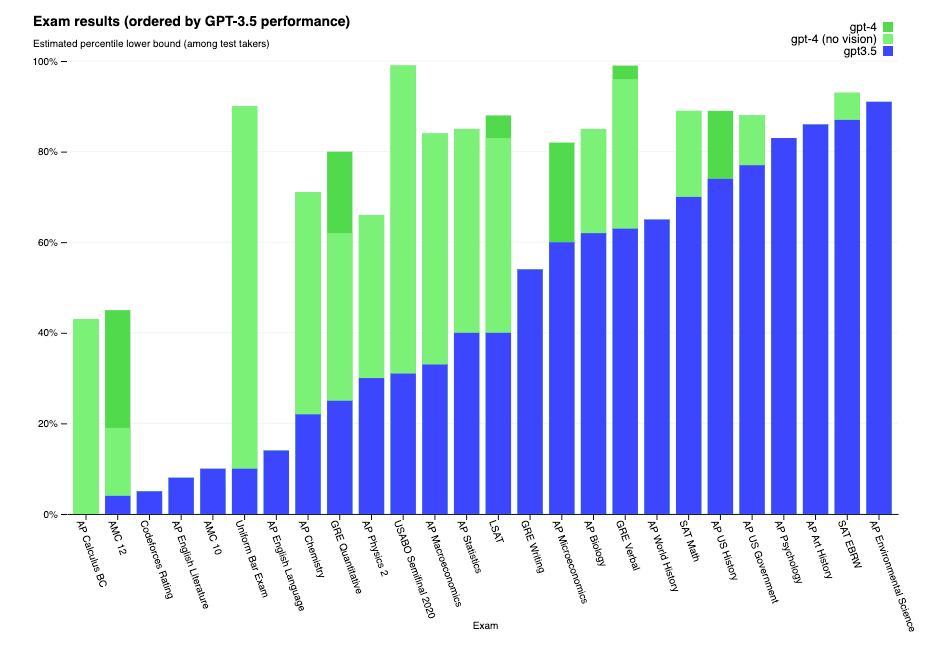
Hence, it comes as no surprise that, not three months since ChatGPT’s release, Edward Tian, an undergraduate student at Princeton University, created GPTZero, a bot to detect a text written by ChatGPT (Bowman, 2023). Similarly, Eric Mitchell, a graduate student at Stanford University, is working on DetectGPT, yet another means to distinguish between human and large language model (LLM)-generated text (Mitchell et al., 2023).
In effect, many of the metrics that society at large measures academic performance can be gamed by AI. Like essay assessments that require no oversight at the time of writing. But there has always been a case to mitigate academic misconduct, even before AI: “In the past, students could hire a ghost writer through widely available and easily accessible essay mills to write an assignment. Now with ChatGPT, they can instruct artificial intelligence (AI) instead of a person, at no cost…” (Harte et al, 2023). The qualifying difference is the ease with which students may now cheat.
Interestingly, the one area in which GPT-4 has performed less admirably is the skill of writing. It showed no significant improvement from the last two versions for AP English Language, Literature, and the writing portion of the GRE (Open AI, 2023). Consequently, one must distinguish between subjects wherein equal weight is put on a text’s content and the quality of the writing itself. One can argue that assessment standards should be modified to require the high clarity, concision, and eloquence that is often demanded of students studying subjects like creative writing, literature, or philosophy. Or else, the mode of assessment be modified, or a reliable means of detecting AI-written text made widely available.
In early 2023, The New York Times published an article wherein more than 30 professors, students, and university administrators were interviewed on how to adopt to ChatGPT. Together, they outlined three ways to address the issue: require a higher standard of writing, modify assessment, and create a detector for AI-written text. One professor claimed that the “imagination, creativity, and innovation of analysis that we usually deem an A paper needs to be trickling down into the B-range papers.” Another professor now requires students to write their first drafts in the classroom. Lastly, the article underlines how more than 6,000 professors from Harvard University, among other tertiary institutions, have signed up for Edward Tian’s GPTZero (Huang, 2023).
In any case, one thing is clear: the real conundrum is the ease with which students will willingly use ChatGPT for their academic assessments. Indeed, therein lies the potential of AI to either be beneficial or detrimental. If a student can save time, effort, and learn better with ChatGPT, then academia is better served by ensuring that students are more inclined to use it without forgoing academic integrity; to act based on an intrinsic preservation of integrity, rather than the avoidance of negative extrinsic repercussions of misconduct. And certainly, the uses of AI to improve academic practice are abundant, from providing a personalized learning experience to helping students brainstorm ideas to curating relevant resources (Hamdan, 2023).
Considering the dilemmas ChatGPT raises about academic integrity, it is prime time to refocus on a core issue that predates AI: the perception on the necessity of learning to write well. In 2002, Petelin coined the terms, “working writers and writing worker to distinguish between professionally trained writers (career writers) and those who are not necessarily trained as professional writers but whose jobs require them to write.” The former refers to journalists, playwrights, poets, etc. While the latter refers to lawyers, managers, engineers, architects, etc. (Petelin, 2022). The perception is that certain occupations require less training in writing, and indeed, not every individual must aim to write to the degree that career writers do. After all, a medical student is better prepared by spending more time on the sciences.
However, instilling students with the desire to learn writing beyond the requisite level to pass their courses is an investment that is unquestionably worthwhile. As Oscar Wilde once said, “If you cannot write well, you cannot think well; if you cannot think well, others will do your thinking for you.” Likewise, Joan Didion, a celebrated American writer mirrored this sentiment: “Had I been blessed with even limited access to my own mind, there would have been no reason to write.” While Stephen King notes that “writing is refined thinking” (King, 2000). These writers, whether they knew it at the time or not, were talking about the writing-thinking-learning connection, a relationship that language scholars have long since studied. Essentially, writing about something allows one to understand and learn it better, thus exploiting the connection between the three acts (Petelin, 2022).
Moreover, research shows a high correlation between writing and speaking. A study done in 2022 revealed that “student achievement in learning writing skills can predict achievement in learning speaking skills, and vice versa. If a student has good writing skills, it is almost certain that he will have good speaking skills as well” (Rahman et al, 2022). And speaking well is indubitably beneficial across different careers. Furthermore, a meta-analysis on the effects of writing on learning in science, social studies, and mathematics concluded that teachers in these subjects “can reasonably expect that asking their students to write about content material will enhance learning” (Graham et al, 2020). Not to mention the capacity of writing to be therapeutic and beneficial for mental health (Bergqvist et al, 2020). Value is found in the act of writing itself, exclusive of the output produced; value that is forgone by heavily relying on AI.
To effectively capitalize on AI while preserving academic integrity, intervention can be divided into two categories: changing academic practices and student attitudes toward the importance of writing well. For the former, we have the tactics outlined by professors, like modifying assessments and creating GPTZero. While the latter category requires a stronger push. But combined, the two interventions provide intrinsic and extrinsic motivation and are thus a better way forward for students and academic institutions alike.
But what does changing student attitudes toward writing well look like? As it stands, the way that we teach students to write differs too much across disciplines, and some students inherently find the act of writing cumbersome. Instead of an enjoyable, empowering, and powerful skill for any career – “Its importance in organisations often goes unnoticed until there’s a document-related crisis” (Petelin, 2022). Furthermore, in most “Australian and British universities, writing is under-taught, under-valued, and under-researched” (Petelin, 2022). In contrast to American universities, where there is a long and strong tradition of rhetoric at the undergraduate level (Petelin, 2022).
Good rhetoric and composition speak for themselves. Often, the challenge is exposure to quality writing that inspires; to strings of words that entice not only with their content but with an eloquence that arrests. Sentences that speak not only about desire, but is desire embodied—obsessively, incessantly, and with a maddening hunger whose tendrils worm their way into a reader’s mind. No. The kind of writing found in required texts for subjects outside of the arts and humanities is far too often dry. Texts that read more like an instruction manual than anything else. How often do people read the instruction manual? Only when the table, despite all the tinkering, cannot be trusted to hold itself together. Now, perhaps the last couple of sentences sparked in you a defiance, a sort of stubbornness that proclaims: I always read the instruction manual! Or, most plausibly: not all writing needs to be creative writing! Indeed. I concur.
But all writing can benefit from amelioration. At the time of Dr. King’s illustrious I Have a Dream speech, he was scarcely the only man who dreamt of the “unalienable rights of life, liberty, and the pursuit of happiness for all men” (King, 1963). But he was one of the most eloquent. And while eloquence by itself does not a great leader make, it is a common denominator. From Dr. King to former president Barack Obama and to Professor Richard Feynman, notable not only for his contribution to physics but also for his ability to teach well.
Ergo, a solution might be to initiate introductory classes on literature and composition for academic departments like the hard sciences, healthcare, and business; make the skill more accessible. In this way, students learn early the supremacy of good writing, heightening the likelihood that they willingly invest time in the craft. Despite the presence of technologies that can write for them. Or else, more universities could adopt the practice of many American universities, where students must take classes on rhetoric and composition. Regardless of their chosen major (Petelin, 2022). If done correctly, swiftly, and universally, AI may very well bring about a resurgence in the art of rhetoric and composition—to the benefit of society at large.