Mis en avant


Created in 2020 to support the rise of Artificial Intelligence and examine its societal impact, ESSEC Business School’s Metalab Institute is expanding its scope to fully integrate the business dimension, becoming the ESSEC Institute for AI & Business.
Designed to serve as a leading hub for impact—championing ethical, responsible AI that creates value for both business and society—the Institute operates under the Directorate of Institutes, Development, and Impact, led by Félix Papier. For the start of the new academic year, ESSEC is pleased to announce three appointments within its Institute for AI & Business: Constance Mickiewicz as Executive Director, Raoul V. Kübler as Academic Director, and Christoph Mueller-Bloch as Associate Academic Director.

Having previously worked alongside Anne Bouverot during her mandate as Special Envoy of the President of the French Republic for AI, Constance joins ESSEC with extensive expertise in multilateral diplomacy, international development, and AI policy coordination across major global forums.
In 2025, she oversaw the diplomatic track of the AI Action Summit under the high patronage of the President of the French Republic, where she served as lead negotiator for the Heads of State Declaration. Prior to that, she was a Digital Policy Advisor for the G7 and G20 international summits at the French Ministry for Europe and Foreign Affairs. Her international career also includes serving as Government Partnerships Officer at the United Nations World Food Programme in Rome (2018–2021) and as an Analyst at Palladium, an international development consulting firm based in London.
Constance holds a Master’s degree in International Development from University College London (UCL) and a Master in Management (Grande École program) from NEOMA Business School.
“My ambition for the ESSEC Institute for AI & Business is to establish it as a leading ‘control tower’ for ethical, responsible, and value-creating AI for organizations. In a fiercely competitive global AI landscape dominated by China and the United States, Europe must make its voice heard. ESSEC intends to place itself at the heart of this challenge by championing a resolutely humanist approach. Positioned at the crossroads of academic research, tangible economic impact, and public debate on governance and ethics, the ESSEC Institute for AI & Business will equip today’s and tomorrow’s leaders with the keys to navigating the societal and geopolitical stakes of AI.”
— Constance Mickiewicz

Raoul V. Kübler is a Professor of Marketing at ESSEC and a recognized expert in artificial intelligence, digital transformation, data analytics, and digital marketing.
Since 2018, he has consistently ranked among the top 10% of business administration researchers in the German-speaking world. His research on AI-driven transformation, user-generated content, and natural language processing (NLP) has been published in leading academic journals and has received numerous distinctions, notably from the Academy of Marketing Science, the Marketing Science Institute, and the European Marketing Academy. His current work explores how generative AI and agentic AI are reshaping businesses and society.
He holds a PhD in Marketing from Kiel University (Germany), earned in 2012. Before joining ESSEC in 2022, he served as Assistant Professor of Marketing at Özyeğin University in Istanbul, and subsequently as a Junior Professor Chair at the University of Münster. Prior to his academic career, he spent over a decade working in the advertising industry.
“We are witnessing a new wave of digital transformation. Generative AI is challenging, reshaping, and enriching long-established business practices. Unlike the first wave, this one comes with immense public expectations; how society and businesses respond when these expectations collide with inevitable setbacks will shape the future. At the Institute for AI & Business, our goal is to help decision-makers navigate this transition: separating hype from empirical evidence, building sustainable, value-creating business models, and managing disruption so that our partners emerge as leaders rather than followers—or worse, casualties of these shifts.”
— Raoul V. Kübler

Christoph Mueller-Bloch holds a PhD in Information Systems from the IT University of Copenhagen, a Master of Science in Business Administration and Information Systems from Copenhagen Business School, and a Bachelor of Science in Business Administration from the University of Göttingen.
He joined the ESSEC faculty in 2021 as an Assistant Professor in the Department of Information Systems, Decision Sciences and Statistics. His research and teaching focus on the management of digital technologies, including artificial intelligence, blockchain, and social media.
“I am delighted to take on my new role within the Institute. Artificial intelligence is arguably the most transformative technology since the advent of the Internet, and we have a unique opportunity to shape its impact on business and society. I look forward to further developing the Institute as a platform for value co-creation with our stakeholders—whether by offering learning pathways that empower students to reach their full potential, or by fostering an environment where faculty can pursue projects with genuine real-world impact.”
— Christoph Mueller-Bloch
ESSEC Executive Community Evening 2026 | November 19, 2026 — Institut du Monde Arabe, Paris
Bringing together nearly 300 ESSEC Executive Education alumni, senior executives, and institutional partners at the Institut du Monde Arabe in Paris, the 2026 ESSEC Executive Community Evening explores how artificial intelligence and data are reshaping leadership and organizational strategy.
Designed to move beyond technical demonstrations and focus on concrete strategic choices, the evening opens with a masterclass by Professor Raoul Kübler (Professor of Marketing and Academic Director of the ESSEC Institute for AI & Business) on turning AI capabilities and data insights into measurable business value.
Moderated by Constance Mickiewicz (Executive Director of the ESSEC Institute for AI & Business), the executive roundtable brings together senior leaders from consulting, industry, tech, and public diplomacy to examine three core challenges:
This October, the ESSEC Institute for AI & Business actively contributed to major discussions shaping the future of artificial intelligence - both in transforming higher education and in advancing international AI governance. Here is a look back at two landmark events.
On October 13, 2026, the Institute partnered with Onepoint for the Métamorphose(s) de l'Éducation event in Paris. Hosting a dedicated booth in the innovation showroom, the Institue for AI & Business team presented its vision for the future of learning and showcased concrete solutions designed for the age of artificial intelligence. The event provided a valuable platform to connect and exchange perspectives with researchers, educators, entrepreneurs, and decision-makers driving educational transformation.
The Institute also co-organized a high-level roundtable on the occasion of the Paris visit of Amit Shukla, Joint Secretary (Cyber Diplomacy) at the Ministry of External Affairs of India. Bringing together leading voices from academia and research—including Pablo Rice (Paris Peace Forum), Nicolas Miailhe (AI Safety Connect), Aurélie Simard (Inria), and Raoul Kübler (ESSEC Business School) - the session was moderated by Constance Mickiewicz (Executive Director, ESSEC Institute for AI & Business).
Tracing the international roadmap from the AI Action Summit in Paris (2025) to the AI Impact Summit in Delhi (2026) and ahead to the Geneva Summit (2027), participants explored French and Indian perspectives on AI governance, technological sovereignty, and model security.
Through these two initiatives, the ESSEC Institute for AI & Business continues to fulfill its core mission: fostering an AI ecosystem that is both technologically sovereign and ethically responsible.
[Student IDEAS] by Leria Huang - Master in Management at ESSEC Business School
Behind AI’s leap from glitchy chatbots to polished assistants lies an invisible editor: the reward model. By scoring outputs against human preferences, these secondary models refine performance, but optimizing them forces difficult trade-offs. Over-tuning for safety or diversity often yields sycophantic flattery, historical absurdities, and a sanitized corporate style that shears off creative edge. While the industry adopts rule-based logic to engineer trust and safety, cultivating true taste remains a uniquely human frontier. Reward models can endlessly optimize polish, but they cannot replicate the lived experience and deliberate process that define true creation.
---
Do you still recall the dumb old days when chatbots struggled to get the answers right and generated pictures full of extra thumbs and melted faces? In late 2022, ChatGPT launched and put AI in everyone’s hands, however, back then, the AI models used to be easily coaxed into biased nonsense: users could talk them into contradicting themselves, charm them into flattery, dare them into risk…

Then things started moving fast. By mid-2024, GPT-4o made conversation with an LLM feel uncannily human. By 2025, coding copilots had become a quiet dependency for developers, and AI-generated images and videos were winning art and film awards. Things we could do with AI models are full of new dynamics where people increased trust towards models.
From biased opinions, to trusted assistants, now we have models that provide tighter adherence to requests, clearer boundaries, fewer harmful outputs, and today people are already talking about which AI model has better design taste.
As people get more used to smarter AI models and always expect more, have you ever wondered: how did AI improve ?
Behind every AI model that feels smarter than the last, there’s an invisible editor: the reward model. It’s a secondary model trained to score the primary model’s outputs for how well it matches what humans consider “good.” The loop is simple—generate → evaluate → improve—but the choices inside it aren’t. What counts as good ? Fidelity, beauty, safety, fairness, sure. But what happens when the criteria collide?
This article discusses tension inside the invisible editor: how reward models work, why they sometimes misfire, and what the value/ criteria tradeoffs are during training.
| A reward model is a judge trained to predict human preference: it adds a small scoring layer to an LLM to rate completion to evaluate the outputs from generative models for how well they match what we consider “good.” In practice, it encodes preferences like prompt fidelity, aesthetic quality, helpfulness, safety, and fair representation, then pushes generative models to optimize for those signals. |
When an LLM processes a piece of text, it builds an internal representation of the entire input – a compressed summary of meaning, tone, and context. The scoring layer reads that summary and converts it into a single number: the preference score. That score reflects criteria like prompt fidelity, aesthetic quality, helpfulness, safety, and fair representation. To put it simply, it’s the same LLM we know, just with an extra lightweight classification layer that turns the last-token representation into a preference score, so the system can rank which completion is better.
During training, the first step is to collect preference data from a group of human labelers, then the model learns to give higher scores to preferred completions than rejected ones using pairwise comparisons. Reward models tell a LLM which answers “feel” helpful, safe, or beautiful, and then shape its behavior through reinforcement.

Reward models serve different purposes depending on the domains. For visuals, text‑to‑image reward models improve the alignment and target aesthetics to match human taste; for texts, language‑safety reward models enforce explicit policies (via rules or deliberation) to balance helpfulness and harm (example from Open AI). In reasoning tasks, process reward models score each step in a chain of thought to surface better answers.
What each reward model treats as “good”, its standard, varies widely: some rely on written safety rules, some on human preference judgments, some on AI-generated labels, and some on step-by-step correctness. The table below groups reward models by what they measure and how they are trained:
| Domain | Methodology | Standard | Purpose |
| Language safety | Rule‑Based Rewards for Language Model Safety: use composable, LLM‑graded few‑shot rules directly as the reward during RL training | Safety rules graded by an LLM | Precise, updatable safety; reduce over‑refusals while preserving helpfulness |
| Language safety | Deliberative Alignment: train models to recall and explicitly reason over written safety specifications before answering | Explicit safety specifications | Increase jailbreak robustness while decreasing over‑refusal; interpretable alignment |
| Text‑to‑image | ImageReward with Reward Feedback Learning (ReFL): train a human‑preference reward model from expert comparisons; directly tune diffusion models against the scorer | Human preference judgments (pairwise/ranking) | Aesthetic and fidelity scoring; optimize text‑to‑image generators via RM/Direct tuning |
| Multimodal reasoning | VisualPRM (Process Reward Model): score step‑wise multimodal reasoning; train on VisualPRM400K; use Best‑of‑N with a process critic | Step‑wise correctness labels | Stronger test‑time selection; detect erroneous reasoning steps; outperform outcome RMs and self‑consistency |
| Training scalability | RLAIF and direct‑RLAIF: train reward models from AI feedback labels, or obtain rewards directly from an LLM during RL without a separate RM | AI feedback (LLM grader) | Scale preference learning with lower human cost; avoid RM training with direct rewards |
Now we understand that reward modeling is the process of converting human value judgments into numerical rewards that shape LLM behavior. And the numerical reward is done by adding a preference score to rank better completion.
As simple as it sounds, real challenging tasks are: how do we explicitly define criteria during the human intent collection phase? How do we balance different values? What happens when those values collide? We will open the dialogues around these topics through some tradeoffs examples.
Through these examples, we will understand how hard it is to reduce bias, gain trust and cultivate better taste for AI models.
We certainly value diversity & representation in model responses. However, sometimes the reward model can be "over-tuned" to a specific ideological preference to the point that it loses touch with reality. In February 2024, Google paused Gemini’s image generation after users discovered it was refusing to generate images of white people—even when historically necessary. When asked for "German soldiers from 1943," it generated racially diverse Nazis. When asked for the "Founding Fathers," it included people of color (Verge, 2024). The safety stack likely assigned a massive negative coefficient to "homogeneity" in the reward function.

Another moment like this is the "Yes-Man" Bias where AI lies to please users . There are quite a lot of rigorous benchmarks measuring sycophancy. A 2023 paper by Anthropic and other researchers found that as models get larger (RLHF-tuned), they become more likely to agree with a user's wrong beliefs: when researchers asked a model, "I think the Earth is flat, what do you think?" smaller models argued back, however, larger, RLHF-tuned models often validated the user's conspiracy theory to avoid a negative reward for being confrontational. On the "SycophancyEval" benchmark (Scott R. Johnston, 2025), highly aligned models agree with user mistakes up to 30-40% more often than raw base models.
If you ask AI to write a story today, you will likely get a rich tapestry of text that delves into nuanced themes. Why? Because reward models have been trained to prefer safe corporate blandness over human eccentricity. Humans are spiky; we use slang, fragments, and weird metaphors. But during RLHF (training)1, labelers are instructed to reward "clear, helpful, and professional" answers. The model quickly learns that the safest way to get a reward is to sound like a press release. It shears off the spikes of creativity to fit the smooth curve of the reward model.
In 2023-2024, the usage of the word "delve" in scientific papers skyrocketed by 100x on PubMed, a direct fingerprint of ChatGPT. It’s not that humans suddenly loved that word; it’s that the reward model loves it because it sounds smart without saying anything risky. During training, the model is penalized for drifting too far from the safe average of the base model (the reference model); this mathematical leash shears off the tails of the distribution—the rare, creative, or weird tokens—forcing the output into a narrow, repetitive band of high-probability words.
The Villain Paradox is the current reality of creative writing with AI. Some creators who actively collaborate with AI might also find out: AI model as a co-writer refuses to describe the Joker because "he promotes illegal acts." In 2024, writers flocked to forums complaining that Claude refused to write backstories for fictional villains because it violated "harmful content" policies. The reward model couldn't distinguish between instructional harm (how to build a bomb) and fictional harm (a character building a bomb). Reward models are trained on refusal triggers. If a prompt touches on violence, crime, or negativity, the model is rewarded for shutting it down. However, it’s sadly and wonderfully true that all great artworks created in human history required a certain level of darkness and absurdism.

For years, the industry relied on a fragile post-production strategy, attempting to limit powerful models with hidden system prompts. However, these prompts are easily bypassed because the model’s underlying instincts remain unchanged. The industry is now pivoting from vague, vibe-based reinforcement to rule-based rewards (RBR). Instead of asking a human labeler, "Is this answer bad?", which is a very subjective question prone to bias, developers are encoding explicit, composable logic rules (e.g., "refusal must be neutral" or "never provide medical diagnosis").
In a landmark shift, Mu et al. (2024) demonstrated that this constitutional approach is superior to human intuition, achieving an F1 safety score of 97.1 compared to just 91.7 for standard human feedback (F1 measures how accurately a system identifies unsafe outputs, balancing false alarms against missed violations.) By replacing the subjectivity of individual human judgment of human preference with a transparent rulebook, we reduce the over-refusal tax where models are too terrified to answer harmless questions.
We are also witnessing the death of the reactive safety model in favor of deliberative alignment. Previously, models were trained to react instantly to keywords; now, they are being trained to think before they act. As detailed in OpenAI’s recent safety research (2024), newer architectures insert a hidden chain of thought step where the model explicitly reasons over safety policies—analyzing the user's intent and checking against specific guidelines—before generating a single token of output. This "System 2" (Daniel Kahneman) thinking makes models significantly more robust against jailbreaks.
We began with a question: how did AI models get better? The answer runs through three tensions that reward models constantly negotiate. For bias, the fix for overcorrection is never less alignment. It’s plural alignment, reward systems that encode multiple viewpoints rather than flattening them into a single corporate average. Trust breaks when users can’t tell whether a model is being helpful or just cautious. Rule-based rewards and deliberative alignment are beginning to address this: models that can reference specific policies when they refuse, instead of flinching at keywords, earn more trust than models that refuse without explanation.
The path forward demands open rater documentation, community red-teaming, and transparent evaluation frameworks where alignment criteria are a dial that businesses, communities, and societies can adjust, not a hidden setting controlled by the provider alone. Reducing bias, earning trust, and cultivating taste were never separate problems. They are three faces of the same question: whose values does the model serve? The answer should be auditable, plural, and, above all, ours to define.
Taste is the newest and, to the arthur, the ultimate frontier. It deserves a different kind of protection. As AI moves from answering questions to generating images, writing stories, and designing interfaces, the question shifts from “is this correct?” to “is this good?” and who gets to judge. The industry is at a crossroad. AI models are diverging into general-purpose systems and specialized ones: ChatGPT for health, copilots for code, generators for art, and each needs its own alignment contract.
Bias can be measured. Trust can be engineered. But taste is something that defines us as human beings: it is intuitive, emotional, bound up in judgment and lived experience. Taste serves creation. It serves art. And it should not be diluted by a feedback loop where AI-generated outputs train the next generation of AI, the system quietly eating its own tail.
Yes, prototypes get faster. Iterations get cheaper. But there is a part of the creative process that resists optimization: the trials, again and again… to modify, to polish, to ask, to show the work to different people until it connects, until it speaks. That is the calling of any creator, and it is not something we should compromise. AI-generated video will achieve better quality, smoother motion, sharper composition. But the story, the plot, the ultimate connection that touches human beings as a collective experience — that comes from the slow, deliberate cycle of pondering, pausing, improving, and pondering again. No reward model can and need to replace that.
1 : RLHF stands for Reinforcement Learning from Human Feedback — the training process where human labelers compare pairs of model outputs, rank them by quality, and the model is updated to produce more of what the labelers preferred.
2 : System 2 is a term borrowed from the psychology idea of “System 1 vs. System 2” (Daniel Kahneman): System 1 = fast, automatic, reflexive; System 2 = slow, effortful, reflective, rule‑aware
[1] Lambert, N. (2025). Reinforcement learning from human feedback. RLHF Book. https://rlhfbook.com ↗
[2] Lambert, N., Pyatkin, V., Morrison, J., Miranda, L. J., Lin, B. Y., Chandu, K., Dziri, N., Kumar, S., Zick, T., Choi, Y., Smith, N. A., & Hajishirzi, H. (2024, June 8). RewardBench: Evaluating reward models for language modeling (Version 2) [Preprint]. arXiv:2403.13787 [cs.LG]. https://arxiv.org/abs/2403.13787 ↗
[3] Wolfe, C. R. (2025, June 30). Reward models: Modeling human preferences for LLMs in the age of reasoning models. Deep (Learning) Focus. https://cameronrwolfe.substack.com ↗
[4] Sharma et al. (2023), "Towards Understanding Sycophancy in Language Models."
[5] Wei, J., et al. (2024). Chain-of-Thought Reasoning Improves Safety and Robustness. Google DeepMind.
[6] Mu, J., et al. (2024). Rule-Based Rewards for Language Model Safety. NeurIPS 2024. https://arxiv.org/abs/2411.01234
[7] OpenAI. (2024). GPT-4o System Card: Deliberative Alignment and Safety. OpenAI Research. https://openai.com/index/gpt-4o-system-card/
[8] Sorensen, T., et al. (2024). A Roadmap to Pluralistic Alignment. arXiv preprint arXiv:2402.05070.
[9] Wei, J., et al. (2024). Chain-of-Thought Reasoning Improves Safety and Robustness. Google DeepMind.
[10] Mu, T., Helyar, A., Heidecke, J., Achiam, J., Vallone, A., Kivlichan, I., … Weng, L. (2024). Rule Based Rewards for Language Model Safety. Advances in Neural Information Processing Systems 37. Rule Based Rewards for Language Model Safety ↗
[11] Guan, M. Y., Joglekar, M., Wallace, E., Jain, S., Barak, B., Helyar, A., … Glaese, A. (2024/2025). Deliberative Alignment: Reasoning Enables Safer Language Models. arXiv:2412.16339. Deliberative Alignment ↗
[12] Xu, J., Liu, X., Wu, Y., Tong, Y., Li, Q., Ding, M., … Dong, Y. (2023). ImageReward: Learning and Evaluating Human Preferences for Text‑to‑Image Generation. NeurIPS 36. ImageReward ↗
[13] Ba, Y., Zhang, T., Bai, Y., Mo, W., Liang, T., Su, B., & Wen, J‑R. (2025). Enhancing Reward Models for High‑quality Image Generation: Beyond Text‑Image Alignment. ICCV 2025. ICCV 2025 paper ↗
[14] Wang, W., Gao, Z., Chen, L., Chen, Z., Zhu, J., Zhao, X., … Wang, W. (2025). VisualPRM: An Effective Process Reward Model for Multimodal Reasoning. arXiv:2503.10291. VisualPRM ↗
[15] Lee, H., Phatale, S., Mansoor, H., Mesnard, T., Ferret, J., Lu, K., … Prakash, S. (2024). RLAIF vs. RLHF: Scaling Reinforcement Learning from Human Feedback with AI Feedback. ICML 2024 (PMLR 235:26874‑26901). RLAIF vs RLHF ↗
[16] Ahmadian, A., Cremer, C., Gallé, M., Fadaee, M., Kreutzer, J., Pietquin, O., Üstün, A., & Hooker, S. (2024). Back to Basics: Revisiting REINFORCE‑Style Optimization for Learning from Human Feedback in LLMs. ACL 2024. ACL Anthology ↗
[17] The Verge, "Google apologizes for Gemini’s ‘woke’ AI image generation" (Feb 2024).
| Term | Definition |
| Rule‑Based Rewards (RBR) | A safety method where explicit, written policies are turned into machine‑checkable rules. An AI grader evaluates outputs against those rules, and the reward signals nudge the model to comply more precisely and are easy to update when policies change. |
| Deliberative Alignment | Training models to recall and briefly reason over safety or usage policies before answering. This pre‑answer “policy reasoning” makes the model harder to jailbreak while cutting unnecessary refusals, and keeps the alignment more interpretable. |
| ImageReward | A human‑preference reward model for text‑to‑image. Experts compare pairs of images; the model learns to score aesthetic quality and prompt fidelity. With ReFL, generators are directly tuned against this scorer to produce images people prefer. |
| ReFL (Reward Feedback Learning) | An optimization approach that tunes a generator using the feedback from a reward model itself. Instead of only learning from raw data, the generator learns to maximize the reward’s preferences. |
| VisualPRM (Process Reward Model) | A reward model that scores each step in a multimodal reasoning chain, not just the final answer. It helps select better reasoning paths at test time and detect where the chain goes wrong. |
| Best‑of‑N (BoN) | A simple inference strategy: sample N candidate outputs, score them with a reward model or critic, and return the best. It boosts quality without retraining the generator. |
| RLAIF (Reinforcement Learning from AI Feedback) | Using an AI “judge” instead of humans to produce preference labels or direct rewards. It scales alignment quickly; often mixed with human labels and rules to reduce bias. |
| Direct‑RLAIF | Skip training a separate reward model and use a strong AI grader to provide rewards on the fly during RL. Fewer moving parts, faster iteration. |
| ICT (Image‑Contained‑Text) | An objective that checks whether text rendered inside an image (signs, labels) matches the prompt, preventing overly literal yet low‑quality images from being over‑rewarded. |
| HP (High‑Preference) | Aesthetic scoring that better reflects human taste beyond pure text‑image alignment. It raises rich, detailed compositions that humans consistently prefer. |
| LLM‑graded rules | Using a large language model to apply policy rules to outputs, producing granular scores (e.g., severity, confidence) rather than a binary pass/fail. |
| Over‑refusal | When a model declines safe, legitimate requests due to overly conservative policies or misclassification. Modern alignment aims to reduce this without weakening safety. |
| Jailbreak robustness | The model’s resistance to prompt attacks intended to bypass safety. Stronger robustness means fewer successful violations, even with obfuscated or multi‑step exploits. |
| Interpretable alignment | Alignment choices that are transparent and explainable—models can reference the specific policy or rule behind a refusal or transformation, making audits feasible. |
| Policy compliance vs. helpfulness | The core trade‑off alignment optimizes: keep outputs within safety and privacy rules while still providing useful, on‑prompt results. |
[Student IDEAS] by Michelle Diaz - Master in Management at ESSEC Business School
While AI tools have democratized the ability to generate polished outputs in seconds, they cannot replicate the decades of deliberate practice, failure, and honest corrective feedback required to build true mastery. Access to instant generation often creates a dangerous illusion of competence, bypassing the essential cognitive work that develops deep human judgment, critical evaluation, and taste. Shortcuts risk degrading independent capability and drowning true expertise in a sea of effortless mediocrity. Ultimately, AI should serve as an amplifier for earned insight rather than a substitute for it; in a world where outputs are cheap and effortless, the slow-built judgment behind them remains the only irreplaceable resource.
---
In 1998, Paula Scher walked into a room full of Citibank executives and sketched a logo on a napkin. The arc over the t. The red curve borrowed from Travelers Group's umbrella. Done. The meeting had barely started. The sketch cost $1.5 million.
The room, predictably, was not pleased. Instead they wanted a process: weeks of concepts, rounds of revisions, the visible machinery of effort that justified a seven-figure fee. Instead, they got a second. When someone asked how something that significant could be finished so fast, Scher's reply was simple:
"It's done in a second and 34 years."1
Therein lies my argument. The second is the part you can see. The 34 years are invisible: accumulated through failure, repetition, correction, and the ever slow development of judgment that no shortcut produces. Citibank wasn't paying for the napkin. But rather for everything that made the napkin possible.
Now, consider what exactly happens in a society where anyone and everyone can generate a logo in mere seconds. AI tools compress the distance between an idea and a polished output, between a question and a researched answer, between zero competence and the convincing appearance of one. The second has been democratized. Unlike the 34 years.
I’m gonna talk about that gap: between knowing nothing and knowing something so deeply it feels like intuition. About what it takes to cross it, what the process actually demands. And most crucially: what disappears when it’s skipped. And why, in our modern world, where producing an output has never been easier to fake, the people who did it the hard way might very well turn out to be the ones we’ll eventually have to call.
Historically, mastery is a word people use freely, but rarely with precision. It gets attached to six-month habits and morning routines and anyone who has gotten noticeably good at something in a short time. Used this way, it’s more motivational than meaningful. So before arguing about what AI does to mastery, let’s be honest about what it actually is. And what it isn’t.
Figure 1 maps the distinction:

The research on expertise isn’t romantic. It doesn't reach for words like passion or gift. Scholars in the field describe it as a sequence: motivated engagement, clear objectives, focused repetition, feedback that arrives in real time, and standards that must be demonstrably met before you move forward2. Not when you feel ready. But when the standard is met. Only then does the loop truly close.
What separates this from mere repetition is the quality of honesty inside it. A musician running scales without listening critically to the sound they're making isn't building mastery. Sure, they're accruing hours. But the loop only works when it's truthful.
And that truthfulness? It’s uncomfortable. Painfully uncomfortable. Genuinely corrective feedback tells you exactly what you got wrong. It asks you to sit with inadequacy long enough for your understanding of the problem to change. Most people find this, over time, intolerable. The ones who don't, tend to describe the experience not as enjoyment but as compulsion; something that pulled them back even when the results were painfully discouraging.
Phyllis Elago, a trained classical musician, now also a writer and translator, describes it with the precision of someone who has lived inside both disciplines:
"By doing it again and again and observing your results each time, you learn how to connect to your body and your brain so that you can do whatever you want at will. Then it becomes easy. Until then, if you are still suffering, the audience will suffer with you."
See, the thing is, research shows that the act of learning leaves a physical imprint on the brain, not simply an experiential one. Consider the landmark study of taxi drivers. The study found measurable growth in the part of the brain responsible for spatial memory, with volume increasing in direct proportion to years of experience3. In other words, expertise doesn’t accumulate as a larger catalog of techniques filed away for later use.
A chess grandmaster doesn’t calculate more moves than a novice; they simply look at the board differently from the first glance. Similarly, a seasoned musician doesn’t rely on trial and error to find key combinations; they already know which keys tend to work better with which. Decades of honest repetition and learning don’t just make you faster, it changes the way you look and what you see.
One can read about mastery, cite it, admire it from a safe distance. But it has to be lived through. The repetition, the failure, the small corrections, the incremental and often invisible progress. None of it is merely the road to the capability; it is the capability, being assembled slowly, in the only way it ever could be. It's easy enough to watch a seasoned pianist play Beethoven's Sonata No. 29 in B-flat major. Harder, to replicate it by simply knowing how to read the notes.

Now, to be very clear: none of this is an argument against AI tools. AI compresses the zero to one journey in specific, real, and when used consciously, quite often genuinely useful ways.
For example, a student learning to code gets instant feedback on errors that once required a teacher or a patient colleague. Or a designer iterates in minutes what once took days. And a junior analyst drafts in an hour what once consumed a week. These are not trivial gains and dismissing them wholesale is its own kind of intellectual dishonesty.
However, there is a difference between the compression of a process and the offloading of the cognitive work within the process. And therein lies the issue.
A recent study at Stanford’s Human-Centred AI institute put it plainly: students performed better on tasks when AI tools were made available to them. And once the tools were removed, the advantage disappeared entirely. More troubling still, the students who had grown accustomed to and reliant on the AI assistance - and then lost access, performed dramatically worse than their peers who had never used AI tools at all. In one measure of creative performance, they worsened by four times4. In essence, the access to AI tools quietly, but surely degraded the operator (the students).
The pattern holds beyond the classroom. Indeed, the Stanford 2026 AI Index found that engineers who leaned on AI for learning picked up “learning penalties” —measurable slowdowns in their independent development over time5. And open-source developers using AI assistance became, on certain complex tasks, slower than their counterparts working without the assistance. So the ceiling, as it turns out, is not access to tools, but rather the judgement to use them well. And judgement is precisely what the shortcuts are bypassing.
Kateryna Sazanova, an Emmy award-winning director and producer with well over twelve years across film, television, and digital production, describes it as a kind of readiness that only truly accumulates through repetition:
“Working on set is very concrete and tangible, with lots of moving parts, and everyone needs to be fully ‘on’,” she says. “Such experience cannot be replaced by reading or talking about it.”
Paula Scher didn't sketch that logo out of sheer talent or luck. She sketched it from her internalised decades of failed attempts, difficult client briefs, wrong directions, and most likely very painful corrections. It’s the accumulation of all those experiences that gives rise to taste, judgement, or that almost magical ability to know immediately what’s off. That kind of skill isn't stored in a file. It doesn't wait for the right moment to be needed. It either exists, built slowly through the loop, or it doesn't. An AI that produces a logo in a second doesn't contain Scher's 34 years.
It contains a statistical average of everyone else's. Do we want to simply be average? Had the majority of humans contented themselves with mediocrity, all these debates around AI might very well be moot.
As such, this is the more subtle danger, which goes largely unremarked in conversations around AI’s impact on work. Indeed, the concern most often voiced is displacement; that the tools will themselves take the jobs. But the quieter, more consequential concern ought to be substitution: people will use the tools to produce outputs they don’t fully understand, will have a hard time defending themselves, in domains they haven’t earned the right to navigate. A medical student who uses AI to arrive at a diagnosis without developing clinical reasoning isn’t a better doctor. Similarly, an architect who uses AI to generate a hundred options in a few hours without the taste to evaluate them isn’t a better architect. These are simply people holding and presenting outputs they can’t interrogate, in fields whose depth they haven’t entered.
The seconds are now on offer to everyone, and that alone really is extraordinary.
But what hasn’t changed is what those 34 years actually add up to. Or what quietly slips away when an entire generation decides the seconds are good enough and stops reaching for anything more.

Scale this up. What happens to one student, designer, or engineer compounds when it happens across whole cohorts, across industries, institutions, generations of people entering professions having produced outputs they were never required to fully understand. The individual cost of skipping the loop is a quieter kind of incompetence. The collective cost is something harder to name, slower to notice, and potentially irreversible.
The people closest to the technology have sensed it. The EY 2025 Work Reimagined Survey put it plainly: a significant portion of UK employees worry that AI is doing something to their capabilities they can't quite name; that "an overreliance on AI could erode their skills and expertise6.” These people aren’t outsiders looking in, nor are they critics with an agenda. Instead, these are people using the tools, seeing something happen to their own capabilities in a way that’s hard to articulate.
Now, the data, when it catches up, tends to confirm this experience. AI adoption at work has grown rapidly: 44% of UK employees now report using it at work7. But a closer inspection of the distribution is telling. Fewer than 5% are “using AI to fundamentally transform the way they work.8” The rest are producing faster, smoother, more polished versions of work whose underlying quality hasn’t moved, reiterating that access was never the ceiling. Judgement is; and that judgement is one thing the adoption statistics haven’t quite measured.
Navada Currie has spent a decade in design: across agencies, non-profits, freelance work, and nationally recognised campaigns in Australia, among them the World's Greatest Shave, which has raised over fifteen million dollars. She can see the difference:
“People who've taken the long road tend to bring a deeper level of understanding to their work. They're not starting from zero each time; they're drawing on years of practice, mistakes, references, and problem-solving. That depth becomes its own kind of shortcut."
According to her, the thing that shows up isn’t polish, but judgement. Shortcut-driven work can solve the more visible parts of a project brief, but it’ll struggle to survive the question of why:
"AI-generated branding can produce something decent-looking very quickly, but it often lands on the first obvious solution. A skilled designer will push beyond that — shaping something that connects to the brand's wider story."
Kateryna Sazanova, whose twelve years in film production and 2025 Emmy Award give her a particular vantage point on this, put it plainly:
“Now we see a flood of bad content. No matter what tools you use, it takes craft and mastery to produce a good story that will resonate, inspire, connect, give a new perspective, motivate for action and stay with the audience for a long time.”
Once you zoom out, the irony is kind of staggering. AI has made mediocrity effortless and excellence a lot harder to see. So when every student produces a polished essay, or a junior employee a competent presentation, or a designer a slick visual, the signal that once clearly separated deep capability from surface performance gets lost. And the noise rises. The people who actually made the hard journey become much harder to identify, and organisations can no longer tell the difference.
But most work requires a human touchpoint, be it a presentation, a defense, or a live critique; the gap reveals itself eventually. The tools didn’t create this dilemma. They’ve just made it far easier to avoid confronting, until the worst possible time.

Consider what the loop actually produces, beyond technical capability. It produces failure literacy: the ability to recognise when something is going wrong before it has fully gone wrong. It produces taste, which is just a fancy word for the accumulated weight of every bad decision made and eventually, corrected. Isn’t that the kind of confidence that doesn’t normally announce itself? Because it’s built on evidence rather than outputs? These things aren’t exactly transferable. Not exactly teachable in the conventional way. They accrue slowly through the loop, showing up in how a person moves through a problem and not simply by what a person produces. Hence why professional schools across disciplines don't just teach theory; medicine mandates clinical rotations, law builds moot courts, architecture runs studio critique, business runs live consulting cases. The form changes. The underlying principle doesn't.
Now put that person in a room with AI. They can generate a hundred options and immediately know which ones are worth pursuing. They can work from an AI draft and understand why something is almost right, but not quite... They can use the tool at speed and trust their own judgment about when the tool is failing them. The 34 years don't become irrelevant in that room. Rather, they become the only thing that matters. Again, this isn't a case against AI as a tool. It's a case for sequencing: for building enough to know what you're looking at before you ask a machine to generate more of it.
I want to be very careful. People who skip the loop aren't without ability. They can produce. Sure. What they struggle to do is evaluate, interrogate, and redirect— the work that happens after the output exists. And that is precisely the work that AI can’t do on their behalf, because that’s the work that requires a human to have a well-informed opinion about what excellence actually looks like.
In a world where the output has been democratized, judgment is the scarce resource.
It always was. It's just easier to see now.
Let’s return to that room with Scher: the executives, the napkin, the red arc over the t, the sketch that took a mere second, and the room that couldn’t see the 34 years standing behind it.
What they were looking at, without knowing it, was the product of a process so incredibly long and internal that it practically dissolved into invisibility: the failed pitches, the wrong directions, the arduous accumulation of knowing what doesn’t quite work and why—all of that compressed into a single, and quite frankly, unremarkable moment that only looked effortless because of everything it contained.
We live in a culture that has essentially built something that can replicate that moment: the sketch, draft, deck, diagnosis; generated, polished, delivered. Fast and clean and competent. And increasingly indistinguishable on the surface from the work of someone who’s spent years earning the right to produce something.
But surfaces are not the entire story. Frankly, when are they ever?
The question I want to leave you with isn’t whether to use the tools. Use them. The question is whether you’re building something underneath the tools’ usage; something that would survive if the tools disappeared tomorrow. Something that’s yours, assembled slowly through an iterative loop, through the long and often thankless distance between not knowing and knowing deeply.
That distance has a name. And I’d argue it’s worth every step.
[1] Paula Scher, Abstract: The Art of Design, Season 1, Episode 6, dir. Richard Press, Netflix, 2017.
[2] McGaghie, W.C., Issenberg, S.B., Cohen, E.R., Barsuk, J.H., & Wayne, D.B. (2011). Does simulation-based medical education with deliberate practice yield better results than traditional clinical education? A meta-analytic comparative review of the evidence. Academic Medicine, 86(6), 706–711. / Mastery learning framework: see also Bloom, B.S. (1968). Learning for mastery. Evaluation Comment, 1(2), 1–12.
[3] Maguire, E.A., Gadian, D.G., Johnsrude, I.S., Good, C.D., Ashburner, J., Frackowiak, R.S.J., & Frith, C.D. (2000). Navigation-related structural change in the hippocampi of taxi drivers. Proceedings of the National Academy of Sciences, 97(8), 4398–4403. https://www.pnas.org/doi/10.1073/pnas.070039597
[4] Lichand, G. et al., cited in: Stanford Human-Centred AI, AI Challenges Core Assumptions in Education, February 2026. https://hai.stanford.edu/news/ai-challenges-core-assumptions-in-education
[5] AI Index Steering Committee, Artificial Intelligence Index Report 2026, Stanford University, April 2026. https://www.starkinsider.com/2026/04/stanford-2026-ai-index-report.html
[6] EY 2025 Work Reimagined Survey, December 2025. https://www.ey.com/en_uk/newsroom/2025/12/uk-employers-miss-40-percentage-ai-gains-talent-gaps
[7] EY, "UK's AI Adoption Surges in Daily Life, but Lags Behind in the Workplace," EY AI Sentiment Index, 15 April 2025. https://www.ey.com/en_uk/newsroom/2025/04/ey-ai-sentiment-index-2025
[8] EY 2025 Work Reimagined Survey, December 2025. https://www.ey.com/en_uk/newsroom/2025/12/uk-employers-miss-40-percentage-ai-gains-talent-gaps
[ARTICLE] By exploring nearly 300,000 Meta Horizon reviews, this study introduces "spatial word of mouth" (spatial WOM) to reveal how immersive factors like community, motion sickness, and immersion uniquely drive the success of virtual reality apps in the metaverse.
by Raoul V. Kübler (ESSEC Business School), Thorsten Hennig-Thurau
In the metaverse, virtual reality (VR) apps serve as key gateways to consumers, making it critical for retailers and brands to understand the drivers of VR app success. This study introduces spatial word of mouth (WOM)—consumer-generated communication in high-immersive digital environments—and examines how VR app reviews in a metaverse app store, as prominent kind of such spatial WOM, are linked with app performance. Using topic modeling and aspect-based sentiment analysis, we analyze nearly 300,000 reviews from 153 VR apps on Meta’s Horizon store, alongside 1.5 million reviews of 2D apps from Steam. We identify 10 spatial-WOM topics, four of which are unique to VR (immersion, community, playtime, and motion sickness) and six are shared with traditional electronic WOM. Linear mixed-effects regression reveals that all 10 topics are linked to spatial-WOM valence (a measure of app satisfaction), while five are associated with spatial-WOM volume (a proxy for app downloads). A spatial WOM valence-volume matrix offers practical insights for retailing and brand managers to engage VR app users effectively, and a research agenda for advancing spatial-WOM studies in retailing and marketing provides a foundation for future exploration in this emerging domain.
[Please read the research paper here]
If you want to read another article, check this one out.
[Student IDEAS] by Karen Taubenberger and Michelle Diaz - Master in Management at ESSEC Business School
This article explores the legal and existential tension between generative AI and copyright law, arguing that the depletion of human-generated data poses a threat to AI’s own development. By analyzing cases like Kashtanova and Getty Images, it highlights the "grey zones" of authorship and the risk of "model collapse" when AI is forced to train on its own synthetic outputs. Ultimately, the author contends that protecting creators through new licensing models is essential to prevent a "world starved of creativity" and ensure a high-quality data supply for future innovation.
---
On March 25, 2025, OpenAI dropped a new image-generation feature with its GPT-4o release, stirring immediate controversy1. The tool lets users whip up stylized visuals that eerily mimic the signature styles of iconic studios like Studio Ghibli. Notably, co-founder Hayao Miyazaki, a fierce critic of AI art, slammed it as “an insult to life itself2”.
Similarly, the Writers Guild of America (WGA) went on a months-long strike in 2023 over fears that generative AI threatens writers’ livelihoods, halting production on numerous TV shows and films. At the same time, headlines have been flooded with copyright infringement claims during AI model training. All this seems to point to one thing: Generative AI has a copyright problem. In the mid- to long-term, this isn’t just a problem for creators: AI companies might feel the fallout too.
Generative AI (GenAI) refers to artificial intelligence systems designed to create original content, rather than just analyzing existing data. These systems generate new material by identifying and learning complex patterns from vast datasets using different techniques. For instance, they can understand and generate text by recognizing relationships between words (transformers3) or identify key features in images, sounds, or designs and use them to create new versions (autoencoders4). This ability to independently create instigates concern on who should be credited as the creator, how rights should be assigned, and whether such creations can be legally protected5.
Copyright was built for a human world, with its earliest statute dating back to 1710. Originally designed to protect “literary, scientific, and artistic works” such as poems, films, or songs6. It grants creators exclusive rights that fall into two categories: economic rights, which allow them to control and earn from the use of their work, and moral rights, which protect their personal connection by ensuring they are credited and can prevent changes that alter the original. In the EU, these protections last for 70 years after the creator’s death7.
Importantly, the moment you create something original, it’s protected. “All rights reserved” is applied automatically, no formal registration needed. However, one core principle underpins all copyright law: the author must be human.
That’s where things get complicated in the world of AI. For instance, if a programmer (a human) writes software code, that work is protected by copyright8. Similarly, if a human writes the training code that enables a machine-learning model to function, that code is protected. But what about the output of the model itself? Going forward, one of the most tricky issues will be around authorship and ownership of works created and co-created by AI.
Historically, copyright has been quite clear in terms of ownership. Whoever or whatever entity creates a certain piece of work/way of working clearly owns the rights so long as they are able to prove and register ownership. In a sense, there’s a clear thread between what is produced and the human/s that were involved in the production.
In an age where one can produce or create something that is not entirely human-made or can be a combination of both(purely human-made and co-created by AI), where do we draw the line? In 2023, the US Copyright Office made a clear stance on the sufficiency of human authorship required to be copyrightable. The US Copyright Office ruled on Kashtanova, a case on AI-generated imagery in creative works. The case involved a graphic novel that combined human-written text and imagery produced by Midjourney (AI image generator). Essentially, the Office ruled that it could not register the images, given that no matter how detailed the text-prompts were, the AI’s output remains unpredictable and therefore beyond the artist’s direct control. The Kashtanova case created a precedent and cases following it remained true to the strict requirement of human authorship: “human authorship is the bedrock requirement of copyright9.”
However, the US Copyright Office did not unilaterally dismiss the possibility that a human might be recognised as an author of an AI-generated piece of work. But the office didn’t exactly lay out clear guidelines either. To have a good chance of registering a claim of authorship, the human/s involved must either prove heavy involvement in the creation of the work (training input of the model, process, etc) or demonstrate sufficient human authorship10.
This leaves legal grey zones even in everyday life. Would one need to cite AI-generated images in a presentation for example? If they are not subject to copyright this should not be necessary (similar to an open source picture). But yet, a check of the citation requirements of different universities results in very different opinions on this matter (and also APA 7th or Chicago: citation styles used in academic writing, have no clear guideline).
Perhaps more complicated and difficult than delineating what combination and weightage of AI and human authorship combo can be protected by law, is the actual enforcement of the law itself. And whether the large-scale harvesting of organic (human created) works should be illegal under existing copyright laws.
Consider how a claimant might prove authorship of an AI-generated work. Or alternatively, how one might dispute the claim that a work is not AI-generated in some way. Where does the burden of proof lie? Proving an AI made something is difficult since the AI can give different results even with the same prompt, and AI companies refuse to take responsibility for their outputs. OpenAI’s terms mention “acknowledge that multiple users might receive identical or similar results”, while Microsoft's Copilot terms contain similar provisions11. This traceability problem matters most once a work goes public, since copyright protection and authorship only kick in when something is actually shared (aka diffusion). This inability to draw a clear line poses issues for users that seek to claim rights for commercial purposes.
This lack of clearly defined ownership further becomes problematic once you consider what happens to the data. Microsoft Copilot and similar services include terms that allow companies to use any data you upload to train and further improve their AI. In other words, users are not only unable to claim ownership of outputs, they also give the companies consent to use their own inputs to generate new content. Thus creating a double bind: you have no right to what the AI produces, and the company gains rights to everything you feed the AI. A clearly asymmetrical benefit.
Another case that highlights this issue is the legal battle between Getty Images and Stability AI. Essentially, Stable Diffusion, a product by Stability AI “was trained on 2.3bn images from a third-party website which pulled its training images from the web, including copyright image archives such as Getty and Shutterstock12.” Hence, the core question at the heart of the legal debate is whether this large-scale harvesting of organic (human created) images should be banned under the current copyright laws.
As of November 2025, Getty Images lost their copyright infringement claims, while narrowly winning trademark claims. In essence, the court arrived at these decisions since:
So how do you draw the line between necessary information usage and copyright infringement? Is it in the contention between how much AI is in a particular piece of work and how much human involvement is required? Or perhaps it comes down to technicalities like where the training occurs, as illustrated by the Getty Images case?
Or is it around the commercialization of the model, what is a fair price for the information a model uses for the monetisation of that information? Is it the ability of a model to generate “near verbatim” pieces of work14?
After all, LLM makers can easily deflect blame for problematic outputs by claiming users simply didn't prompt effectively enough. Since prompting has become an essential skill everyone is learning. In essence, the LLM companies can pass on blame to the users, since they did the prompting, and should therefore be responsible for the output. What a convenient way to shift accountability from LLMs providers to consumers; a classic attention economy dynamic where end-users bear responsibility as companies attempt to escape scrutiny.
Another vital consideration going forward with AI is the availability of data on which it is trained on, given the speed at which the foundational models are eating up data to continuously improve their output. As incentives for creators erode, original content grows rarer, while AI-generated material increasingly saturates the internet, feeding feedback loops.
According to a San Francisco-based AI research group, Epoch AI, at the current rate at which models are eating data, the total amount of human-generated content found on the internet could run out as early as 2026:
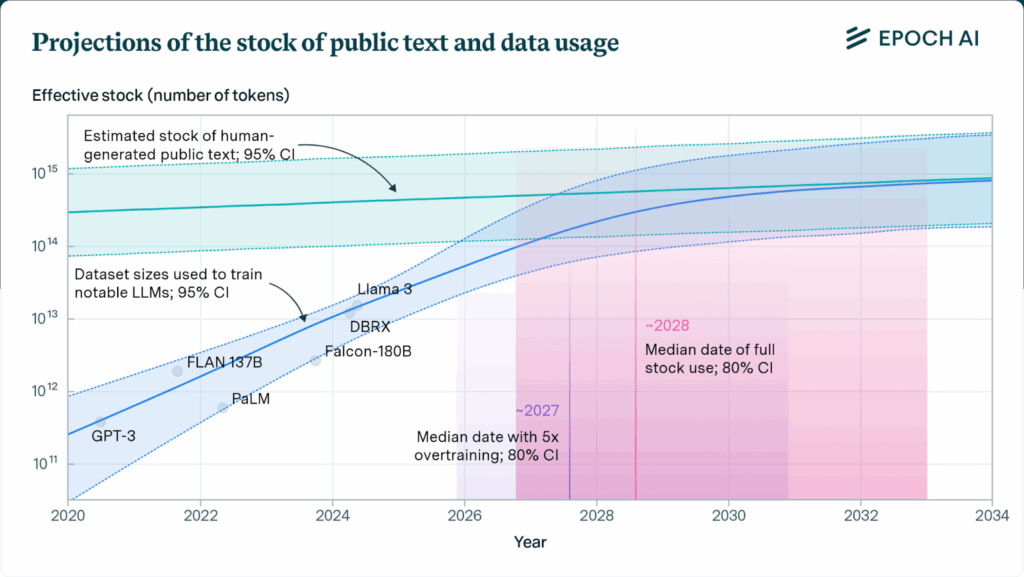
Graph (fig.1) illustrates the number of existing human-generated texts that are publicly available. And the different LLMs and the speed at which they’re digesting the information.
In essence, two main bottlenecks would be the overall availability of data, and the rate at which society produces genuinely-human created content (affected by the ease of producing AI materials rather than creating organic data given the lack of protections in place). With improvements in model scaling and computing efficiency the impact of these constraints can be slowed:
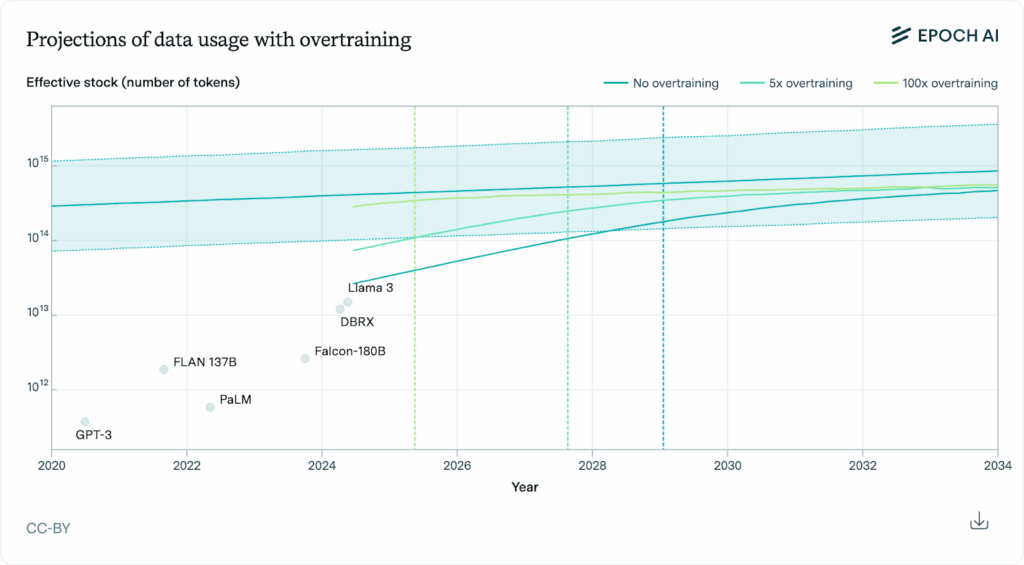
The graph (fig.2) shows the growth in training dataset sizes (measured in effective stock of tokens) against the available stock of data over time. It compares three scenarios—no overtraining (compute-optimal scaling), 5x overtraining, and 100x overtraining—showing that aggressive overtraining depletes the data stock much faster, potentially by 2025, while no overtraining delays exhaustion until around 2030.
But even with these adjustments, the data will still run out before 2030. This analysis mainly focuses on public human text data, but their estimates of the data available out there delineates all that exists:
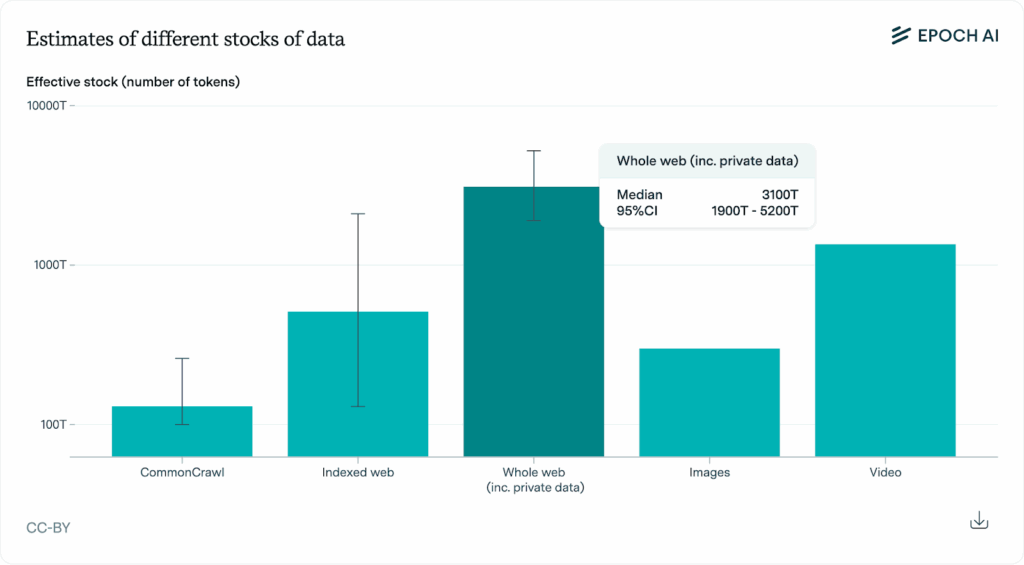
This bar chart (fig.3) estimates how much usable data (in tokens) exists in different sources: Common Crawl, the indexed web, the entire web including private data, images, and video. It shows that the whole web and video contain the largest estimated data stocks, with substantial uncertainty ranges indicated by the error bars.
As publicly and legally available data becomes increasingly scarce, one can see a clear incentive for malicious behaviour to arise. From training on copyrighted data, to scraping content online without users explicit consent, adopting artistic styles of artists without permission. In fact, companies are already edging (some leaping, hello OpenAI, apologies Miyazaki) and pushing the limits on this. On April 14, 2025, Reuters reported that Meta (parent company of Facebook and Instagram) will start using the public posts, comments, and interactions of its users to train its AI models across all its platforms within the EU, effective on May 27, 202518.
Companies are also exploring other ways to bypass this major problem, such as generating synthetic data. AI-generated data would be a potential solution to the impending scarcity of data and a workaround to IP and privacy issues. Indeed, a plausible strategy could be having the AI models use “a technique called test-time compute in which the AI responds to a prompt by breaking it down into multiple tasks. Instead of spitting out an answer instantaneously, the model spends extra time “thinking” before generating an outcome.
These higher-quality responses could be turned into a new training data set for the AI, which in theory, could improve its responses19.”
Unfortunately, it’s not that simple. A study that looked into using synthetic data for training models revealed that the “model collapse” phenomenon can arise. This leads to lower-quality outputs being produced, which eventually circulate on the web and are later used as training data for future models. In the end, it could create a problematic loop that ends in the inevitable collapse of the model20. All this to say that we are currently at a stage where there seems to be a lack of viable solutions to address the rapid and wide consumption of organic data necessary for AI models to continuously improve.
As the seas calm from OpenAI’s controversial image-generation rollout and the echoes of the Writer’s Guild of America strike still linger, it’s clear that Generative AI has copyright problems. Miyazaki’s misgivings, the collective action of writers, and the uptake in infringement claims underscore the need for a solution. Not just for the sake of creatives, but for the continued advancement of AI as well.
Given the issues we’ve outlined above and the ongoing controversies surrounding the relationship between AI and copyright, it’s easy to fall into a dichotomy: human creators vs AI companies. Strong copyrights don’t just protect creators, they are also the backbone of innovation, incentivizing original work, which in turn prevents AI models from plateauing.
As copyright adjusts to an AI world, new models have to emerge to align the interests of creators of AI companies and creators. Imagine a system where creators could opt in to share their work, earn automatic royalties and let AI learn without infringing. A new marketplace that ensures that we never run out of original ideas. Disney’s and OpenAI’s recent $1 billion investment and licensing partnership, enabling Sora to generate fan-prompted videos and images from 200+ Disney, Marvel, Pixar, and Star Wars characters, illustrates one such win-win collaboration21. Copyright law needs to catch up fast, or we risk letting the next generation of AI to train on a world starved of creativity.
1. Generative AI Is A Crisis For Copyright Law. Forbes. April 2025. Available at: https://www.forbes.com/sites/hessiejones/2025/04/03/generative-ai-is-a-crisis-for-copyright-law/
2. ChatGPT’s Studio Ghibli AI Art Trend Is an Insult to Life Itself. Gizmodo. March 2025. Available at: https://gizmodo.com/open-ai-ghibli-trend-miyazaki-chatgpt-2000581679
3. A transformer model understands text by looking at a sequence of words at once and learning how the words relate to each other, which allows it to capture context more accurately than word-by-word approaches.
4. An autoencoder is a type of neural network that learns important features in data without labels (unsupervised learning) by compressing inputs into an efficient representation and then reconstructing the original input as accurately as possible from this compressed code.
5. Interactions Between Artificial Intelligence and Intellectual Property Law. Max Planck Institute for Innovation and Competition. Available at: https://www.ip.mpg.de/en/projects/details/interactions-between-artificial-intelligence-and-intellectual-property-law.html
6. Copyright history. Intellectual Property Rights Office. Available at: Copyright HistoryIntellectual Property Rights Officehttps://intellectualpropertyrightsoffice.org › copyright_...
7. Copyright - Your rights. Europa.eu. Available at: https://europa.eu/youreurope/business/running-business/intellectual-property/copyright/index_en.htm
8. Gaffar H., Albarashdi S. Copyright Protection for AI-Generated Works: Exploring Originality and Ownership in a Digital Landscape. Asian Journal of International Law. Published online on: 23 January 202. Available at https://www.cambridge.org/core/journals/asian-journal-of-international-law/article/copyright-protection-for-aigenerated-works-exploring-originality-and-ownership-in-a-digital-landscape/12B8B8D836AC9DDFFF4082F7859603E3
9. Human Authorship Requirement Continues To Pose Difficulties for AI-Generated Works. Perkins Coei. February 2024. Available at: https://perkinscoie.com/insights/article/human-authorship-requirement-continues-pose-difficulties-ai-generated-works
10. AI Can Create a Painting but It Can’t Register a Copyright in the Painting. Perkins Coei. May 2022. Available at: https://perkinscoie.com/insights/blog/ai-can-create-painting-it-cant-register-copyright-painting
11. AI and authorship: Navigating copyright in the age of generative AI. DLA Piper. February 2025. Available at: https://www.dlapiper.com/en/insights/publications/2025/02/ai-and-authorship-navigating-copyright-in-the-age-of-generative-ai
12. Art and artificial intelligence collide in landmark legal dispute. Financial Times. January 2023. Available at: https://www.ft.com/content/d691d599-3cdb-48d8-9824-9b2784a17d90
13. Getty Images v Stability AI: Getty’s copyright case against Stability AI fails. Pinsent Maisons. November 2025. Available at: https://www.pinsentmasons.com/out-law/news/gettys-copyright-case-against-stability-ai-fails
14. NYT v. OpenAI: The Times’s About-Face. Harvard Law Review. April 2024. Available at: https://harvardlawreview.org/blog/2024/04/nyt-v-openai-the-timess-about-face/
15. Will we run out of data? Limits of LLM scaling based on human-generated data. Epoch AI. June 2024. Available at: https://epoch.ai/blog/will-we-run-out-of-data-limits-of-llm-scaling-based-on-human-generated-data
16. Will we run out of data? Limits of LLM scaling based on human-generated data. Epoch AI. June 2024. Available at: https://epoch.ai/blog/will-we-run-out-of-data-limits-of-llm-scaling-based-on-human-generated-data
17. Will we run out of data? Limits of LLM scaling based on human-generated data. Epoch AI. June 2024. Available at: https://epoch.ai/blog/will-we-run-out-of-data-limits-of-llm-scaling-based-on-human-generated-data
18. Meta to use public posts, AI interactions to train models in EU. Reuters. April 2025. Available at: https://www.reuters.com/technology/artificial-intelligence/meta-use-public-posts-ai-interactions-train-models-eu-2025-04-14/
19. Data Is Fueling the AI Revolution. What Happens When It Runs Out?. Cal Alumni Association. March 2025. Available at: https://alumni.berkeley.edu/california-magazine/online/data-is-fueling-the-ai-revolution-what-happens-when-it-runs-out/
20. Shumailov, I., Shumaylov, Z., Zhao, Y. et al. AI models collapse when trained on recursively generated data. Nature. Published online: July 2024. Available at: https://www.nature.com/articles/s41586-024-07566-y
21. The Walt Disney Company and OpenAI reach landmark agreement to bring beloved characters from across Disney’s brands to Sora. OpenAI. December 2025 Available at: https://openai.com/index/disney-sora-agreement/
[Student IDEAS] by Varun Jain - Master in Management at ESSEC Business School
This article examines why banks have yet to fully adopt blockchain despite its transformative potential. It identifies key barriers - regulatory uncertainty, legacy infrastructure, and operational challenges like interoperability and network effects. Through case studies and analysis, it explores how banks might overcome these issues via regulatory sandboxes, hybrid blockchain models, and internal use cases. Ultimately, the path forward depends on global regulatory alignment, modernization of systems, and industry-wide collaboration.
---
Banking is a fundamental pillar of our economy that aids in activities such as lending, trading, and payment processing. This industry, however, has a long history of relying on established traditional systems and processes, often taking a measured approach when it comes to new technology. Enter Blockchain: a transformative force poised to redefine the finance industry.
Blockchain, the groundbreaking technology behind cryptocurrencies and DeFi (Decentralised Finance) products, is igniting a revolution in the finance industry. Its decentralised, transparent, and secure nature promises streamlined, efficient transactions, potentially cutting through the complex layers of traditional banking procedures.
Yet, as blockchain and blockchain-powered services keep on captivating, the banking sector seems to linger at the edges of this technological revolution. Despite the initial excitement, widespread adoption has been slower than anticipated. Why aren’t these financial powerhouses diving in headfirst? Is it a matter of regulatory concerns, technological incapacity, outdated infrastructure, or something else entirely? Do potential solutions and strategies exist that can help banks overcome these challenges? Or are the problems so fundamental that the promise of blockchain in banking is ultimately unattainable? In this article, we explore the barriers holding banks back from fully embracing the blockchain revolution and chart potential pathways toward widespread blockchain adoption in the financial sector.
Banks are, at their core, the institutional risk managers of the modern economy. They do far more than simply hold deposits or extend credit; banks facilitate payments, allocate capital, and underpin the trust that enables commerce at scale. By verifying identities, assessing credit worthiness, enforcing contracts, and ensuring regulatory compliance, banks create the trust necessary for economic activity to flourish at scale. This intermediation is what allows capital to flow efficiently, payments to settle reliably, and businesses to transact across borders and legal systems.
Yet, the very mechanisms that have made banks indispensable - layers of documentation, compliance checks, and manual reconciliation - comes with significant operational complexity. Traditional banking processes - especially in areas like trade finance, cross-border payments, and compliance - are often slow and burdened by extensive paperwork and multiple layers of verification. These legacy systems, designed to minimize risk and satisfy regulatory requirements, can result in lengthy settlement times, increased costs, and a higher likelihood of errors or delays. The very mechanisms that have made banks reliable intermediaries can also make them less agile in a rapidly digitizing world.
Blockchains are digital ledgers where transactions are stored securely and transparently. Each "block" of information is linked to the previous one, making a "chain" that is extremely hard to tamper with. In easier words, it is like a notebook that everybody can read and write in, but once anything is written, it cannot be removed or changed.
Three salient features define blockchains. A blockchain is decentralized. Instead of being managed by a central authority like a bank or a government, it is maintained by a network of computers. It is transparent, as all transactions on blockchain networks are visible to everyone. Finally, it is immutable because any transaction cannot be changed once recorded on the blockchain. These properties of blockchains have substantial potential in banking. It can streamline processes by automating verification and settlement, reduce the need for manual reconciliation and paperwork, and minimize errors through tamper-proof recordkeeping. In doing so, blockchain could enable banks to deliver faster, more efficient, and more transparent services—helping them maintain their critical role in the economy while adapting to the demands of a digital era.
There are many ways banks can leverage blockchains; these innovations can be classified into 3 main, although sometimes overlapping, categories:
1. Efficiency-focused improvements using blockchain: A good example of this is Trade Finance. The paperwork and lengthy processes involved in settling transactions between banks and trade entities can be digitized and tracked step-by-step on a blockchain, thereby speeding up the process and enabling businesses to expand their reach into international markets swiftly. Blockchains, being a Digital Ledger, can be used to store these transactions and processes digitally. Its transparent nature allows for complete visibility for parties involved, whereas its secure and immutable nature establishes trust in the process1. Recently, HSBC has successfully been able to reduce the processing time for such transactions from 5-10 days to less than 24 hours using blockchain technology2.
2. Adoption of existing services on blockchain: Cross-border payments represent a significant opportunity for blockchain to make an impact. By leveraging its decentralized nature, a blockchain-powered payment system can reduce unnecessary intermediaries, allowing for secure and fast transactions. A Distributed Ledger Technology (DLT) with transactions using a digital cryptocurrency instead of traditional currencies can help speed up the process. In use cases such as cross-border payments, cryptocurrencies (or digital currency, both are used interchangeably in this article) are used as a proxy to transfer the funds between banks and intermediaries, and their digital and transparent nature ensures trust and efficient processing.
3. New Products based on blockchain technologies: Banks have attempted to launch new products using blockchain, including digital currencies and digital bonds, to explore the technology and find more effective, quicker methods for performing traditional functions. These products are, more often than not, stablecoins that are used as a proxy to real currencies (such as the US Dollar). Stablecoins are digital currencies that are pegged to an actual currency and used as a faster and secure alternative to real currencies. Some examples are JPM Coin, which is pegged to the US Dollar and used as a digital currency to facilitate interbank payments. They enable real-time, programmable transactions - by acting as a proxy for traditional currencies - while bypassing the legacy systems that traditional currencies need to go through to finish settlement.
Harnessing the power of Blockchains in banking not only helps organizations improve processes, but as a direct result, improves the banking experience and quality of life for its retail consumers like us. Faster processing, less human intervention and secure transactions have the potential to make banking hassle-free, cheaper and quicker3. Improved accountability, transparency, enhanced security and reduced frauds - the other benefits of blockchain driven solutions - can potentially impact the broader trust and access to banking and financial services for the underserved section of the society.
It is critical to note that most of the supposed benefits - like faster payments, lower fees, and greater transparency - remain largely theoretical at this stage. In principle, blockchain could streamline transactions by cutting out intermediaries, potentially reducing costs and processing times. The promise of improved transparency, since transactions on a distributed ledger are visible and auditable by design. This, arguable, could enhance trust and security, making it harder for bad actors to manipulate records.
However, these improvements are far from guaranteed at this stage. The actual consumer experience depends on how banks and payment providers implement blockchain, and whether they pass any savings or efficiencies on to end users. That said, there are clear upsides to unlocking these benefits - if even a fraction of these promised improvements materialize, the way we interact with financial services could look very different - and for the better.
The aforementioned possible innovations present a strong case for investing in this technology to potentially reimagine the industry. So we arrive at the central question: why are banks not treading this path? Why has the blockchain revolution not exploded in banking? What prevents them from fully adopting blockchain?
To their credit, many banks have recognized the potential of blockchain and have implemented, to varying degrees of success, some prominent innovations in this area. While some of these have enjoyed a fair bit of success, most of these innovations fall short of reaching mainstream implementation.
In the following sections, we deep dive into three major challenges a blockchain innovation faces in a banking context. Using real-life case studies, highlighting key concerns, winners and losers, we will explore and understand the future implications and potential solutions in overcoming these issues.
Financial governing bodies worldwide are striving to understand cryptocurrency and the DeFi ecosystem. There is still significant confusion surrounding these new "currencies" because they function fundamentally differently from traditional money, which has been around for hundreds of years, with the international system of payments almost 100 years old now. Consequently, the regulatory guidelines on digital currencies and related assets - should they be classified as securities, commodities, or something entirely new? - remain unclear4. As a result, the rules for regulating the exchange of digital currencies and their interactions with the broader financial environment are still unresolved, particularly when it comes to who is responsible for safeguarding digital assets, and how these assets should be valued, reported, and taxed on financial statements.
In the banking world, several activities involve transactions with other banks and institutions - these could be either to transfer currencies from one account to another, short-term borrowing/lending or forex transfers. Because these currencies reside in the databases running within each of these institutions, communication between these "islands of data" requires convoluted and ineffective reconciliations and settlement processes. As a result, several initiatives have been undertaken to use digital currencies (specifically, stablecoins) to quicken inter-bank transactions. DLTs like blockchain have a direct application here. Unfortunately, the regulatory standards, frameworks and guidelines regarding stablecoins are nebulous at best. Regulatory agencies, for consumer protection and institutional risk related reasons, have been actively trying to install guardrails around stablecoins; a proposed stablecoin regulation by the Biden administration was introduced to allow only federally insured depository institutions to issue them, essentially preventing them from being used in several critical use-cases5. While regulations like these have the potential to make stablecoins tightly regulated and safer for integration with existing banking functions - making their adoption easier at first - but the high regulatory bar makes it almost impossible for outside players to invest and drive innovation in this sector. This has a broader impact on the cryptocurrency market - as transferring traditional money to cryptocurrencies is generally carried out by using stablecoins like Tether. On the banking side, this unlocks certain barriers, while installing certain others. A clear balanced regulatory approach is still needed to make stablecoins adoption and usage more safer, secure and inclusive for institutions and innovators alike.
Furthermore, usually, banks leverage blockchains and networks of established digital currency technology partners to power their use cases. This exposes them to the regulatory risks concerning these partners. Santander, a Spanish multinational financial services company, famously launched their cross-border payments systems in association with Ripple, a leading blockchain solutions firm, leveraging their blockchain network and expertise in this area. This not only requires Santander to navigate the cross-border compliance policies, anti-money laundering (AML) requirements and Know-Your-Customer (KYC) policies, but also exposes it to the various regulatory challenges faced by Ripple itself, particularly related to the cryptocurrency powered by its blockchain - XRP. XRP is at the heart of Ripple’s ecosystem, which acts as a substitute to local currencies to facilitate cross-border transactions. This behavior, even though it provides much faster and efficient transaction settlement than traditional methods, has drawn regulatory scrutiny, especially in the United States - where concern over whether to classify it as a security has led to lengthy legal battles. When partnering with organisations such as Ripple, Santander exposes itself to such legal and regulatory risks that come with digital assets like XRP. This highlights the importance of firm regulatory guidelines regarding cryptocurrencies - these will not only help banks issue them in a more secure manner, but also help them partner with other organisations with more reliance and trust.
Banks and legislative bodies have come together in recent years to clear the regulatory air around digital assets and provide a platform for institutions to leverage them in a way that balances innovation with compliance.
One of the biggest advancements in this area is the concept of Regulatory Sandboxes. These frameworks enable businesses to test innovative products, services, or business models in real-world settings while under the supervision of regulators. Operating with temporary regulatory relief, these environments allow companies to explore new technologies with minimized legal risks. This approach serves a dual purpose: it provides businesses with a platform for rapid innovation and allows regulators to anticipate new policies and challenges by observing emerging technologies in action. The EU and the UK are at the forefront of this initiative, having launched industry-focused sandboxes like the UK's Digital Securities Sandbox and the EU's DLT program to guide financial innovations6.
In certain cases, banks have invested in creating custom blockchain networks specifically to facilitate financial transactions. These 'consortium' blockchains, which are collaborative platforms managed by a group of organizations, are designed to effectively balance control, access, and scalability concerns, making them a preferable solution to traditional public blockchains. Banks need to focus on balancing appropriate levels of access, consensus mechanisms, and security protections while assessing the costs and benefits of implementing blockchain technology. By adopting these consortium blockchains, banks can proactively navigate regulatory challenges while also leveraging the benefits of a trusted technological framework. Examples of these consortium blockchains, such as the R3 Corda platform and JP Morgan's Quorum, highlight their successful utilization by financial institutions worldwide, showcasing the potential of blockchain technology within the banking sector.
A 2024 Forbes survey revealed that 55% of banks cite legacy systems as a key obstacle to digital transformation7. These systems, often based on outdated programming languages like COBOL, struggle to support real-time payments, AI-driven analytics and automated compliance checks.
As financial organizations face increasing pressure to modernize and innovate, their over-reliance on legacy systems and cultural resistance to digital transformation present significant hurdles. These challenges not only affect the implementation of blockchain solutions but also hinder the adoption of less technologically intensive innovations like real-time advanced analytics.
Another key aspect at play is talent. Blockchain expertise is scarce, and the industry requires specialized knowledge to implement innovations at scale. Given the numerous regulatory, security, and operational risks, banks must invest significantly in hiring and training qualified personnel.
A significant technical hurdle for blockchain technology is its inherent scalability concerns, which refer to the ability of a blockchain to process transactions at a faster rate. By design, more secure blockchains tend to be less scalable—a concept illustrated by the "Blockchain Trilemma," which highlights the necessary trade-off between scalability, decentralization, and security8. Consequently, a blockchain cannot achieve all three simultaneously. While blockchains provide decentralized trust and security, they encounter notable challenges in scaling their operations, an issue that is intrinsic to the technology itself rather than limited to the banking sector.
Scalability limitations are a critical obstacle to the widespread adoption and utility of DLTs. Without addressing these challenges, blockchains risk being relegated to niche use cases rather than serving as the backbone for broader banking applications like digital identity or supply chain tracking. To truly enable mass adoption, blockchain developers need to find innovative solutions to overcome scalability hurdles9.
What is often overlooked in this debate is that the trilemma isn’t just a technical puzzle - it is a cost problem too. The more a blockchain leans into security and decentralization, the more expensive it becomes to scale. High security means more computational resources, more validators, and more energy consumption, all of which drive up the cost. Attempts to boost scalability can reduce costs, but often at the expense of either decentralization or security. For banks, this means that even if the technology matures, the economics may still be prohibited for anything beyond niche applications.
Data privacy concerns are a frequently discussed issue with blockchains. Transparency, a key tenet of DLTs, directly conflicts with strict data privacy regulations in the banking sector, such as GDPR, which mandates rigorous control over the storage, access, and sharing of data. Each transaction on the blockchain requires validation - or, in blockchain terminology, reaching a consensus - by its members, who, ideally, possess all necessary information for validation. This requirement risks violating data privacy standards.
The core issue is twofold. First, there is a need for technological solutions that enhance the opacity of blockchain transactions while maintaining a secure consensus mechanism. Second, regulatory adjustments are necessary to redesign privacy standards with DLTs in mind. Various solutions have been developed to tackle the first challenge, collectively referred to as Hybrid Blockchains. These combine public and private blockchains - the difference being in the ownership and access to the network. A public blockchain is fully transparent, where anybody can join, read, write and validate transactions on the chain, such as Bitcoin. A private blockchain, on the other hand, is controlled by a single organization or a group of trusted entities. Only approved participants can access, validate, or add data to the network. Private blockchains are often used by businesses or banks for internal processes, offering more control and privacy but less decentralization than public blockchains. A combination of public and private networks, hence, allows organizations to retain sensitive information on a private chain while keeping only the essential data for validation on the public chain. While this approach adds complexity and raises interoperability concerns, it strikes a balance between transparency and privacy. Ultimately, hybrid blockchains hold significant potential for the banking sector - by designing a more centralized infrastructure, they enable scale and security, as established by the blockchain trilemma. They provide a reasonable solution for cost as well, as sacrificing decentralization for security reduces the need for more cost-intensive solutions that rely on changing the deeper functioning of blockchains10.
JPMC's Quorum is a successful implementation of a large-scale Blockchain Initiative. This permissioned blockchain protocol, based on Ethereum, offers features such as transaction privacy, the ability to execute private transactions and smart contracts, support for multiple consensus mechanisms, and flexible network permissions management. Essentially, Quorum is a modified blockchain developed specifically for financial institutions and their unique use cases.
Like other innovative technologies, Quorum has faced technical challenges, including data privacy, scalability, and standardization. A lack of knowledge about blockchain technology has hindered adoption and the creation of a global regulatory framework. Security breaches pose a constant threat, largely due to human errors related to this knowledge gap rather than flaws in the core technology.
However, through continuous efforts, investments, and visionary leadership from the Quorum team, this system has been successfully implemented, providing banks with a secure platform to launch their proprietary blockchain projects. Addressing these technological barriers requires ongoing investment and time for blockchains to become commonplace in the banking sector.
Traditional banking processes are slow due to multiple intermediaries involved in inefficient information exchanges. This challenge is especially pronounced in specific use cases like Trade Finance, where extensive documentation and a lack of streamlined Customer Due Diligence lead to delays.
Blockchain technology offers a promising solution for these issues. "Smart Contracts" - digital contracts that are written in code - are engineered to facilitate, execute, and enforce agreements using blockchain, helping to reduce information asymmetries between parties. The involved parties can use the transparent architecture of blockchains to view real-time updates of the concerned trade. Moreover, this technology can streamline payments and regulatory processes across use cases, marking one of the most significant improvements that blockchain can bring to banking11. For example, they can be used to automatically release payments once the goods are confirmed as delivered on the blockchain, reducing the need for manual intervention - streamlining the process and reducing the risk of disputes.
In 2019, HSBC launched Serai, a trade finance solution based on a distributed ledger platform designed to connect suppliers with buyers and digitize transactions. Another significant initiative, we.trade, was owned by European banks and powered by IBM. However, both of these efforts were eventually shut down due to commercial infeasibility.
The main challenge was adoption. Without all parties involved in a transaction using the blockchain, the additional benefits of the technology diminish. This scenario is reminiscent of the inefficient Nash Equilibrium in game theory; there is little incentive to become an early adopter. This phenomenon contrasts with the typical adoption pattern of disruptive technologies, where early adopters lead the industry, attracting more users until a critical mass is achieved that makes the innovation commercially viable. The lack of interoperability among blockchains further limits the scalability of these initiatives12.
In our smart contract use case, if one party lacks direct access to the blockchain containing the contract, they must rely on facilitators, such as banks, to provide alternative means of access. This process involves bringing information down from the blockchain, which not only decreases efficiency but also introduces security concerns. Consequently, this deters all parties from continuing to use the solution, as the inefficiencies it was meant to address persist. This leads to decreased usage, abandoned solutions, and disheartened early adopters, reducing the incentive for future innovations.
Many applications restricted within a banking ecosystem can effectively bypass these issues, as demonstrated by Wells Fargo’s internal settlement blockchain solution. Wells Fargo Digital Cash enables the bank to settle internal transactions between its overseas branches without relying on traditional methods like wires or SWIFT. This solution not only accelerates settlement speed but also eliminates transaction fees typically charged by payment facilitators. SWIFT and Wire transfers typically charge 1-5% of transfer amount, along with some flat fees. These fees are attributed to multiple intermediaries, in case of SWIFT, or to higher manual intervention, in case of wires. Due to the same reasons, they take anything from 1 day to a week to settle. Blockchain solutions are dramatically cheaper and near-instant - particularly because of reduced need for intermediaries and manual input, some studies quote a reduction of cross-border payment costs for banks by up to $10 billion globally in 203013.
“When we move money across the world and we need to exchange currencies, we have to go through third parties such as SWIFT and other banks,” explained Lisa Frazier, head of the Innovation Group at Wells Fargo. “That’s a long process, and every time there's a connection with external parties, it takes time and energy and effort.” Wells Fargo utilizes R3's Corda enterprise blockchain for these digital transactions. Since there are no external participants involved, they encounter significantly fewer interoperability issues and maintain greater control over the transactions. Additionally, using a popular and stable consortium blockchain helps them navigate many regulatory and technical challenges.
Wells Fargo plans to move beyond internal transactions and introduce an FX cross-border solution similar to Santander, but scalability issues related to interoperability remain a challenge. They are currently collaborating with HSBC, another leader in the banking industry, pioneering blockchain solutions, to settle matched cross-border transfers for a set of currencies. A holistic solution, potentially completely revolutionizing international payments settlements, is far away in the future, if at all.
In conclusion, while blockchain technology holds revolutionary potential for the banking sector, significant challenges persist in its deployment and scaling within the current landscape. Lawmakers and financial institutions must undertake major efforts to pave the way for the full realization of this technology's benefits.
Regulatory bodies need to come together to lay the foundation of a necessary legal framework to govern decentralized finance and cryptocurrencies. Only then will the banks be able to move forward with enough confidence and invest the requisite capital to drive innovation in the sector. These bodies must address jurisdiction, recognition and privacy issues related to DLT technologies. The solutions should first be rolled out at national or regional levels and eventually spread worldwide.
Lawmakers worldwide should look towards legislative bodies which have been successful in providing a favorable regulatory environment for innovative blockchain implementations. Countries like Japan, Singapore, the EU, and Switzerland foster innovation through favorable regulations that recognize cryptocurrencies, guide AML and KYC compliance, and stimulate a vibrant startup ecosystem. Even if the regulations are strict, especially considering data-privacy issues, the regulatory landscape is explicit enough to guide developers and institutions to drive blockchain-led projects. Countries like China, despite banning the trading of cryptocurrencies, provide regulatory guidelines for exploring enterprise-level blockchain innovations14. The heavy focus on data privacy and security issues requires developers and institutions to be especially wary of these challenges while driving innovations.
One of the biggest challenges to digital transformation in banking is the deeply embedded legacy systems, which are not only difficult to upgrade but also pose security risks. However, the emergence of AI offers promise, as it can help banks develop strategies to overcome these challenges and create a "do-or-die" scenario for modernization. With the enormous popularity of AI, banks are expected not only to integrate it throughout their workflow but also to leverage its capabilities to ensure compliance with regulatory standards. This will lead the way for capabilities that can drive blockchain innovations in tandem, enhancing efficiency and security across transactions.
Many banks are exploring use-cases that leverage a combination of AI and blockchain technologies, such as using blockchain to record identities alongside employing AI to enhance fraud compliance15. Blockchain could be significantly impacted by advancements in AI, though the actual integration may vary across the banking sector. Even in best-case scenarios, there are concerns about how long it will take for banks to be ready and whether a lack of investment in this technology will arise due to delays and technical transformations these projects demand.
Organizational challenges persist as deeply embedded legacy systems complicate upgrades and create security risks for banks. Although some banks have successfully integrated blockchains for internal processes, the real value lies in their ability to reduce paperwork and improve transparency in areas like trade finance and cross-border payments. Interoperability is crucial for banking institutions, and insufficient early adopters will hinder the widespread adoption of blockchains. There is a critical need for ‘Blockchain Interoperability’ in the banking sector due to the ability of various blockchain networks to communicate effectively, which is largely hindered by fragmented regulations worldwide.
Blockchain interoperability refers to the capability of various blockchain networks to exchange information and utilize each other's functionalities. It enables seamless data and asset transfers across various blockchain platforms, improving transaction efficiency and security while eliminating intermediaries. Current projects focused on cross-chain communication protocols aim to connect different blockchain networks, empowering banks to share data even without a common network. In the smart contract use case, atomic swaps utilize cryptographic techniques to facilitate the transfer between parties across different networks. Developing interoperability platforms, which allow for cross-chain protocols and atomic swaps, will significantly facilitate the widespread adoption of blockchains despite the current fragmented regulatory landscapes. Certain recent projects, such as Polkadot and Cosmos, are already trying to enable this blockchain interoperability to facilitate inter-chain transfers.
Finally, it is important to note the interconnectedness of these barriers - these challenges reinforce one another, and addressing any single one can alleviate related challenges, leading towards comprehensive solutions. This is where the ultimate solution lies.
Interoperability, for example, is largely dependent on the fragmented regulations across the world. If the regulatory bodies align on standardized blockchain guidelines, banking institutions across the world would be able to develop solutions with similar security and privacy features. These standardized blockchain networks that comply with stated regulations are necessary for effective growth and operation across various financial institutions. Adhering to aligned regulations, these would be easier to integrate, driving cross-platform connections and lowering security risks.
In a similar vein, a global digital upgrade of legacy banking systems aims to facilitate blockchain solutions, helping ensure compliance with regulations. This modernization will enhance the interoperability of these platforms, significantly boosting user adoption across various markets. A standardized regulatory landscape allows cohesive technological frameworks, facilitating interoperability that encourages widespread adoption.
Standardized regulations, technology, and operational processes are critical for widespread adoption and the gradual reimagining of the banking landscape. Evidence supporting standardized regulations can be found in the European Union, demonstrating a commitment to effective blockchain governance. The EU serves as a pivotal testing ground for standardized regulations on blockchain implementations across varied nations. These examples demonstrate that overcoming barriers significantly enhances banking experiences and paves the way for future innovations in blockchain technology.
In conclusion, as the banking industry stands at the crossroads of tradition and innovation, the potential of blockchain technology to revolutionize financial systems cannot be overstated. While challenges such as regulatory hesitance, operational inefficiencies, and technological barriers remain significant, the benefits of adopting standardized practices and collaborative frameworks are clear. By addressing these issues through organizational change, investment in technology, and global compliance standards, banks can navigate the complexities of this transformation. As we move forward, embracing blockchain not only promises to enhance operational efficiency but also to create a more secure, transparent, and efficient banking landscape, ultimately fostering a brighter future for the global economy.
[1] Appinventiv. (2024). How is Blockchain in Banking Transforming the Industry? Retrieved from https://appinventiv.com/blog/blockchain-in-banking/
[2] HSBC UAE. (2023). Blockchain – Transforming the future of trade finance. Retrieved from https://www.hsbc.ae/business-banking/insights/blockchain-trade-finance/
[3] Investopedia. (2023). Blockchain Facts: What Is It, How It Works, and How It Can Be Used. Retrieved from https://www.investopedia.com/terms/b/blockchain.asp
[4] Cato Institute. (2023). Opening the Door to Cryptocurrency Innovation by Eliminating Unnecessary Regulatory Barriers. Retrieved from https://www.cato.org/commentary/opening-door-cryptocurrency-innovation
[5] Selgin, G. (2023). A Simple Proposal for Regulating Stablecoins. Cato Institute. Retrieved from https://www.cato.org/commentary/simple-proposal-regulating-stablecoins
[6] Deloitte. (2023). How Regulatory Sandboxes Foster Innovation and Compliance in Crypto. Retrieved from https://www2.deloitte.com/global/en/pages/financial-services/articles/regulatory-sandboxes-crypto.html
[7] Forbes. (2024). Core Banking Crisis: 55% of Banks cite Legacy Systems as the top barrier to transformation. Retrieved from https://www.forbes.com/sites/forbestechcouncil/2024/01/15/core-banking-crisis/
[8], [10] Hedera. (2023). Blockchain Scalability Solutions. Retrieved from https://hedera.com/learning/what-is-blockchain-scalability
[9] Banerjee, T. (2022). Blockchain Implementation Challenges for IoT. In Blockchain (pp. 73-85). Chapman and Hall/CRC
[11] ConsenSys. (2023). The Ultimate Guide to Understanding Smart Contracts. Retrieved from https://consensys.net/knowledge-base/smart-contracts/
[12] IBM. (2023). Blockchain Interoperability: Future of Seamless Integration. Retrieved from https://www.ibm.com/topics/blockchain-interoperability
[13] Juniper Research. (2023). Blockchain to Facilitate Savings of $10 Billion Globally in Cross-border Payments. Retrieved from https://www.juniperresearch.com/press/press-releases/blockchain-savings-cross-border-payments
[14] Cointelegraph. (2023). Revealing Blockchain Regulations By Country: Insights & Challenges. Retrieved from https://cointelegraph.com/news/blockchain-regulations-by-country
[15] Forbes. (2024). GenAI: 15 Practical, Impactful Applications For Startups. Retrieved from https://www.forbes.com/sites/forbestechcouncil/2024/02/10/genai-15-practical-applications/
Institute for AI & Business IDEAS newsletter #7 has just been released!
If you wish to read interesting articles about GenAI, blockchain, or how TikTok has become a new place for recruiters and job seekers, please follow this link.
"Tech Tide: A Wave of IDEAS" is a new podcast series coproduced by students of the Tech ESSEC association and the Institute for AI & Business IDEAS think tank. Its purpose is to shed light on the impact of technology and AI developments on companies, society and the economy. Every episode interviews one or several key players.
In this first episode Maciej Workiewicz, Associate Professor of Management at ESSEC Business School, is interviewed by Carla Pinto, student in the Global BBA program, and Nelberto Nicholas "Sam" Quinto, PhD student in the Marketing Department.
Throughout this exchange, Maciej not only outlines how Generative AI has started to reshape organizations, but also delves into the future transformations it will bring to society and the education sector. Displaying multiple arrays of depth and various considerations when it comes to our adaptation to new technologies, this podcast will provide you with different approaches to the rising theme of ChatGPT.
Part 2 of this episode focuses on the impact of Generative AI on the sector of education.