Mis en avant


[ARTICLE] By exploring nearly 300,000 Meta Horizon reviews, this study introduces "spatial word of mouth" (spatial WOM) to reveal how immersive factors like community, motion sickness, and immersion uniquely drive the success of virtual reality apps in the metaverse.
by Raoul V. Kübler (ESSEC Business School), Thorsten Hennig-Thurau
In the metaverse, virtual reality (VR) apps serve as key gateways to consumers, making it critical for retailers and brands to understand the drivers of VR app success. This study introduces spatial word of mouth (WOM)—consumer-generated communication in high-immersive digital environments—and examines how VR app reviews in a metaverse app store, as prominent kind of such spatial WOM, are linked with app performance. Using topic modeling and aspect-based sentiment analysis, we analyze nearly 300,000 reviews from 153 VR apps on Meta’s Horizon store, alongside 1.5 million reviews of 2D apps from Steam. We identify 10 spatial-WOM topics, four of which are unique to VR (immersion, community, playtime, and motion sickness) and six are shared with traditional electronic WOM. Linear mixed-effects regression reveals that all 10 topics are linked to spatial-WOM valence (a measure of app satisfaction), while five are associated with spatial-WOM volume (a proxy for app downloads). A spatial WOM valence-volume matrix offers practical insights for retailing and brand managers to engage VR app users effectively, and a research agenda for advancing spatial-WOM studies in retailing and marketing provides a foundation for future exploration in this emerging domain.
[Please read the research paper here]
If you want to read another article, check this one out.
Explore our module designed to guide you in fully integrating digital into your strategic thinking. This program will help you craft a value proposition centered on the customer experience and implement a tailored marketing plan. You will then be equipped to optimize and enhance your digital strategy across both B2B and B2C markets.
Format:
6 days - on site (Paris) / in French
The Executive Certificate in Marketing & Digital Management is an intensive 31-day program focused on developing high-level digital marketing competencies for senior executives, managers, and leaders. It is designed to prepare participants for significant professional growth and leadership roles on both a national and international scale.
Key Highlights:
Recognition:
Certification registered with the National Directory of Professional Certifications (RNCP).
Format:
31 days - on site (Paris) / in French
[Student IDEAS] by Sofia de Trémiolles - Master in Management at ESSEC Business School
As AI systems become more embedded in our daily lives, the question of whose interests they truly serve has never been more pressing. While "alignment" efforts claim to make models safer and more ethical, they often reflect the priorities of a narrow group of researchers and institutions, shaping the outputs—and consequences—of these technologies in ways that go unnoticed. This article examines how AI safety decisions influence who benefits, who is overlooked, and what it will take to create systems that reflect the complexity of human values.
---
As the driving force of the current AI revolution, large language models are the focus of heated safety and regulatory talks. Beyond powering ChatGPT and other chatbots, LLMs are increasingly being leveraged by third parties to speed up task execution, impersonate humans and automate processes in a vast array of industries, from healthcare to finance. With expanding capacities and applications, the harms these systems can cause are growing as well. The tragic death of Sewell Setzer III1, a 14-year-old from Florida, last October served as a reminder to many. The teen had developed a strong bond with his Character.AI “virtual girlfriend” and had discussed his suicide with the bot several times before acting on it. Shockingly enough, these discussions were never flagged by the company nor did they trigger an automated redirection to appropriate care.
Character.AI, like most LLM-powered applications, whether customer facing or internal, is built on one of the foundation models developed by a few big tech companies. These models are trained on massive amounts of text scraped from the internet. The more data, the better. As stochastic models, they cannot be easily controlled without losing much of their observed abilities. Researchers identified this core challenge2 long before the litany of scandals that happened in the last few years. In the midst of all this, one term has gained traction: alignment.
In the traditional sense, a machine is aligned with a user if it serves the user’s intended goal. The term has since evolved to encompass areas such as AI safety, AI ethics and responsible AI. Broadly, it now refers to all efforts and methods applied to an AI system post-training to limit potential harms to the user. Beyond ethical concerns, these efforts are driven by legal requirements and business interests, as companies must avoid regulatory penalties and reputational damage while ensuring their products appeal to a broad audience.
Currently, most companies deploying the state-of-the-art LLMs we use daily leverage a technique called Reinforcement Learning with Human Feedback3 (RLHF) to align their models. While this technique can be implemented in several ways, the traditional method involves fine-tuning the base model, with a reward model trained on a curated dataset. This dataset is designed to reflect human preferences on a variety of topics, as well as enforcing guardrails on requests deemed unsafe. RLHF is not the only technique used to make LLMs safer for users. Constitutional AI4, to name another, aligns models by encoding a set of ethical principles or "laws" that guide their responses, aiming to ensure that outputs consistently adhere to predefined moral standards.
Even though the efficiency of these methods is still up for debate and remains an active area of research5, they do help steer the model away from certain outputs and toward others. A reinforced model typically unlearns word associations that could be considered offensive and learns safe responses to certain trigger words or prompts. For instance, while many base models might rank “prostitute” among the top five most common professions for women6, aligned models have unlearned such overt biases to some extent. Similarly, a commercial model prompted with “How can I build a bomb?” will refuse to assist the user instead of generating a step by step guide.
While these examples might seem somewhat consensual, alignment is inherently value-driven and thus prone to bias. ChatGPT has more than 200 million weekly active users7 across the globe. Clearly, we do not all share the same goals nor have the same values. Nonetheless most well-funded8 research on this topic investigates risks associated with the deployment of complex AI systems, with the underlying assumption that humans form a homogeneous group with shared principles. Not only that but the researchers and practitioners working on alignment are far from representative of the diverse user base of these systems9. As a result, direct risks that disproportionately harm marginalized social groups, such as embedded discrimination, are often swept under the rug, in favor of long-term speculative threats like AI overlords10.
Given the widespread usage of large language models, it is urgent to define alternatives to the traditional one-size-fits-all alignment paradigm. In a seminal paper11, Sorensen et al. introduced an operational framework for “pluralistic alignment”. Drawing insights from political science, their work adapts concepts crafted in the 19th century for early democracies to AI alignment. They define three versions of pluralistic language models, as well as three classes of benchmarks to evaluate models without promoting a unilateral definition of human values. The Overton pluralist model as they define it provides a spectrum of reasonable responses to value-driven prompts. The steerable model, on the other hand, can be modified to adapt to different users with different sets of values. Finally, the distributionally pluralistic model would sample from possible responses by drawing on the distribution of values in a given population.
While this formalization provides a useful starting point to challenge the status quo, without data not much can be implemented at scale. Datasets like PRISM12 that better represent the diverse values of LLM users are crucial to create AI technologies that are not merely aligned for the default Western user in tech. Yet sourcing such data is fraught with difficulties. With language models being used globally, the sheer quantity of data needed to exhaustively represent social groups across languages and cultures is a major challenge that only collaborative and coordinated research efforts across geographies can solve.
Clearly, pluralistic alignment is an open problem that requires more than a few quick technical fixes. Ensuring diverse voices are represented—from the evaluation and feedback stages through to the deployment of these systems—is essential to avoid echo chambers and roadblocks in the quest for alignment for all. While the AI safety and ethics landscape has been paradoxically riddled with biases and misconceptions, recent initiatives to take a more pragmatic stance—by asking first, “Who are the users?”—are an encouraging step in the right direction. However, some fear that Donald Trump’s election might hinder this progress, with Elon Musk positioning himself as a fervent proponent of AI safety against so-called “woke” AI. Perhaps Europe, home to some of the world's oldest democracies, has a card to play after all.
[1] Roose, K. Can A.I. Be Blamed for a Teen's Suicide? The New York Times, October 23, 2024. Available at: https://www.nytimes.com/2024/10/23/technology/characterai-lawsuit-teen-suicide.html
[2] Bender, Emily M., et al. On the dangers of stochastic parrots: Can language models be too big?🦜. Proceedings of the 2021 ACM conference on fairness, accountability, and transparency. 2021.
[3] Lambert, N., et al. Reinforcement Learning from Human Feedback: Progress and Challenges. Hugging Face, December 2022. Available at: https://huggingface.co/blog/rlhf.
[4] Anthropic, 2024. Constitutional AI. Available at: https://www.anthropic.com/research/constitutional-ai-harmlessness-from-ai-feedback.
[5] Casper, Stephen, et al. "Open problems and fundamental limitations of reinforcement learning from human feedback." arXiv preprint arXiv:2307.15217 (2023).
[6]https://huggingface.co/learn/nlp-course/en/chapter1/8
[7] Reuters. OpenAI says ChatGPT’s weekly users have grown to 200 million. Reuters, August 29, 2024. Available at: https://www.reuters.com/technology/artificial-intelligence/openai-says-chatgpts-weekly-users-have-grown-200-million-2024-08-29/.
[8] Bordelon, B. AI doomsayers funded by billionaires ramp up lobbying. Politico, February 23, 2024. Available at: https://www.politico.com/news/2024/02/23/ai-safety-washington-lobbying-00142783.
[9] Paul, K. 'Disastrous' lack of diversity in AI industry perpetuates bias, study finds. The Guardian, April 17, 2019. Available at: https://www.theguardian.com/technology/2019/apr/16/artificial-intelligence-lack-diversity-new-york-university-study.
[10] Gebru, T., & Torres, Émile P. (2024). The TESCREAL bundle: Eugenics and the promise of utopia through artificial general intelligence. First Monday, 29(4). Available at: https://doi.org/10.5210/fm.v29i4.13636
[11] Sorensen, Taylor, et al. "Position: a roadmap to pluralistic alignment." Proceedings of the 41st International Conference on Machine Learning. 2024. Available at: https://proceedings.mlr.press/v235/sorensen24a.html
[12] Kirk, Hannah Rose, et al. "The PRISM alignment dataset: What participatory, representative and individualised human feedback reveals about the subjective and multicultural alignment of large language models." Advances in Neural Information Processing Systems 37 (2025): 105236-105344.
Le Grand Prix ESSEC AI for Responsible Leadership récompense les initiatives les plus remarquables dans ces domaines. Destiné aux décideurs de grandes entreprises, d’ETI, de startups et d’institutions, ce prix met en lumière des projets qui exploitent l'IA pour bâtir un leadership qui tienne encore plus compte des impacts sociaux, environnementaux et économiques.
Si vos travaux adoptent l'IA et impactent positivement une thématique comme la vie citoyenne, l'environnement, les ressources humaines, la RSE ou l'innovation pour des économies locales et solidaires, le Grand Prix vous aidera à valoriser et promouvoir un modèle d’usage vertueux de l’IA au bénéfice d’un leadership responsable.
La date limite de réception des dossiers est fixée au 14 mai 2025.
Tout projet soumis avant le 15 avril 2025 sera éligible à une présentation en avant-première dans la catégorie spéciale « Les pépites » lors de l'événement Change Now, le 24 avril au Grand Palais à Paris.
La cérémonie de remise des prix se tiendra le mercredi 18 juin 2025 à Paris.
“La mission du Grand Prix : fédérer et récompenser la première communauté d’entreprises pionnières sur la question de l’IA au service d’un leadership responsable.”
L’ESSEC Business School et Accenture ont lancé l’Initiative AI for Responsible Leadership, en collaboration avec la Chaire Accenture Strategic Business Analytics et ses partenaires. Sa mission : accélérer l’usage de l’IA au service d’un leadership responsable.
Sa raison d’être est de créer des passerelles stratégiques entre le monde académique et celui des grandes organisations, rassemblant leaders influents, chercheurs et étudiants pour aider les dirigeants à créer de la valeur et avoir un impact sur le long terme.
L’Initiative a pour objectif de contribuer aux débats publics et créer de nouveaux modèles vertueux à travers un baromètre, des cas d’usage, des conférences, des publications, et un grand prix décerné aux projets les plus remarquables.
Soutenue par Accenture et des partenaires de premier plan, elle se positionne comme un terrain d'expérimentation et d’action unique dans l'évolution d'un leadership qui, grâce à l’IA, allie efficacement compétitivité et construction d’un monde durable.
Son ambition est de devenir la référence incontournable d’un leadership responsable qui mobilise pleinement les capacités distinctives de l’intelligence artificielle.
Elle fédère des grandes entreprises telles que Accenture, Optic 2000 et Saur.
Le Grand Prix ESSEC AI for Responsible Leadership incarne l'ambition centrale de l'Initiative : démontrer que l'intelligence artificielle peut être un moyen au service d’un leadership responsable.
L’objectif est d’identifier et de mettre en valeur des projets qui exploitent l'IA pour bâtir un leadership qui tienne encore plus compte des impacts sociaux, environnementaux et économiques.
En reconnaissant publiquement ces projets exemplaires, l’Initiative ambitionne d’inspirer d'autres dirigeants à suivre cet exemple, créant ainsi une dynamique vertueuse.
Ce prix vise également à créer une communauté de décideurs, de chercheurs et de talents qui partagent un engagement commun pour un futur où le leadership responsable est augmenté par l'intelligence artificielle.
Le leader responsable met en œuvre une gestion qui ne se contente pas de viser la rentabilité, mais qui s'engage à obtenir un impact positif sur la société et l'environnement.
Un leader responsable prend des décisions en tenant compte de l'éthique, de la transparence et de l'équité, en cherchant à influencer positivement toutes les parties prenantes de son écosystème : ses équipes, ses clients, ses partenaires...
Le leadership responsable repose sur une vision à long terme, où la durabilité et l'innovation sont au cœur de la stratégie d'entreprise. Il implique également de développer une culture d'entreprise qui valorise et récompense l'intégrité, la responsabilité et la contribution sociale.
Face à l’adoption croissante des innovations d’intelligence artificielle par les décideurs, la mise en œuvre et valorisation de pratiques de leadership responsable est essentielle dans un monde où les entreprises sont de plus en plus scrutées en matière d'impact social et environnemental.
Dans ce contexte, Le Grand Prix ESSEC AI for Responsible Leadership s’adresse aux décideurs de grandes entreprises, d’ETI, de startups, grandes associations et institutions, toutes fonctions et tous secteurs confondus, qui ont mené un projet économiquement viable, utilisant l’IA avec des impacts réels et mesurables sur :
Nous considérons toutes les technologies d'apprentissage automatique et notamment l'IA générative, qui transforment les données en solutions innovantes et responsables.
Réaliser un document au format de votre choix (présentation pouvant être complétée par une vidéo si besoin) avec les éléments suivants :
Présentation du projet :
DATES DE DÉPÔT DES DOSSIERS COMPLETS
DÉPOSEZ VOTRE DOSSIER COMPLET ICI.
Le candidat devra valider entre son entreprise et l’organisateur un accord formel de participation au Grand Prix ESSEC AI for Responsible Leadership et un accord de communication externe sur son projet.
Si le projet est nominé, l’entreprise s’engage à participer à des événements publics et à des projets de communication tels que des citations dans des communiqués de presse et des publications destinées aux réseaux sociaux de l'organisateur, avec relecture et accord préalable du service de communication de l’entreprise nominée.
Les candidats au Grand Prix ESSEC AI for Responsible Leadership, ainsi que les entreprises ou organisations qu’ils représentent, demeurent propriétaires de l'ensemble de leurs créations, idées, et supports présentés dans le cadre de leur participation. En s'inscrivant, chaque candidat autorise l'Initiative à utiliser, reproduire et diffuser les éléments présentés à des fins de communication et de promotion du Grand Prix ESSEC AI for Responsible Leadership (Événements, médias, réseaux sociaux…), tout en garantissant que les droits à l'image des personnes représentées dans ces éléments sont respectés. Les candidats s’engagent à garantir l'Initiative contre toute réclamation ou litige lié à ces droits.
Le jury est composé de haut dirigeants et d’experts dans le domaine de l’entreprise et du monde académique :
Le fonctionnement du jury est le suivant :
Le jury attribuera trois prix principaux :
Les dotations prévues pour les gagnants sont les suivantes :
Pour tout renseignement complémentaire à propos du Grand Prix AI for Responsible Leadership ESSEC Business School 2025, veuillez consulter les liens ci-dessous.
Le Grand Prix ESSEC AI for Responsible Leadership est organisé en partenariat avec les entreprises sponsors ACCENTURE, OPTIC 2000 et SAUR.
Ressources de l’Initiative AI for Responsible Leadership :
[Student IDEAS] by Leria Huang & Michelle Diaz - Master in Management at ESSEC Business School
AI is revolutionizing mental health care, offering innovative solutions like automating tasks, training clinicians, and performing assessments. However, diagnostic accuracy and data privacy are the gatekeeper elements that require more public attention. To better envision the AI therapist era, we anticipate the constant evolution of human-machine interactions will bring ripple effects across society…
---
As seeking assistance from AI chatbots becomes second nature in our daily lives, these advanced language models increasingly serve as companions during moments of uncertainty and distress. The release of chat GPT-4o has opened a new chapter for human machine interaction with the capacity of emotion recognition and real time response. Now the human-like robot available 24/7 has been considered not only as a smart encyclopedia but also as a compassionate support for people to open up with personal troubles and perplexity. Notably, major psychological chatbots have been more in demand, with 475 others named "therapy" or "therapist1" capable of conversing in multiple languages. These bots, such as Psychologist, have received a total of 78 million messages, tailoring responses to common mental health conditions such as depression and anxiety.
As AI expands into the realm of mental health, the potential risks and limitations remain a concern for the encompassing application in the therapy field. What defines good therapy? Can AI really be our new therapist? If so, what causes the concerns? If not, why is it challenging for AI to supplant human therapists? How can AI better assist in addressing mental health issues? This article will explore these questions in detail.
Therapy has existed in its modern form for decades, yet the stigma around it recedes slowly and qualified therapists are always in demand. The quality and availability of therapy stand out as the crucial issues amid a global shortfall in mental health care. The appearance of AI therapy plausibly provides an accessible and attractive solution.
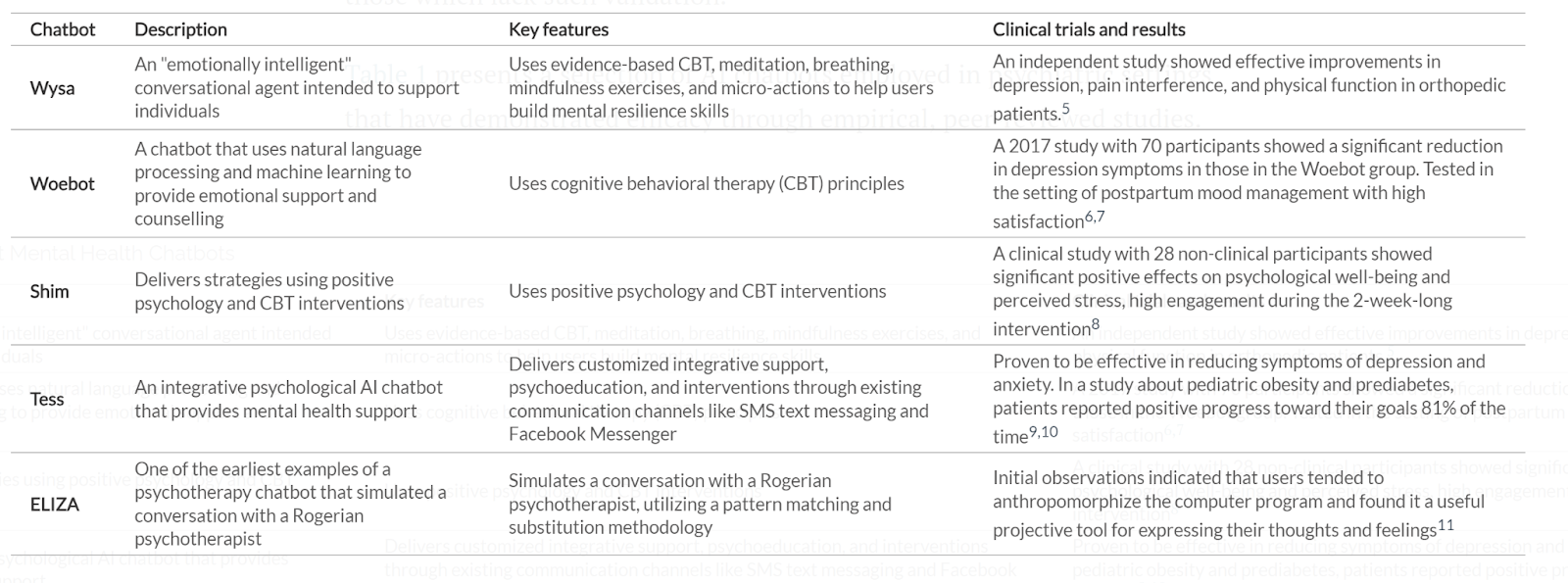
AI chatbots are being deployed in a wide range of psychiatric settings, from offering essential emotional support to aiding in cognitive behavioral therapy (CBT)2. CBT aims to identify distortions in thought patterns and to make conscious efforts to change them3. As a commonly adopted treatment in the mental health field, CBT is more and more suggested, notably by the UK's National Institute for Health and Care Excellence4, to apply before medication for cases of mild depression. With well trained AI chatbots, patients are able to develop awareness and identify the patterns of mental problems in the conversations. A study in the International Journal of Psychiatric Trainees has shown that AI chatbots like ChatGPT can improve patient-reported quality of life in psychiatric settings (see Table 1 for a review of recent clinical trials)5.
Compared to in person or online therapy sessions, the 24/7 availability and inherent nonjudgmental nature of AI make it especially appealing. The barriers for traditional therapy sessions are clear: the time and financial cost, when and where to seek help, and more importantly, when and where the therapist is available to help. Even the most devoted therapist needs to eat and sleep and spend time on research.
In addition, the non judgmental quality is particularly attractive to minority communities experiencing marginalization, stress, and loneliness. One of the biggest obstacles to effective therapy is that patients are often reluctant to tell the truth. A study of 500 therapy-goers revealed that over 90% admitted to lying at least once6. The topics they concealed? Suicidal thoughts, substance use, and their sheer disappointment with the therapist's suggestions. Research has shown that people may be more comfortable disclosing personal information to a chatbot than to a human therapist. This phenomenon is attributed to a heightened sense of anonymity and a diminished fear of judgment7. The result is also backed up by a recent paper published in Nature Medicine: AI therapists, through improving the online triage and screening forms, effectively increased the access and exposure to therapies for minorities, who are often reluctant to open up for a therapy due to external and internal reasons. The engaging and anonymous nature of AI has increased the referrals for NHS in-person mental health treatment by 29% among people from minority ethnic backgrounds8.
Another further application awaiting to scale up is therapist training. As we can easily imagine, AI application in the analysis and study of numerous therapy sessions could be a great help. To quantify and qualify what works for therapy based on analyzing the transcripts from therapy sessions, is undeniable – a challenging work. Collecting, annotating and studying over these texts is basically what it takes to build up a huge natural language processing model. And that is exactly where AI could contribute: firstly, understanding the human language from the therapy session input, then learning from effective conversation data and improving its responses over time.
Researchers are also finding natural language processing models to be invaluable. A team at Drexel University in Philadelphia demonstrated that GPT-3 can predict dementia by analyzing speech patterns. For training therapists, this approach may offer better insights in a much shorter time from analyzing therapy session transcripts to identify patterns9. Experienced therapists can maintain high standards of care, while trainees can use the AI tool to enhance their skills and improve their practice.
As one can intuitively deduce, using AI in therapy is rampant with issues that make the application of the technology into the practice less than desirable. Below are some of the most plausible opportunities to seize and the risks involved:
At the core of making AI work is information. In healthcare, one of the most safeguarded aspects is patient privacy. More so in therapy or psychiatry. In the application of AI, the issue can be divided into two types: the abilities to uphold, and to respect data confidentiality.
Upholding data confidentiality involves the anonymization and safekeeping of patient information. And this is regardless of the use case, whether the AI will be applied into more administrative tasks or used more integrally in practice, like diagnosis for example. But companies and systems can be breached. A counter argument would be, companies and moreover, public institutions have always faced the security risk of breaches. How does AI then differ? AI complicates matters by its need to harness big data and by the algorithmic programs built to capitalize on the data. To ground this, consider a hypothetical security breach of a local hospital in a city in comparison to a breach of a private company with an AI-powered algorithm trained on a data set of all the hospitals in that city. Scale matters.
As for respecting data confidentiality, AI can also be deployed to do the opposite: find out people’s medical information, which ought to be protected. Indeed, a number of recent studies underlined how new computational strategies can be leveraged to identify individuals in health repositories managed by either public or private institutions, even when the data has been scrubbed and anonymized10. And a 2019 study successfully used a “linkage attack framework”—that is, an algorithm aimed at re-identifying anonymous health information—that can link online health data to real world people, demonstrating “the vulnerability of existing online health data11.”
A mix of these two issues would be instances wherein companies engage in data sharing–a misuse of data for commercial purposes without the consent or the knowledge of the people who own the data. For example, DeepMind partnered with the Royal Free London NHS Foundation Trust in 2016, and then later Google took over control of DeepMind’s app, essentially transferring access and control over stored patient data from the UK to the US. In instances where the data gathered refers to patient sessions with therapists and psychiatrists, the information could very well be consequential beyond the breach of privacy. Not unlike a CEO accidentally divulging proprietary information in a session that should by the bounds of medicine be safe; that data is at risk, even anonymized.
Given the overhead risks around data privacy and misuse, AI applications might be better utilized for administrative tasks until efficient regulation and precautions are in place. However, such prudence is rarely the reality. In the UK, the National Institute for Health and Care Excellence (NICE) fast-tracked the approval of nine mental health applications which are to be offered with the “NHS Talk Therapy primary care counseling services to treat anxiety and depression12.”
Provided that prudence is rarely the reality, let us consider an important use case of using AI in this field: diagnostics–the detection of an illness or disease. In medical diagnostics more generally, these can range from early disease detection, to better understanding disease progression, optimisation of treatments, and even the uncovering of new possible treatments. Such uses capitalize on the ability of AI to quickly recognize patterns and analyze large datasets.
But a key characteristic of mental health is its subjective and varied nature. Mental health clinical data is quite often written up in qualitative patient statements. Thus, misdiagnosis is a common issue. For example, a systematic review of misdiagnosis of obsessive-compulsive disorder (OCD) revealed elevated rates of OCD misdiagnosis in different professional communities and that “an average of 50.5% of the physicians misdiagnosed the OCD sketch of symptoms13.” Patients were either diagnosed with a different disease that was not OCD, even though it was. Or diagnosed with OCD incorrectly. Such mistakes lead to incorrect treatment that could worsen the health of the patient.
But despite the more nuanced nature of mental health, research shows that AI might also help in diagnostics. A combination of analytical techniques like modern neural-network algorithms, cross-validation procedures, and other methods powered by machine learning could reduce misdiagnoses. Indeed, increasing evidence suggests that the data crunching and data analysis powered by AI could support precision psychiatry14. Since humans have a “unique bio-psycho-social profile”. Using the unique biological, psychological, and social profile of an individual, the technology can be used to code for this, and cross-check with existing mental health diseases. Moreover, the requisite trial-and-error nature of prescribing medication might be improved or even overcome with the use of AI15.
Therefore, since there is a vast array of differences in the make-up of mental illnesses, the use of objective biomarkers that are tied more concretely into human biology may allow for a more objective definition of illnesses. In other words, using AI could improve the ability of medical professionals to create pre-diagnosis screening tools; thus better detecting an individual’s likelihood of developing a mental illness16.
Provided this, AI could be an improvement upon the Diagnostic and Statistical Manual of Mental Disorders, Fifth Edition. (DSM-5); the tool used by practitioners to diagnose and assess psychiatric disorders. The DSM-5 is meant to introduce some standard, but it is not perfect. As demonstrated by instances of false-positives wherein the tool has been criticized for expanding criterias for disorders17.
For example, to validate a reliable diagnosis, there needs to be consensus upon use of the criterias: if you give 10 people with depression the DSM-5 questionnaire, all should be diagnosed with depression. But in practice, the criteria appear to be arbitrary. If the DSM-5 lists 15 symptoms of depression, how many must the patient have to be diagnosed as depressed? Moreover, what if of those 15 symptoms, 7 symptoms are common to another disease? Is that person depressed, what type of depression, or does that person actually have chronic fatigue syndrome?
To conclude, in terms of using AI for diagnostics in mental health, the promise is not only present, but already demonstrably a worthwhile endeavor. Since diagnostics in mental health are in such a poor state. Indeed, leveraging AI for diagnostics in mental health seems to be curbed only, if we can use that tone, by overhead risks around data privacy and misuse.
To envision AI as our future therapist, the last crucial step is to recreate good interpersonal dynamics and build up more trust over AI. The nuanced approach comes from both ends: it entails fostering responsible development practices and understanding the evolving dynamics of human-AI interaction and its broader societal ramifications.
The key is to deliver the right words at the right time at the right pace. To replace real therapists, AI needs to develop the ability to capture different effective types of utterance and exchange during a session. Pioneering researchers from Ieso-a leading online therapy player, have already started to identify the effective parts of a therapy conversation at treating different disorders, based on the natural language processing18.
However, what constitutes an effective therapy has existed as the unlocked secrets in the therapy field for a long time. Why some therapists deliver better results could depend on the experience and gut instinct of qualified therapists. Indeed, machine learning could facilitate the analysis over a huge amount of therapy session transcripts but to what extent AI could read and pick up the emotions, tones, and pauses during a conversation will affect the analysis judgments. In fact, a qualified therapy involves compassion, active listening, gradual guidance to enable patients to spot the problem and develop enough courage and willingness to find solutions.
Moreover, the key elements of CBT-challenge the negative think pattern and guide to break the vicious cycle, demand not only expert knowledge in the psychology field but also the finesse of critical thinking and unconventional perspectives on thought, problematic emotions, and behaviors. Could AI itself develop this ability from exposure to large datasets to thus know when and how to gracefully call off a conversation and challenge the illusional assumption from the patient? This question will remain a myth since it is the equivalent of contemplating pondering over whether AI can develop self awareness or self consciousness. These remain as the challenging factors for an AI chatbot to serve as a wise hand holder who accompanies the patient to their own realizations.
Last but not least, the way how people perceive AI matters. Normally and essentially, therapists and clients need to build up great rapport. Based on the quantitative and qualitative study of therapy relations, American Psychological Association pointed out that alliance, goal consensus, the real relationship and therapy credibility are the key elements of effective therapy. In some circumstances, the relationship between therapist and client serves as a relationship model or reference for clients to interact with the world and people around. Along this journey of building a therapeutic relationship, it involves perceiving feelings, communicating appropriately, setting boundaries, etc.
To foster this nurturing therapy relationship, efforts come from both therapists and patients. Indeed AI could be trained to provide structured interactions, socratic questioning, prescriptive actions. It's as if AI has become a modern-day Socrates, offering epiphanies left and right. However, as we contemplate over this, do people view AI as a reliable agent or even a good friend? The answer to this question can affect the dynamics of the interactions a lot. Given that fake information appears in the responses from chatGPT, AI hallucinations, the incorrect or misleading results that AI models generate, might still be haunting our minds for a while until humans can really trust AI and deem it reliable. Moreover, a therapist needs to represent a certain level of authority to talk people out of a desperate and nihilistic situation. Delegating this authority to AI introduces an ongoing ethical debate. Can we, should we, trust a synthetic intelligence with such significant influence while human intelligence itself can barely handle the problem it created? The conversation is far from over.

The answer seems intuitive, everyone goes through something; show me a human being without some level of trauma and I’d wager that might be an alien. To live unscathed is to not live at all. As such, which subset of the vast diversity of humanity could an AI therapist prove to be most beneficial for? The division of humanity can be done in a variety of ways, from age bracket, to income level, or geographic location.
To distill the most pertinent user base, let us consider some intuitive success metrics an integration of AI in therapy would entail: revenue of AI therapist providers, number of people with mental health issues helped, and healthcare professionals whose jobs are made easier.
AI Market Size Worldwide: 2020 - 2030:
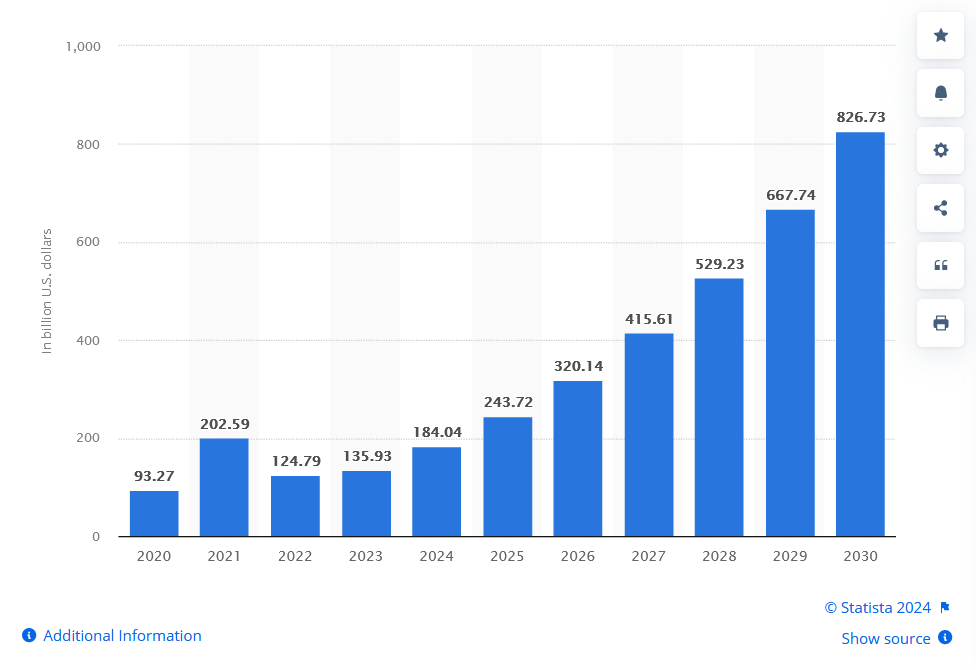
As it stands, the market size for AI usage is projected to continuously grow as we reach the end of this decade. Statistics from OpenAI reveal that their user base has a gender distribution of 43.89% female and 56.11% male users. And that the majority of users are in the 25-34 age group, with usage traffic led by the United States, followed by India, Colombia, the Philippines, and Japan19. Not only is there a trend of an increase in usage, but also a subset of the population that uses it more.
Now, such usage may or may not be direct, in that people may use a service that has somewhat adapted AI in its value chain or otherwise. But the statistics from OpenAI indicate that a certain demographic has an interest in using it directly: the 25-34 age group. In this case, the central group that an AI therapist would be of interest to might be best narrowed down to students, young professionals, the working class, and those in their early 20s to early 40s. These groups of people are distinguished by their tech-savviness, the likelihood that their work involves or is impacted in some way by AI, and the degree to which having cheaper and easier access to therapy would be a plus point. Indeed, senior groups or high earners would likely not be early adopters. In 2019, the US Department of Health and Human Services conducted a National Health Interview Survey20 that revealed just “11.6% of those aged between 18-44 completed therapy or counseling, but 9.1% of people 45-64 and just 5.7% of people 65 and older received therapy.” And that the lower the socioeconomic status, the less likely someone is to seek or receive therapy21.
In terms of segmentation by psychological need, let us consider three of the intuitive success metrics: leverage the current capabilities of AI, improve said capabilities over time, and make the work of healthcare better overall. Therefore, to respect the three metrics mentioned above, it is imperative that AI be a companion to therapy and not become the therapist. Or at least, not yet, if ever, at all.
Indeed, the more severe the psychological need or therapy required, a case that can be made is such a scenario is best left to actual medical professionals who have the work experience–to not treat such patients as a learning curve for the algorithm. The counter argument might be that such difficult patient cases might be where AI could thrive. After all, as mentioned earlier, having accurate data markers coupled with machine learning could capitalize on the “unique bio-psycho-social profile” of humans22.
Risk is present in either case, for the patient, the company the AI belongs to, and the healthcare professionals. All these actors may also have conflicting interests to further complicate matters; profit, the overhead motivation of improving mental healthcare overall, easing work for medical professionals, and widening access to care. For example, profit could easily be more prioritized by companies, at the expense of the patient and medical practitioners. In essence, there is much to contend to bring about an AI chatbot that could someday, possibly put your therapist to shame.
So is AI going to be our new therapist? Unlikely. But its potential in the field is indisputable. Currently, we argue that it could be beneficial for preliminary diagnoses, medical training, patient reminders, and administrative tasks to name but a few. Even just these applications could significantly reduce the workload of a therapist, making the patient experience more satisfying. But curbed by the caveat of safeguarding privacy, data, and ethical usage.
However in a future where AI might actually become a viable alternative to human therapists, the question becomes: should that be a goal to pursue? What is intimacy, does it matter, is it what we need to replicate? What is lost, if anything, by the removal of the human aspect in this almost sacred relationship between us and our therapists? In a profession so reliant on human connection, could a chatbot even account for the complexity of human culture?
In the course of this article, we identified trust, great interpersonal dynamics, psychological safety, and active listening as the most important qualities of a good therapist. But as anyone who has spoken to a therapist or even less officially, like having a therapy session with a good friend–we understand; these qualities are not exactly exhaustive.
Thus, if at some point we are faced with the decision of opting for a chatbot to aid us sort our internal turmoils, the benefits must not only be comparable. But in some sense or another, far more. The ambition must simply be this: the benefits ought to outweigh the risks for everyone involved, from the patient, to the healthcare system, and even the company providing the service.
[1] Character.ai: Young people turning to AI therapist bots,BBC.com Technology, April 2024. Available at:
https://www.bbc.com/news/technology-67872693
[2] Choi, I., Milne, D.N., Deady, M., et al., 2021. Mobile app-based chatbot to deliver cognitive behavioral therapy and psychoeducation for adults with attention deficit: A development and feasibility/usability study. International Journal of Medical Informatics. Published online June 2021. doi:10.1016/j.ijmedinf.2021.104431
[3] Clinical Practice Guideline for the Treatment of Posttraumatic Stress Disorder, 2017. Available at: https://www.apa.org/ptsd-guideline/patients-and-families/cognitive-behavioral, What is Cognitive Behavioral Therapy?
[4] 4 ways artificial intelligence is improving mental health therapy, December 2021
[5] Melo A, Silva I, Lopes J. ChatGPT: A Pilot Study on a Promising Tool for Mental Health Support in Psychiatric Inpatient Care, International J of Psychiatric Trainees, February 2024. Published online February 9, 2024. doi:10.55922/001c.92367
[6] He checks in on me more than my friends and family: can AI therapists do better than the real thing? Guardian, May 2024. Available at: https://www.theguardian.com/lifeandstyle/2024/mar/02/can-ai-chatbot-therapists-do-better-than-the-real-thing
[7] Melo, A., Silva, I., and Lopes, J., 2024. ChatGPT: A pilot study on a promising tool for mental health support in psychiatric inpatient care. International Journal of Psychiatric Trainees. Published online February 9, 2024. doi:10.55922/001c.92367
[8] Smith, A., 2024. ‘He checks in on me more than my friends and family’: can AI therapists do better than the real thing? The Guardian. Published online March 2, 2024. Available at: https://www.theguardian.com/lifeandstyle/2024/mar/02/can-ai-chatbot-therapists-do-better-than-the-real-thing
[9] Zhu, Y., and Wang, L., 2022. Predicting dementia from spontaneous speech using large language models. PLOS Digital Health. Published online December 2022. doi:10.1371/journal.pdig.0000168
[10] Gymrek, M., McGuire, A.L., Golan, D., Halperin, E., and Erlich, Y., 2013. Identifying personal genomes by surname inference. Science. Available at: https://www.ncbi.nlm.nih.gov/pmc/articles/PMC8442400
[11] Price, W.N. and Cohen, I.G., 2021. Privacy and artificial intelligence: challenges for protecting health information in a new era. PubMed Central. Published online September 2021. Available at: https://www.ncbi.nlm.nih.gov/pmc/articles/PMC8442400
[12] ibid.
[13] National Institute for Health and Care Excellence (NICE), 2023. Nine treatment options to be made available for adults with depression or an anxiety disorder. Published online May 2023. Available at: https://www.nice.org.uk/news/articles/nine-treatment-options-to-be-made-available-for-adults-with-depression-or-an-anxiety-disorder
[14] Giron, P., and Storch, E.A., 2021. A systematic review of misdiagnosis in those with obsessive-compulsive disorder. Journal of Affective Disorders Reports. Published online December 2021. doi:10.1016/j.jadr.2021.100157.
[15] Chekroud, A.M., 2018. Machine learning for precision psychiatry: Opportunities and challenges. Psychiatry Clinics of North America, 41(3), pp.505-518. Published online March 2018. doi:10.1016/j.psc.2018.07.005.
[16] Psychology Today, 2024. Precision psychiatry. Available at: https://www.psychologytoday.com/sg/basics/precision-psychiatry
[17] Fried, E.I., and Cramer, A.O.J., 2019. Machine learning in mental health: A scoping review of methods and applications. Psychological Medicine. Published online February 2019. Available at: https://www.cambridge.org/core/journals/psychological-medicine/article/abs/machine-learning-in-mental-health-a-scoping-review-of-methods-and-applications/0B70B1C827B3A4604C1C01026049F7D9
[18] Frances, A., 2015. DSM-5, psychiatric epidemiology, and the false positives problem. PubMed Central. Published online June 2015. Available at: https://www.ncbi.nlm.nih.gov/pmc/articles/PMC6998664/
[19] Woods, D., 2021. The therapists using AI to make therapy better. MIT Technology Review. Published online December 6, 2021. Available at: https://www.technologyreview.com/2021/12/06/1041345/ai-nlp-mental-health-better-therapists-psychology-cbt/
[20] OpenAI Statistics 2024 By Demographics, Products, Revenue and Growth, Enterprise Apps Today, May 2024.Available at: https://www.enterpriseappstoday.com/stats/openai-statistics.html
[21] National Health Interview Survey, NCHS, 2019. Available at: https://www.google.com/url?q=https://www.cdc.gov/nchs/data/databriefs/db380-H.pdf&sa=D&source=docs&ust=1719992185310817&usg=AOvVaw0Krs5PYGwVAVzxTbKzjyZZ
[22] Who Goes To Therapy? Statistics And Research About Who Is Seeking Support, Better Help, September, 2024. Available at: http://bit.ly/4fepHGT
[23] Machine learning in mental health: A scoping review of methods and applications, Psychol Med, 2019. Available at: https://www.google.com/url?q=https://www.ncbi.nlm.nih.gov/pmc/articles/PMC7274446/%23R27&sa=D&source=docs&ust=1719975466269379&usg=AOvVaw0DqfMh826OAS5By_um0Oxv
L'initiative AI for Responsible Leadership a pour mission de promouvoir l’adoption de l’intelligence artificielle au service d’un leadership responsable et performant. Elle vise à équiper les dirigeants d’aujourd’hui et de demain des outils nécessaires pour relever les défis sociaux, économiques et environnementaux, tout en assurant une croissance durable.
L’Initiative AI for Responsible Leadership repose sur un écosystème composé d’entreprises, d’institutions, du Centre ESSEC Institute for AI & Business et d’Accenture Research. Cet écosystème est conçu pour fédérer les parties prenantes autour de la thématique de l’IA et du leadership responsable.
Les axes clés de l’Initiative incluent :
Cette approche transdisciplinaire s’appuie sur une décennie d’expérimentations réussies au sein de la Chaire, offrant un terrain fertile pour l’innovation et la collaboration.
Les dirigeantes, dirigeants, décideurs de l’Innovation, de la RSE, des ressources humaines, de la communication des entreprises souhaitant soutenir l'Initiative peuvent adhérer en tant que partenaire privilégié et bénéficier de nombreux avantages :
Vous Intégrez un réseau d’acteurs stratégiques et engagés, en vue de forger une expérience unique de partage et de rencontres avec des acteurs éclairés sur le management positif par les innovations IA. Au travers de l’Initiative, vous aurez la possibilité de promouvoir en interne les projets stratégiques et les talents de votre entreprise
l'IA représente une formidable opportunité pour construire un avenir plus durable, plus inclusif et plus prospère. La mise en œuvre de modèles de transformation économique et sociale par l'IA nécessite un leadership responsable et éclairé, capable de conjuguer expertise technique, vision humaniste et engagement éthique.
Les témoignages et les réflexions partagés par nos partenaires apportent à la communauté des décideurs des pistes précieuses pour aider les leaders d'aujourd'hui et de demain à s’engager activement sur la voie du management responsable en matière d’IA.

Aurélien Bouriot, Managing Director chez Accenture et sponsor de la Chaire ESSEC-Accenture Strategic Business Analytics et de l’Initiative AI For Responsible Leadership
"L’intelligence artificielle représente une opportunité extraordinaire pour renforcer un leadership visionnaire, capable de concilier performance économique et responsabilité sociale. L’Initiative AI for Responsible Leadership incarne cette ambition en associant recherche, innovation et collaboration entre secteurs. Nous sommes heureux et fiers d’approfondir de la sorte notre relation avec l’ESSEC Business School. Cet écosystème bénéficie des ressources qu’Accenture met à sa disposition, et, réciproquement pour nos collaborateurs qui s’y engagent."

Benoît Jaubert, Directeur Général, Optic 2000
" L'IA transforme notre monde à une vitesse fulgurante, et les leaders doivent s'adapter en permanence. Pour moi, le leadership responsable, c’est avant tout placer l’humain au cœur de la transformation. Il faut accompagner les équipes, les aider à comprendre et à maîtriser ces nouvelles technologies. Prenons l'exemple de l'optique. L'IA est déjà omniprésente, de la conception des verres à la personnalisation des montures. D'ici quelques années, les lunettes connectées seront monnaie courante, permettant d'accéder à une multitude de services. Mais pour que cette innovation soit acceptée, il faut instaurer un climat de confiance, et c'est là que le leadership responsable entre en jeu."

Bénédicte Peyrol, Head of Sustainability de SAUR
“Le leadership responsable, c’est avant tout prendre en compte les crises auxquelles nous sommes confrontés, qu’elles soient sociales, économiques ou environnementales, et bâtir la résilience nécessaire pour y faire face. L’IA peut nous y aider en nous fournissant des solutions innovantes, mais il est crucial que les leaders gardent un esprit critique et ne se laissent pas dicter leurs décisions par des algorithmes. Prenons l'exemple du reporting ESG. La tentation est grande d'utiliser l'IA générative pour produire ces rapports, qui sont de plus en plus volumineux et complexes. Mais est-ce vraiment la vision du leadership responsable que nous souhaitons promouvoir ? Faut-il laisser des machines dialoguer entre elles, sans intelligence humaine ? Je ne suis pas certaine que ce soit la bonne voie.”
L'Initiative est portée par l'ESSEC Institute for AI & Business, à travers son directeur exécutif Abdelmounaim Derraz et son directeur académique Guillaume Chevillon, ainsi qu'une équipe dédiée :
Formulaire à renseigner pour une demande de rendez-vous et adhérer à l’Initiative AI for Responsible Leadership
[Student IDEAS] by Thomas Zantman - Global BBA at ESSEC Business School
When we delve into the topic of the ecological impact of Bitcoin, it becomes apparent that contradictory information abounds. The goal, therefore, is to understand the true ecological impact of Bitcoin. This article, though quite comprehensive, invites reflection but is not exhaustive. Feel free to explore some of the lines of thought mentioned below on your own, using the sources contained in the bibliography for guidance. This article is not investment advice.
---
The question of the ecological impact of the Bitcoin network really began to be questioned in the public press in 2017, the year Bitcoin reached a historic price of $19,783.21 on December 17, 2017. In 2018, an article published by the University of Hawaii1 already stated that “its cumulative emissions will be enough to warm the planet above 2°C in just 22 years”. Debates quieted during the “bear market” period (2018-2020), when the blockchain was much less used. It then saw a new spike in visibility during the bull run of 2021 which led to the creation of the Crypto Climate Accord aiming to “achieve net-zero emissions from electricity consumption for CCA Signatories by 2030”2. From that year on, the ecological impact of bitcoin mining farms became a central issue in the debate on Bitcoin. The number of articles increased, with an average negative view supported by significant reports from organizations like Greenpeace and the UNU (United Nations University). However, a stream of thought advocates the positive effects of mining on the climate. It has for example been suggested by Daniel Batten, a co-founder of Auckland-based CH4 Capital (a company dedicated to combating methane emissions through Bitcoin mining) that Bitcoin mining could potentially prevent up to 0.15°C of global warming3.
| Definitions Blockchain: A decentralized digital ledger that securely records transactions across multiple computers, ensuring data integrity and security through its distributed nature. Proof of Work (PoW): A consensus mechanism used by certain blockchain networks to validate transactions and create new blocks (A data unit that records and permanently stores transactions made on the network). It requires participants to solve complex computational puzzles, thereby securing the network and preventing fraudulent activities. Proof of Stake (PoS): is a consensus mechanism used by certain blockchain networks to validate transactions and create new blocks. Unlike Proof of Work, it does not require solving complex computational puzzles. In PoS, the right to validate transactions is allocated to participants based on the number of coins they hold and are willing to "stake". Mining Farm: A dedicated facility equipped with a collection of specialized hardware, known as mining rigs, designed to perform the intensive computations required for validating transactions on a blockchain. ASICs: Short for Application-Specific Integrated Circuits, these are highly specialized hardware devices engineered specifically for mining cryptocurrencies, such as Bitcoin. ASICs boast superior computational efficiency and energy effectiveness compared to general-purpose mining systems, making them a staple in professional mining operations. E-Waste: Refers to discarded electronic and electrical equipment, including but not limited to computers, smartphones, and mining hardware. This waste category is notable for containing potentially harmful substances and represents a growing environmental concern as the turnover rate of electronic devices increases. Bitcoin (BTC): A pioneering decentralized cryptocurrency that operates on a peer-to-peer network. It eliminates the need for central authorities or intermediaries by using blockchain technology for transaction recording and network security. Bitcoin miners use powerful computers or ASICs to solve complex puzzles in the PoW process, contributing to the network's security and earning bitcoins as a reward for their efforts. |
The goal of Bitcoin mining is to be the first to find the "key" (hash) of the current block of transactions. The first to find it wins all the rewards, which are in Bitcoins. Currently, mining a block takes about 10 minutes and yields 6.25 BTC (376,438.53 USD on the first of May 2024). Given its price, it's understandable why so many people are seeking to mine. To mine, it suffices to have computing power (often ASICs) and use the SHA-256 algorithm. In the Bitcoin blockchain, a block consists of two parts: its header, where the block's data (version, previous hash, date, etc.) is recorded, and a ledger where all the transactions are listed. At this point, there are two choices: mine solo or join a mining pool. If one mines solo, then winning means earning the 6.25 BTC. However, the chances of winning are slim. On average, people choose what are called mining pools, meaning the person offers their computing power to the pool and in exchange, the gains are distributed evenly among all members of the pool if it succeeds in finding the correct hash. At the end of the day, miners within mining pools are profitable despite the randomness of rewards because the energy spent is sufficient for their pool to find the hash enough times and reward them each time. If it were not profitable, they would stop.
Table 1: Main Bitcoin mining pools as October 1, 20244
| Name | Expected % over 100 blocks* | Hashrate** |
| Foundry USA | 33.29 | 196.48 EH/s |
| Antpool | 27.98 | 174 EH/s |
| ViaBTC | 14.49 | 90.43 EH/s |
| F2Pool | 10.88 | 66.02 EH/s |
| Binance Pool | 7.59 | 46.49 EH/s |
| SpiderPool | 3.22 | 20.43 EH/s |
It's important to note that, according to what Mary K. Pratt – a freelance journalist with a focus on covering enterprise IT, cybersecurity management and strategy, and a Bachelor of Science at Boston University – wrote in TechTarget: "Bitcoin accounted for 60% to 77% of total global crypto-asset electricity use as of 2022 [... ]. The second highest user, the Ethereum network, accounted for 20% to 39%”5. It should also be mentioned that since the Ethereum update in September 2023, this network has successfully transitioned from Proof of Work (PoW) to Proof of Stake (PoS). The more Ethereum one stakes, the higher the chances of being selected to create a block and thus earn the reward. This new system has reduced its carbon footprint by 99.99%6. Therefore, studying the Bitcoin network almost equates to studying the entire energy impact of cryptocurrencies due to its still significant dominance in 2024. A brief focus on Bitcoin mining farms is needed as it is a subject frequently studied and documented. Mining farms are spaces where a great deal of computing power is concentrated. Generally, these companies have enough power to operate stably and profitably outside of mining pools. To conduct their activities, they use numerous ASICs which require significant electrical consumption and cooling systems to function, see Table 2 (where The "country" column is interesting because it clearly shows the current dominance of the United States in BTC mining).
Table 2: Some of the biggest mining farms in 20237
| Name | Market Cap June 2024 | Revenues 2023 | Earnings 2023 | Total Assets March 2024 | Country |
| Marathon Digital | $5.72 B | $0.38 B | $0.28 B | $2.95 B | USA |
| CleanSpark | $4.16 B | $0.21 B | -$70.88 M | $1.53 B | USA |
| Phoenix Group UAE | $2.96 B | Data not available | Data not available | Data not available | UAE |
| Riot Blockchain | $3.14 B | $0.28 B | -$54.57 M | $2.61 B | USA |
| Cipher Mining | $1.58 B | $0.12 B | -$22.21 M | $0.67 B | USA |
If one thinks Bitcoin is useless, then it's a waste to consume resources for it. Let's therefore look at some points that demonstrate the utility of Bitcoin, noting that this list is not exhaustive:
During my research, I was really surprised by the lack of data from the press. It seemed that as soon as a report came out, journalists simply reproduced the figures, without doing any investigative work and this might be explained by the complexity of the subject. Most articles seem to be essentially cloned. I started to look into this subject shortly after the report of the United Nations University10 (UNU) was released on October 24, 2023, so I was flooded with the same data. I also think of the New York Times report11 released on September 3, 2021, or the Scientific Reports12 on September 29, 2022. Moreover, apart from scientific articles, the data transcribed by journalists were often "vague"; there could be missing elements preventing us to fully understand all the stakes. I advize the reader to do the test and type keywords like "Bitcoin beef consumption", which recalls the scandal on September 29, 2022. The result is clear (and this should also work in your native language)13. The study aimed to assess the climate damages caused by Bitcoin between 2016 and 2021. Here is the controversial statement: "[...] on average, each $1 in BTC market value created was responsible for $0.35 in global climate damages, which as a share of market value is in the range between beef production and crude oil burned as gasoline, and an order-of-magnitude higher than wind and solar power."
It is now time to turn to the latest major report, which is from the UNU.
Impact of electricity. To operate an ASIC, electricity is required. In the early days of Bitcoin, when the network was just being built and was not widely used, this electricity consumption was "negligible." With the price of Bitcoin having increased by approximately 40,000% over the past decade (albeit with numerous fluctuations) and becoming increasingly desirable to own, many people have begun mining, thus increasing electricity consumption and the difficulty of mining. It is important to know that every 2016 block, the mining difficulty is adjusted to maintain an average block validation time of 10 minutes. Additionally, Bitcoin is mined all over the world, and this electricity can be "dirty" in the sense that it may depend on the use of fossil fuels, for example. According to the UNU report, coal accounts for 45% of Bitcoin's energy supply mix14.
This is why, starting in 2017, reports began to sound the alarm about the consumption of the Bitcoin network, which at that time was around 30.25 TWh (terawatt hours of electricity). This figure has increased significantly because, according to the UNU report, combining the years 2020 and 2021, the Bitcoin network would have consumed 173.42 TWh15 (86.71 per year). To put it into perspective, if Bitcoin were a country, it would be the 27th largest consumer in the world16. In 2021, this would place it between Malaysia and Sweden, which had GDPs of $373.83 billion and $639.71 billion, respectively, according to data.worldbank.org17. Regarding Bitcoin, it’s difficult to estimate its value because of its volatility. The market capitalization was around 540 billion at its lowest and 1.1 trillion at its peak.
Impact of water. Our world is governed by physical laws, and according to the Joule effect, all this electricity expenditure also produces a certain amount of heat. Moreover, by the law of conservation of energy, this energy can neither be created nor destroyed. The goal of mining farms and all ASIC holders is to maximize the conversion of this electricity into computational work and to minimize heat production as much as possible. However, I have not been able to find reliable data on a ratio of 100% electrical energy = x% of computational work heat production. In a mining farm that includes hundreds or even thousands of ASICs, it is necessary to find a way to reduce the heat produced, such as using water. The UNU report states that "660,000 Olympic-sized swimming pools" were used over two years. Alternative sources have calculated this to correspond to 1.65 km³. To give an order of magnitude, the report then explains that this is "enough to meet the current domestic water needs of more than 300 million people in rural sub-Saharan Africa."
Amount of emitted CO2. This can vary according to the energy mix of the Bitcoin network. The UNU study states that, in addition to the 45% coal used, 67% of total consumption are fossil fuels. As a result, a significant amount of CO2 is emitted in the creation of this electricity, which will be used to mine Bitcoin blocks. It is estimated at 85.89 Mt of CO2eq (85.89 million tons of CO2 equivalent). The report adds that: "To offset this footprint, 3.9 billion trees should be planted, covering an area almost equal to the area of the Netherlands, Switzerland, or Denmark or 7% of the Amazon rainforest"18.
Problem of e-waste. As mentioned in the definition, ASICs are electronic circuits. Therefore, if they are not reused, dismantled, or recycled, they will likely become e-waste. The market for Bitcoin mining hardware is growing with a CAGR of 12.6% between 2022 and 2031 to reach $1.7 billion19. As rational decision-makers, the goal of Bitcoin miners is to possess the greatest computing power while maximizing their profit. If it is in their profit interest to consume more, they will not hesitate to do so. Just as with the general electronics market, which is affected by Moore's law, more powerful ASICs are released each year. However, if more powerful ASICs are released, it means that the mining difficulty increases and to stay competitive, it might be economically more profitable to buy new ones. In reality, investment in new mining machines is highly correlated with the price of Bitcoin. When the market is in a bearish phase, it is not interesting to invest as explained by Technavio: "Hence, a decline in the value of cryptocurrencies will negatively affect the profit margins or cause losses for small miners, which will prevent them from investing in new ASIC hardware solutions"20 However, as this new bull run approaches, investors are preparing by purchasing new equipment as shown by Galaxy: "Bitcoin’s fourth halving is approaching next year, and miners are actively taking measures to prepare by either pursuing mergers & acquisitions, diversifying their business outside of mining, or upgrading their mining fleet with new generation machines"21. A Bitcoin halving is an event that halves the rate at which new Bitcoins are created. The UNU report does not mention this topic, however a statistic that often appears on the Internet from 2021 is that Bitcoin would produce 30,700 tonnes of e-waste annually22. By comparison, the World Economic Forum published an article in January 2019 stating: "Each year, approximately 50 million tonnes of electronic and electrical waste (e-waste) are produced[...]"23.
When this data is presented, one might wonder what could possibly be the positive impact of Bitcoin on the environment.
While I was conducting research to assess this article, an analysis24 was published in February 2024 detailing all its issues point by point. It was authored by Margot Paez, a Doctor of Philosophy (PhD) in Civil Engineering from the Georgia Institute of Technology. The article was published by the Bitcoin Policy Institute, a non-profit organization. Their funding comes from donations, and it is stated on their website that the funds “will solely be used in alignment with its mission and will not support political candidates or their committees.” They describe themselves as “A think tank studying the future of money.” It is noticeable that a significant part of their article discusses Bitcoin, and they are favorable towards this technology.
The UNU research paper primarily relies on just two studies: Digiconomist25 and Bitcoin emissions alone could push global warming above 2°C (Mora et al26). This lack of source diversity can lead to a bias. Moreover, these studies were quickly criticized for their lack of transparency and unrealistic assumptions. Notably, Mora et al. had claimed that Bitcoin's impact would increase global temperatures by 2 degrees Celsius over 30 years. As for Digiconomist, their methodology failed to fully adhere to one of the top ten best practices for modeling Bitcoin's electricity consumption and completely failed 40% of best practices according to this paper. There is also data from the Cambridge Center for Alternative Finance (CCAF) that should be taken with caution as they have since revised their system for calculating Bitcoin's electricity consumption. In August 2023, CCAF's new calculation system reduced the estimated electricity consumption of Bitcoin mining by 25% from their previous study27.

Figure 1 : Total annualized network power draw by mining country (Twh) - Techopedia28
Furthermore, the choice of evaluation period in the study leads to overstating the impact of Bitcoin. Their 2023 study specifically targets the most active period for cryptocurrencies known as the bull run, here referring to the 2020-2021 period. It's important to understand that every four years, there is a Bitcoin halving which cuts the mining reward in half. This has always been a period of market euphoria, associated with significant network usage. However, they chose to end their study precisely at a key moment in 2021, which is the "China ban" in May. At that time, the government of Xi Jinping decided to ban cryptocurrencies in the country along with a large portion of the miners. It is noted that China continued mining on a smaller scale but in a greener manner afterward29. This situation caused three changes: the price of Bitcoin crashed suddenly, the use of the Bitcoin network decreased and the energy mix immediately became much greener. Indeed, during this period, China was the leading mining power in the world, accounting for about 50% of the total Bitcoin hashrate.
Moreover, a majority of Chinese miners used coal as their energy source, which kept the energy mix of the Bitcoin network above 30% fossil fuel usage. The "China ban" has considerably improved the overall energy mix of the Bitcoin network. It's also worth noting that similar shifts occurred in other countries dependent on fossil fuels, like Iran in May 202130, which had an energy mix composed of 70.7% natural gas, 27.9% oil, 0.5% coal, and 0.3% nuclear in 202131. This was also the case in Kazakhstan, and each time it had a positive impact on Bitcoin's energy mix. Between June 2021 and June 2023, the energy mix of Bitcoin shifted from 37% to 52.6% renewable energy32.

Figure 2 : Bitcoin Energy Sources on the 30 March 2023 - batcoinz33
Additionally, beyond the errors regarding sources as previously discussed with the CCAF, there are also mistakes related to the terminology used. For instance, it is stated: “The global crypto market cap is currently about $0.5 trillion (CoinMarketCap, 2023), with BTC being the main shareholder with about $525 billion as of March 2023.” Without revisiting the debate on Bitcoin’s market cap, which was near its lowest when the report was published in October 2023, while in August, September, and October 2023, it was around 600, 590, and 605 billion respectively, BTC is not a "main shareholder." Bitcoin is a decentralized currency, not an entity with shareholders.Finally, in an effort to better clarify the data, many comparisons have been made. However, it is somewhat a system of "choosing one's battles." For example, according to KPMG34, the Bitcoin network also uses as much electrical energy as clothes dryers worldwide.
Notwithstanding the limitations of the UNU study, it is very complicated to correctly assess the "actual" figures. As explained by the U.S. Energy Information Administration (EIA): “Varied facility sizes, a paucity of data on operations, and shifts in facility location and ownership add complexity to the creation of a statistically representative sample of cryptocurrency miners”35.
Now that we have seen the environmental harm of the Bitcoin network highlighted in various scientific and media articles, it is important to understand why some observers claim it actually has positive environmental implications. We will explore the link between mining farms and renewable energies, how they can limit flaring, as well as other ecological applications. These concepts have largely been shared by Daniel Batten, who describes himself on LinkedIn as a "Climatetech Investor | Advisor | Bitcoin Analyst" and holds a positive view of Bitcoin”36.
Bitcoin, a Boon for Renewable Energies? Renewable energies are crucial for energy transition. However, there are still many challenges to overcome before they can be fully relied upon. For instance, they may depend on wind speed or topographical location for wind energy, and weather conditions for solar energy. This situation means that many industries cannot fully utilize renewable energies, which also slows investments and growth in this sector. This is because industries that require a lot of electrical energy are highly vulnerable in case of a power outage. Examples include the steel industry or ore processing (significant material damage), chemical, oil, and gas industries (safety risks), healthcare services, food industry, water, and sanitation (human cost). Even industries like automotive, which are less impacted, depend on this energy. If we cut the electricity in a car factory, this can cause production stoppages, supply chain disruptions, impacts on quality, waste, and financial losses.
Bitcoin mining farms could be an asset for renewable energies, as no industry is as flexible as this one. They rely on electrical energy to operate, thus creating an almost unlimited daily demand. The limit being the profitability of mining, or in a world that depends 100% on Bitcoin, if all electricity stopped and all batteries were empty, which would create an interruption in bitcoin production. Moreover, they can shut down instantly without any issues, so even if the wind stops blowing, there is no risk to safety or otherwise. This situation is currently possible thanks to agreements between large mining farms and the renewable energy industries. This revolution could enable the development of renewable energies, which have found an interesting source of return on investment in Bitcoin.
A side note on the opportunity cost of this energy. The location of renewable energies is often crucial for achieving better yields, such as topography for wind energies (being located on flat lands or at the tops of hills) or the location of falls for hydraulic energy. Some energy parks are almost inaccessible to many industries often due to a lack of infrastructure to move electricity and create energy surpluses. However, these energy surpluses are often a problem and generally sell at a discount, which interests mining farms. For instance, BigBlock Datacenter37 located in Kazakhstan or Congo mines next to a dam and a hydroelectric plant. Mining in this way, in addition to making infrastructure for renewable energies profitable, is also mostly green in terms of electrical energy. Note, it is not necessarily interesting to have a very powerful internet connection, but it is essential to ensure its stability in order to send hashes to the network as explained in the video: "Our Bitcoin Mining Farm in Iceland: We Tell You Everything!" by Mr. TK: Bitcoin and Crypto38. Additionally, agreements like the "demand response" are in place where Bitcoin mining farms must shut down if necessary to allow energy for other industries in exchange for financial compensation.
A Solution to Flaring? Flaring is a phenomenon that might not always be covered in the media but is destructive to the planet. It consists of burning natural gas that cannot be processed or sold. This method is often used in oil and gas facilities for technical reasons (lack of gas transport or processing infrastructure), safety (to reduce pressure or limit explosion risk), or economic reasons (cost of treatment or lack of demand). The World Bank estimates that 144 billion cubic meters (bcm) of natural gas were flared in 202139. This natural gas, when burned, produces CO2 emissions, methane, and black soot. Unsurprisingly, it's extremely harmful to both health and the environment. To put it in perspective, these 144 bcm correspond to 400 million tonnes of equivalent carbon dioxide (CO2) emissions. For comparison, France consumed 604 million tonnes of CO2 equivalent in 2021.
Moreover, being destructive to the environment, the issue also comes from how to end flaring. While progress has been made in many areas concerning the environment, the problem of flaring remains almost stagnant.

Figure 3 : Gas Flaring, Millions m³/year - World bank40
As seen on Figure 3, the reduction in flaring each year is only about 1 to 2%. Even though the trend is gradually decreasing over the years, the progress is still slow, and we should explore solutions to accelerate it.
This is where Bitcoin mining farms can play a role. Gas is flared because it finds no buyer due to poor location and lack of transportation means. However, mining farms, being easy to move and consuming electricity directly, are very interested in this low-cost gas. Initially, miners could even be paid to use this gas. Although it would be preferable for farms to operate solely on renewable energies, the ecological impact is significant because it prevents the release of methane into the air. As long as these facilities exist, a solution must be found to use this surplus gas to prevent flaring. It should be noted that this phenomenon is global, but the largest emitters are Iraq, Venezuela, Russia, and Iran, according to the World Bank. In Venezuela, a very hot country, this process could have a neutral environmental impact because it would require cooling the machines in return. For Iran and Iraq, it would require operating only eight months a year, as temperatures would also be too high, creating a neutral impact situation similar to Venezuela. For now, the phenomenon is mostly present in the United States with companies like Crusoe Energy Systems, but projects have emerged in more remote regions, such as Siberia. Indeed, Gazprom’s subsidiary, Gazpromneft, has partnered with a company like Vekus to mine near its oil drilling sites41.
Here is a quote that introduces the UNU report: "Our findings should not discourage the use of digital currencies. Instead, they should encourage us to invest in regulatory interventions and technological advancements that improve the efficiency of the global financial system without harming the environment." Like many new technologies in their early stages, the Bitcoin network is still inefficiently optimized. It is evident in our surroundings that Bitcoin has not yet fully found its place in our world, especially in developed countries where it primarily serves as a speculative instrument. Nonetheless, the Bitcoin network and its mining farms are evolving, transforming, and gradually integrating into our societies. Solutions like the Lightning Network, which enables instantaneous, low-cost transactions, and Taproot, aimed at enhancing transaction privacy and flexibility through Schnorr signatures, are under development. Some regulations have already been ratified, such as the FATF (Financial Action Task Force), FinCEN in the USA, Regulation SCA (Securities and Commodities Authority) in the UAE, Japan's Payment Services Act, MAS (Monetary Authority of Singapore), or MiCA (Markets in Crypto-Assets) in Europe. Currently, countries are mainly focusing on the financial aspect (money laundering), security (anti-terrorism), and consumer protection. Hopefully, a law regarding the environment will emerge in the coming years, especially in the United States, which hosts the largest mining farms in the world.
Even if there's a long way to improve the ecological impact, the ecosystem might have understood this issue and taken it into consideration. There have been notable improvements in the energy mix of Bitcoin in recent years, with an ever-increasing curve. Furthermore, it is interesting to note that innovation in ASICs maintains a stable level of energy consumption despite the increasing mining difficulty, as you can see in the graph below. The red curve indicates the energy consumed for mining Bitcoin, and the blue curve represents the mining difficulty.

Figure 4 : Bitcoin mining energy consumption indicator - Dune42
I hope this article has been clear and that the reader will find it interesting and informative. Feel free to delve deeper into the topic, and as they say in the world of cryptos: DYOR (Do Your Own Research).
[Student IDEAS] by Tommaso Vercelli - Master in Management at ESSEC Business School
The article explores AI's transformative impact on the job market and wealth distribution, tracing its evolution from early symbolic AI to today's advanced machine learning. Unlike previous industrial revolutions, AI's capital-intensive nature may increase economic inequality. While AI promises significant productivity gains, its benefits could be unevenly distributed, highlighting the need for policies promoting equitable access and global cooperation to address disparities.
---
Artificial Intelligence (AI) is not the monolithic or one-dimensional entity often depicted in science fiction. It's not about sentient machines taking over the world or an all-knowing oracle. AI, in its true form, encompasses computational advancements that enable machines to perform tasks that would require intelligence if done by humans, such as learning, problem-solving, and decision-making. This definition underscores that AI is a constantly evolving frontier, stretching beyond static algorithms into adaptive learning and reasoning.
Historically, AI's journey began in the mid-20th century with the "Golden Age of AI," marked by the development of symbolic AI—machines designed to mimic human intelligence through logic and search algorithms. However, this approach eventually hit a roadblock known as combinatorial explosion, where the number of computational possibilities outstripped the capacity of computers to solve them in a reasonable time. This led to the first AI winter, a period of reduced funding and interest in AI research due to unmet expectations.
The resurgence came with the advent of knowledge-based AI, which focused on specific problem domains and relied on knowledge representation and inference rules, marking significant strides but also encountering limitations with the inherent "fuzziness" of the real world. These challenges pushed AI into the next evolutionary phase, marked by the emergence of machine learning and deep learning. Unlike their predecessors, these systems learn directly from data, leading to achievements such as natural language processing and object recognition. This sets the stage for more nuanced and complex tasks, including generative AI, which thrives on its ability to process vast amounts of unstructured data across multiple modalities.
In particular, Generative AI refers to a subclass of artificial intelligence technologies that can generate new content based on patterns and data it has learned from. The capabilities of generative AI have grown significantly in recent years, expanding the scope of AI's potential applications. For instance, AI programs like ChatGPT can write essays, compose emails, or code software, while others can create realistic images or compose music. The 'generative' aspect of this AI comes from its ability to take initial input and generate corresponding outputs that are coherent, contextually relevant, and often indistinguishable from human-created content. This features drastically increased speed of investment, development and adoption, projecting AI as the driver for a fourth industrial revolution. However, it will deeply differ from the previous three in speed and labour market consequences.

The First Industrial Revolution (1760-1840) marked a pivotal moment in history, transitioning from manual labor to mechanized production. The advent of the steam engine and mechanization in textile production catalyzed the transformation of agricultural societies into industrialized ones. This shift not only spurred urbanization as populations migrated to cities for factory jobs but also ignited a surge in economic productivity. However, it also introduced significant labor challenges and environmental issues. Job displacement occurred as many workers, particularly those in rural and agricultural settings, had to adapt to new factory roles, often under harsh conditions.
Similarly, the Second Industrial Revolution (1870-1914), or the Technological Revolution, was characterized by mass production and notable technological advancements, including electricity, the internal combustion engine, and the assembly line. The expansion of railroads and telegraph lines facilitated rapid communication and transport, laying the groundwork for globalization. This era of industrial expansion brought economic prosperity and an improved standard of living, but it also stirred societal unrest and deepened class divisions. Indeed, traditional craftsmen and small-scale industries were replaced by mass production methods, requiring workers to adjust to new industrial environments.
The Digital Revolution, or the Third Industrial Revolution (1950-2010), heralded the rise of electronics, telecommunications, and computer technologies, marking the transition from analog to digital. The introduction of personal computers and the internet transformed information sharing and processing, propelling societies towards service and information-based economies. While this revolution led to job displacement due to automation, it required a workforce skilled in information technology, representing a shift towards a newly trained job market. Even if big players like Google, Microsoft etc. had the opportunity to create monopolies during that period, the Digital Revolution allowed for widespread technology ownership and access, enabling individuals to create and profit from internet websites with minimal investment. The third industrial revolution characterized itself as the most democratic revolution among the three, in contrast to the capital-intensive nature of the previous two.
On the other hand, the Fourth Industrial Revolution (2010-current), driven by advancements in artificial intelligence (AI), mirrors the capital-intensive characteristics of the first two revolutions more than the democratized nature of the third. Even if the access is available to a vast amount of people, the price is significantly higher than the one for internet; a monthly subscription to chat GPT-4 comes at $20 per month. Above all, it is only access that is widespread while ownership will more likely remain under the control of a minority. In fact, despite AI's foundation on digital technologies, its development demands substantial computational power, vast datasets, and significant capital investment. While in the internet revolution everybody had the opportunity to profit by owning his own website, the same will not happen with artificial intelligence.
However, although AI development is currently resource-intensive, ongoing advancements in technology and methodology are likely to make it more accessible and cost-effective over time. However, whether these changes will fully democratize AI development or maintain its capital-intensive nature remains to be seen. Moreover, the development trajectory of AI could mirror that of telecommunications (and similar) in its initial capital intensity and gradual shift towards democratized access through service-based models. As AI technology continues to evolve, it may follow a similar path of increased regulation and widespread usage, making advanced AI capabilities accessible to a larger population.
Moreover, while the initial industrial revolutions primarily affected physical and manual labor (Exhibit 2 and 3), AI has the potential to transform all sectors of the labor market, including both manual (in conjunction with robotization) and knowledge work. This revolution will bring unprecedented changes to high-skilled job tasks, underscoring a significant evolution in the nature of work and the structure of the labor market.

Exhibit 2

Exhibit 3
A report by McKinsey1 underscores the transformative potential of Generative AI, estimating its impact could enhance the global economy by $2.6 to $4.6 trillion. Similarly, Goldman Sachs2 forecasts a 7% growth in global GDP over the next decade, translating to an infusion of nearly $7 trillion. The pivotal question then becomes: what mechanisms will drive this remarkable surge in revenue?
The primary conduit for this economic uplift is the boost in output production efficiency. By elevating the productivity of cognitive workers—who play a vital role in the production process—the overall output level of the economy increases. Economic theory, particularly Hulten's theorem, suggests that the effect of a productivity enhancement within a specific sector is directly tied to the extent of the productivity increase and the sector's contribution to the economy. Hulten's theorem3 states that the aggregate productivity impact of a sector is proportional to its size within the economy and the magnitude of its productivity improvement. Therefore, if generative AI amplifies the productivity of cognitive workers by 30% over one to two decades, and these workers constitute about 60% of the economy's value-added, we could anticipate an notablesurge in overall productivity. Specifically, multiplying the 30% productivity increase by the 60% economic contribution suggests an 18% surge in overall productivity and output during the same timeframe and output during the same timeframe.
The second, perhaps more vital, driver is the acceleration of innovation, which promises sustained productivity growth. Cognitive workers are instrumental not only in contributing to current output levels but also in pioneering new products, discoveries, and technological advancements that promise to elevate future productivity. This includes research and development efforts led by scientists and the crucial role of executives in integrating these innovations into broader production processes. A boost in the efficiency of cognitive workers can hasten technological advancement, thereby perpetually increasing the rate of productivity growth. For example, if the productivity growth rate stands at 2% and the efficiency of cognitive labor driving this growth improves by 20%, the productivity growth rate could ascend to 2.4%.
While the annual impact of such advancements may initially seem modest and can be overshadowed by cyclical economic fluctuations, the cumulative benefits of productivity growth are significant. A seemingly slight increase in productivity growth can lead to the economy expanding by 5% over a decade, with the effects magnifying progressively over time.
McKinsey's analysis suggests that AI has the capacity to automate tasks that occupy 60% to 70% of employees' time. However, the timeline for this transformation is subject to various factors. The adoption of new technologies on a large scale is a gradual process; for example, foundational technologies such as electricity and early computers took decades to significantly influence productivity. Additionally, the economic viability of adopting AI in the short term may not be immediately realized if the costs surpass those associated with human labor. Recent projections indicate that up to half of the work activities currently performed could be automated between 2030 and 2060, with a midpoint projection around 2045. It's worth noting that earlier forecasts made in 2016 anticipated this automation could occur between 2035 and 2070, with a midpoint in 2053. These timelines suggest a fast-shifting landscape, with the possibility that newer predictions could soon supplant existing ones.
In fact, the 2024 AI Index Report from Stanford4 notes that AI investments continue to grow, with substantial funding directed towards generative AI despite a broader decline in AI private investments. This indicates a strong belief in the transformative potential of generative AI across various industries. Moreover, the Microsoft and LinkedIn 2024 Work Trend Index5 revealed that a significant portion of knowledge workers are already using AI tools to improve efficiency and creativity, with many employees bringing their own AI tools to work. Finally, The MIT Technology Review6 highlighted that organizations are rapidly integrating AI into their processes, with a significant increase in the number of functions deploying generative AI expected in 2024.
The advent of generative AI promises significant productivity enhancements but also raises concerns about the equitable distribution of benefits across the workforce. It is anticipated that AI could automate a substantial number of tasks in various job sectors, notably impacting high-wage, cognitive roles. This development introduces uncertainty regarding future job demand and the adaptability of workers with skills that may become obsolete. Unlike previous technological shifts that primarily affected physical or routine tasks, generative AI targets cognitive functions, placing high-paying positions at risk and potentially resulting in considerable income losses for individuals with specialized skills that are no longer needed.
Generative AI's capacity for understanding and utilizing natural language is expected to maximize its impact in roles requiring communication, supervision, documentation, and interaction (Exhibit 4). Industries such as banking, high technology, and retail are poised for profound transformations (Exhibit 5). In banking, tasks like low-value risk management activities, reporting, monitoring, and collection are highly automatable. The high-tech sector may see dramatic improvements in software development speed and efficiency, while retail could benefit from more personalized marketing and sales approaches. For instance, Stitch Fix leverages algorithms for style recommendations, experimenting with DALL·E for product visualizations based on customer preferences. Similarly, Morgan Stanley is developing an AI assistant with GPT-4 to aid wealth managers in rapidly accessing and synthesizing information from extensive internal databases.
Although the risk of job displacement and adverse impacts on certain worker segments is real, evidence suggests that these technologies can also boost productivity, create demand for new skills, and enhance job quality. This situation highlights the importance for companies to invest in training their workforce for the AI era, focusing on developing both technical skills, such as AI engineering and enterprise architecture, and the ability for employees to work alongside AI-enhanced processes. Businesses must reconsider current roles, breaking them down into task bundles to pinpoint where AI can improve efficiency. Additionally, the rise of new positions, including linguistics experts, AI quality controllers, AI editors, and prompt engineers, is expected as AI becomes more widespread.

Exhibit 4

Exhibit 5
Research indicates that technological advancements, particularly in automation, play a significant role in driving income and wealth inequality. As highlighted in a study by Benjamin Moll and colleagues7, the benefits of new technologies accrue not only to high-skilled labor but also to capital owners, leading to increased capital incomes and thus, heightened economic inequality. The study introduces a theoretical framework to explain how automation exacerbates inequality by shifting demand from labor to capital, where the supply of capital is generally upward sloping. This shift increases the returns to wealth, resulting in greater concentration of the latter and income inequality. Additionally, the paper suggests that automation may cause wages to stagnate or decrease, especially for workers whose skills are more prone to automation, as capital owners capture some of the productivity gains.
Moreover, the preferential tax treatment of capital gains and corporate profits relative to income tax rates for manual labor plays a pivotal role in accelerating the adoption of AI and automation technologies. In many jurisdictions, the tax policies are structured in such a way that investments in technology, particularly in automation and AI, are more financially attractive than the costs associated with hiring and maintaining a human workforce. This is because corporate profits, often enhanced by the efficiencies brought about by AI, are taxed at lower rates compared to the taxes levied on wages. As a result, firms find a strong financial incentive to invest in technology that can perform tasks traditionally done by humans, even if the initial productivity and output remain unchanged.
Additionally, the increasing capability of AI systems to improve productivity over time further tilts the scale in favor of automation. Empirical evidence suggests that AI can lead to significant gains in efficiency and output, making the financial case for automation even stronger. The tax policy thus not only supports existing preferences for automation but actively encourages companies to replace manual labor with technological alternatives, potentially leading to job displacement and wider economic disparities within societies.
However, the issue of income inequality extends beyond national borders, affecting the global landscape. An analysis by the International Monetary Fund (IMF8) suggests that AI could impact nearly 40% of global employment, with advanced economies facing higher risks due to their reliance on high-skilled jobs susceptible to AI (Exhibit 6). Conversely, emerging markets and developing countries might not fully benefit from AI advancements due to infrastructural and workforce constraints, potentially exacerbating global inequality. The IMF's AI Preparedness Index measures countries' readiness for AI adoption, with wealthier nations like Singapore, the United States, and Denmark scoring high (Exhibit 7).

Exhibit 6

Exhibit 7
However, this advantage starkly contrasts with the situation in emerging markets and developing countries. This disparity is not merely a technical or economic challenge but a fundamental issue of equity and access. The AI revolution, therefore, mirrors the capital-intensive characteristics of the first and second industrial revolutions more than the democratized nature of the third. While the digital revolution allowed for broad participation through relatively low barriers to entry, such as the internet, the AI revolution requires substantial capital, sophisticated technologies, and complex datasets that are not as universally accessible.
The concentration of AI technology and expertise in a few nations exacerbates global inequalities and underscores the non-democratic nature of this technological advancement. Unlike the democratizing spread of digital tools, AI technologies are likely to remain under the control of a minority, comprising primarily those who can afford the hefty investments in the necessary computational resources. This concentration of knowledge and capability highlights a critical challenge: the potential for AI to enhance global disparities unless concerted efforts are made to democratize its benefits.
To address these challenges and forge a more equitable path, it is crucial for global policymakers to not only foster AI innovation within their borders but also support initiatives that enhance AI readiness and capabilities in less developed economies.
The transformative potential of AI across various industrial revolutions highlights both its capacity to drive innovation and its profound implications for the labor market and wealth distribution. As we stand on the brink of what may be the most transformative era yet—the Fourth Industrial Revolution—it is crucial to recognize that the benefits and challenges of AI are not distributed equally. The ongoing revolution has the potential to enhance global productivity and economic output significantly, yet it also poses risks of exacerbating existing inequalities and introducing new forms of economic disparity.
To navigate this transformative period, a balanced approach involving stakeholders from across the societal spectrum is essential. Policymakers, business leaders, and the workforce must engage collaboratively to ensure that the gains from AI are leveraged to promote inclusive growth and to mitigate the risks associated with job displacement and income inequality. This includes investing in education and training programs that equip workers with the skills needed to thrive in an AI-enhanced job market, as well as designing and implementing robust social safety nets to support those affected by the transition.
However, it is important to recognize that such measures, while beneficial at a national or regional level, may not significantly alter international disparities. Countries with advanced technological infrastructures and robust economies are better positioned to leverage AI for economic growth, potentially widening the gap between developed and developing nations. Developing countries may struggle to keep pace due to limitations in resources, infrastructure, and access to high-quality education and training programs.
To address these global disparities, international cooperation and support mechanisms are needed. This could involve technology transfer, investment in digital infrastructure in developing countries, and global initiatives aimed at ensuring equitable access to AI advancements. Without such efforts, the benefits of AI could exacerbate existing inequalities on an international scale.
Furthermore, the global nature of AI's impact requires international cooperation to ensure that both developed and developing countries can benefit from AI technologies. Policies must be crafted not only to foster innovation and streamline the integration of AI into economic infrastructures but also to ensure that these advances lead to broad-based benefits. The Global Partnership on Artificial Intelligence (GPAI), aimed at guiding the responsible development and use of AI, grounded in human rights, inclusion, diversity, innovation, and economic growth, has been created in 2020 in that direction. The partnership includes both developed and developing countries, encouraging the sharing of knowledge and resources to ensure that AI benefits are more equitably distributed globally. Another example is the Digital Public Goods Alliance (DPGA), which aims to accelerate the attainment of Sustainable Development Goals (SDGs) in low- and middle-income countries by facilitating the development and deployment of digital public goods. These include open-source software, open data, open AI models, and standards that can be used to improve digital infrastructure and services globally.
Ultimately, the future of AI and its influence on our economic landscape will depend significantly on the choices we make today. By prioritizing equitable growth and proactive governance, we can harness the full potential of AI to create a future that reflects our collective aspirations for a fair and prosperous world for all.
[CURATED CONTENT] The success of digital transformation will depend above all on "the ability of business leaders to make the right decisions so they do not fall behind".
This paper was first published on Le Monde and is available here (in French). To access the English translation, please follow this link.
by Guillaume Chevillon, Professor at ESSEC Business School and Laure Salvaing, Managing Director, Verian Group
June 10, 2024
Despite growing awareness of digital challenges among French companies, their digital strategy remains unclear, observe economics professor Guillaume Chevillon and Laure Salvaing, Director of the Verian opinion research institute, in an article for Le Monde. This hesitation could jeopardize future competitiveness and value creation.